
About the Standard
Scope title: safety of audio, video and information technology equipment
IEC 62368 is a standard published by International Electrotechnical Commission (IEC). It publishes international standards for electrical, electronic and related technologies; it is the foundation of the EMC and electrical safety body of work. CISPR publications belong to a special committee within the IEC.
See the other 102 codes from IECCoverage areas
What Is IEC 62368?
IEC 62368-1 is the safety standard for audio/video and information technology equipment. It has replaced two earlier standards: IEC 60950-1 for information technology equipment and IEC 60065 for audio/video equipment. In a world where device categories have merged — a television became a computer, a loudspeaker a network device — maintaining two separate standards had lost its meaning.
The approach of the standard differs structurally from its predecessors and is called HAZARD-BASED SAFETY ENGINEERING (HBSE). The old standards gave lists of rules by product type: this distance shall be so many millimetres, that component shall be of such a class. IEC 62368-1 instead first classifies the energy sources inside the device, then defines the safeguards that prevent that energy from reaching a person or a combustible material. The result is a text that can be applied even to product types not yet invented.
Energy sources are divided into three classes. Class 1 is a level that can be detected but does not cause pain and is not expected to lead to ignition. Class 2 is a level that may cause pain but not injury, and where ignition is possible. Class 3 is a level that may cause injury and where ignition is likely. The same three-way logic is established separately for electrical energy, electrically caused fire, thermal sources, mechanical sources, acoustic sources and radiation.
Safeguards are classified too, and the logic here is the most practical aspect of the standard: the class of an energy source together with the type of person who will reach it determines the level of safeguard required. Different expectations are defined for an ordinary person, an instructed person and a skilled person — a part reached by a service technician does not require the same safeguard as a part reached by a child.
Why Does This Standard Exist?
The problem with the old standards was that their rule lists were tied to product type. IEC 60950-1 was written for information technology equipment and assumed the typical architecture of that equipment. As products moved outside that assumption — smart televisions, networked loudspeakers, tablets, games consoles — which standard applied became a matter of debate. For the same device it was not clear which of the two standards governed.
HBSE solves this at the root: the question becomes not "which category does this device fall into?" but "which energy sources are inside this device and how can they reach whom?". The debate about categories disappears.
The transition was painful. As IEC 60950-1 and IEC 60065 were withdrawn, industry held thousands of old reports that could not be converted one-to-one into the new standard, because the new standard uses not merely different limits but a different set of QUESTIONS. Gap analysis therefore became an established step in transition files: which parts of the old report can be used, and which parts must be reassessed?
In its later editions the standard clarified the requirements on the power supply and battery side, introducing additional provisions particularly for high-power supplies and battery-operated products.
What It Covers
- Audio, video and information technology equipment connected to the mains or to an external power supply
- Power supplies and charging units used with that equipment
- Outside the scope: household appliances (the IEC 60335 series), measurement and laboratory equipment (IEC 61010-1), medical electrical equipment (IEC 60601-1)
Classification Scheme
Class 1 energy source
A level that can be detected but does not cause pain; ignition is not likely. It may be accessible to an ordinary person.
Class 2 energy source
A level that may cause pain but not injury; ignition is possible. A safeguard requirement arises.
Class 3 energy source
A level that may cause injury; ignition is likely. A reinforced or double safeguard is required.
Types of person
Ordinary person, instructed person and skilled person. The level of safeguard required is determined by assessing the energy class together with the type of person who has access.
Which Products Require It
- Televisions, monitors, projection equipment
- Computers, servers, network equipment and data centre hardware
- Power adapters, chargers and external power supply units
- Audio systems, loudspeaker and headphone amplifiers
- Set-top boxes, games consoles, smart displays and digital signage
- Consumer electronics containing a radio (for the safety requirement of radio legislation)
Related Legislation and Schemes
- It is harmonised as EN 62368-1 under the Low Voltage Directive (2014/35/EU)
- It is used for the safety requirement of Article 3.1(a) of the Radio Equipment Directive (2014/53/EU)
- A CB certificate is issued under the IECEE CB scheme and opens the door to many national certifications
- In North America, UL 62368-1 and CSA C22.2 No. 62368-1 are the corresponding national adoptions
- The EMC side is a separate body of work: emissions under CISPR 32, immunity under CISPR 35
How the Assessment Runs
- 1Identifying the energy sourcesThe device is opened and the electrical, thermal, mechanical and radiation sources inside it are listed. This step is carried out together with the design documentation.
- 2ClassificationEach source is measured in normal operation, abnormal operation and single fault conditions and determined to be class 1, 2 or 3.
- 3Access analysisIt is determined who can reach each source and under what conditions: an ordinary person, an instructed person or a skilled person?
- 4Assessment of the safeguardsIt is examined whether the existing safeguards (insulation, enclosure, interlock, warning, protective circuit) provide the required level.
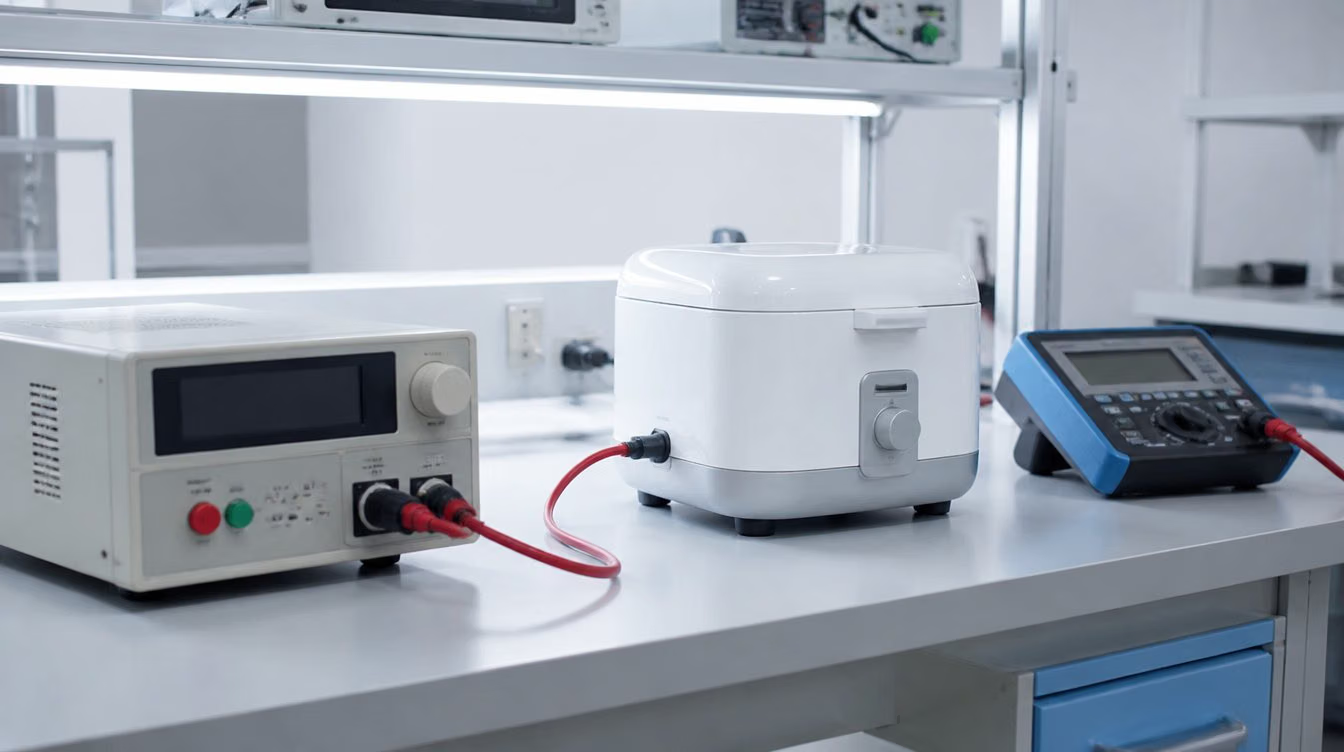
- 5Testing and verificationDielectric strength, temperature rise, leakage current, mechanical strength, assessment of fire sources and fault condition tests are carried out.
Neighbouring Standards and the Differences
IEC 60950-1 and IEC 60065
WITHDRAWN. This standard has replaced them; specifications referring to these codes must be updated.
The IEC 60335 series
Household and similar appliances. If a product has the character of both IT and a household appliance, which standard applies is determined by the intended use.
IEC 61010-1
Measurement, control and laboratory equipment. It establishes a different risk framework on the assumption that the user is trained.
IEC 62133-2
Cell and pack safety in battery-operated products. IEC 62368-1 treats the battery as an energy source but does not replace the battery standard.
Commonly Confused Points
- IEC 60950-1 and IEC 60065 HAVE BEEN WITHDRAWN. A specification referring to these codes or an old certificate based on them is not accepted in a current file.
- The HBSE approach does not carry over the rule lists of the old standards one-to-one. An old report cannot be converted automatically to the new standard; a gap analysis is required.
- For battery-operated products, battery safety is not covered by this standard alone; the cell and pack standards also apply.
- A CB certificate is not a CE declaration. CB is the output of a mutual recognition arrangement that eases national certification; the CE declaration is made by the manufacturer under its own responsibility.
- If the accessibility analysis is skipped the assessment remains incomplete: the same energy source may be acceptable where only service personnel reach it and unacceptable where the user does.
Structure of the Code
- Published by
- IEC
- Serial number
- 62368
- Part
- without partition
Codes in the library without release year is kept. The current version changes over time; If the year is specified in your specification, that version is taken as basis, if not specified, the most current version is applied.
Scope
- Test
- Electrical Safety
Related Tests and Services
Of the 32 pieces of content this code is referenced in, the 16 with their own published page are listed below.
Test · 16
- Dielectric Strength – IEC 60335 / IEC 62368 / IEC 61010
- Hipot – IEC 60335 / IEC 62368 / IEC 61010
- Insulation Resistance – IEC 60335 / IEC 62368 / IEC 61010
- Leakage Current – IEC 60335 / IEC 62368 / IEC 61010
- Ground Bond – IEC 60335 / IEC 62368 / IEC 61010
- Earth Continuity – IEC 60335 / IEC 62368 / IEC 61010
- Touch Current – IEC 60335 / IEC 62368 / IEC 61010
- Temperature Rise – IEC 60335 / IEC 62368 / IEC 61010
- Abnormal Operation – IEC 60335 / IEC 62368 / IEC 61010
- Overload – IEC 60335 / IEC 62368 / IEC 61010
- Short Circuit – IEC 60335 / IEC 62368 / IEC 61010
- Creepage & Clearance – IEC 60335 / IEC 62368 / IEC 61010
- Glow Wire – IEC 60335 / IEC 62368 / IEC 61010
- Needle Flame – IEC 60335 / IEC 62368 / IEC 61010
- Ball Pressure – IEC 60335 / IEC 62368 / IEC 61010
- CTI/PTI – IEC 60335 / IEC 62368 / IEC 61010
Technical Requirements
Standard texts are copyright of the relevant organization; test condition, sample and acceptance criteria cannot be fitted here.
Basis: The IEC 62368-1 scope statement in the IEC catalogue and the HBSE energy class scheme (class 1: no pain; class 2: pain, no injury; class 3: injury); the withdrawal of IEC 60950-1 and IEC 60065; the EN 62368-1 adoption.
Technical requirements specific to your product, once we clarify the scope At offer stage shared in writing.
Relevant Product Groups and Legislation
This code is included in the standard tag of the product pages below.
These product pages carry notes for the following markets: European Union, United Kingdom, USA. Whether the standard is mandatory in the relevant market varies depending on the product group and the applicable legislation.
Regulations published with this code on the same product pages:
- 2014/35/EULVDThe Low Voltage Directive. Governs the electrical safety of equipment operating in the 50–1000 V AC range; the manufacturer makes the declaration, with no notified body involvement.
- 2014/30/EUEMCThe Electromagnetic Compatibility Directive. Covers both the interference a device emits into its environment (emission) and its resistance to interference from outside (immunity).
- 2011/65/EURoHSRestriction of certain hazardous substances in electrical and electronic equipment; an integral part of the CE declaration.
- (AB) 2019/2021EcodesignEcodesign requirements for electronic displays. Includes on-mode power consumption, standby mode and repairability requirements.
- (AB) 2019/2013Energy LabelEnergy labelling for electronic displays. Requires a separate class declaration for SDR and HDR modes and EPREL registration.
- 2014/53/EUREDThe Radio Equipment Directive. For a product with a radio interface, spectrum, EMC and electrical safety are assessed together; the 3.3(d)(e)(f) cybersecurity articles also apply.
- 2012/19/ABWEEEWaste electrical and electronic equipment. Requires product marking and registration with the collection system.
- (AB) 2019/1782Ecodesign (external power supplies)Ecodesign requirements for external power supplies. Sets minimum thresholds for loaded efficiency and no-load power consumption.
- (AB) 2022/2380Common Charging InterfaceA common charging solution for certain radio equipment. Requires a USB-C interface and declaration of charging information on the label.
- (EU) 2024/2847CRAThe Cyber Resilience Act. Cybersecurity requirements for products with digital elements; reporting from 11 September 2026, full application from 11 December 2027.
- (AB) 1275/2008Ecodesign (networked standby)Minimum requirements for standby and off-mode power consumption in networked equipment.
- (EU) 2022/2555NIS2 (indirect)Cybersecurity risk management for essential and important entities; a network-equipment supplier is affected through its customers' obligations.
- (EC) 1907/2006REACHRegistration, evaluation, authorisation and restriction of chemicals; SVHC notification.
- (EU) 2016/679GDPR (indirect)Devices that process personal data incur a data-protection-by-design obligation.
- (EU) 2023/1542Batteries RegulationSustainability, safety and transparency for batteries. Carbon footprint declaration, recycled content and the battery passport apply on a staged timetable.
- (AB) 2023/1670Ecodesign (smartphones)Ecodesign requirements for smartphones and tablets. Sets requirements for durability, repairability, spare parts and software-update duration.
- (AB) 2023/1669Energy Label (smartphones)Energy labelling for smartphones and tablets; battery life, drop resistance and a repair score are declared on the label.
- (AB) 617/2013Ecodesign (computers)Ecodesign requirements for computers and servers. Includes requirements for annual energy consumption, standby mode and power management.
Related Standards
Frequently Asked Questions About IEC 62368
I have an IEC 60950-1 certificate — what should I do?
The certificate has lost its validity; keeping the product on the market requires reassessment under IEC 62368-1. Part of the old report can be used in a gap analysis.
My product is like both a household appliance and an IT device — which standard?
The intended use is decisive. The decision must be justified and written into the technical file; where it is unclear, the relevant parts of both standards are assessed together.
My adapter is separately certified — is that enough for the device?
No. The adapter's own conformity does not cover the conformity of the device; the device is assessed as the system it forms together with the adapter.
If the energy class is low, is no testing required?
The classification itself is made by measurement; showing that the class is low is also a verification exercise. A class cannot be claimed without measurement.
Frequently Asked Questions
Is this standard mandatory for my product?
Whether it is mandatory depends on the product group, the target market and the applicable legislation. Once you tell us your product and market, we clarify in writing whether this standard is required.
How long does the test process take?
Duration depends on the scope of the standard, the number of specimens and current capacity. The exact duration is shared, together with the specimen and scope details, at the quote stage.
Do you issue certification against this standard?
Which activity is carried out under which accreditation scope is separately confirmed at the application stage. Up-to-date scope information is published on our corporate page.
What happens if the standard I need is not here?
The library is based on a continuously growing inventory. If you cannot find the code you are looking for, you can send it through the quote form; we will assess the relevant scope and get back to you.