
About the Standard
Scope title: lithium battery safety in industrial applications
IEC 62619 is a standard published by International Electrotechnical Commission (IEC). It publishes international standards for electrical, electronic and related technologies; it is the foundation of the EMC and electrical safety body of work. CISPR publications belong to a special committee within the IEC.
See the other 102 codes from IECCoverage areas
What Is IEC 62619?
IEC 62619 is the safety standard for lithium cells and batteries used in industrial applications. Where IEC 62133-2 is the counterpart for portable products, stationary energy storage, uninterruptible power supplies, forklifts, telecom backup power and industrial handling systems fall within the field of this standard.
What separates an industrial battery from a portable one is SCALE AND DURATION: the packs are larger, the voltages higher, the service life longer and the consequence of a failure more severe. The failure of a phone battery affects the user; the failure of an energy storage system affects a building, a facility or a grid connection.
The standard therefore gives separate weight, alongside cell safety, to the functional safety of THE BATTERY MANAGEMENT SYSTEM and to THE PROPAGATION OF THERMAL RUNAWAY. In a small pack, thermal runaway of a single cell is a manageable event; in a system of hundreds of cells the same event becomes uncontrollable if it propagates to neighbouring cells.
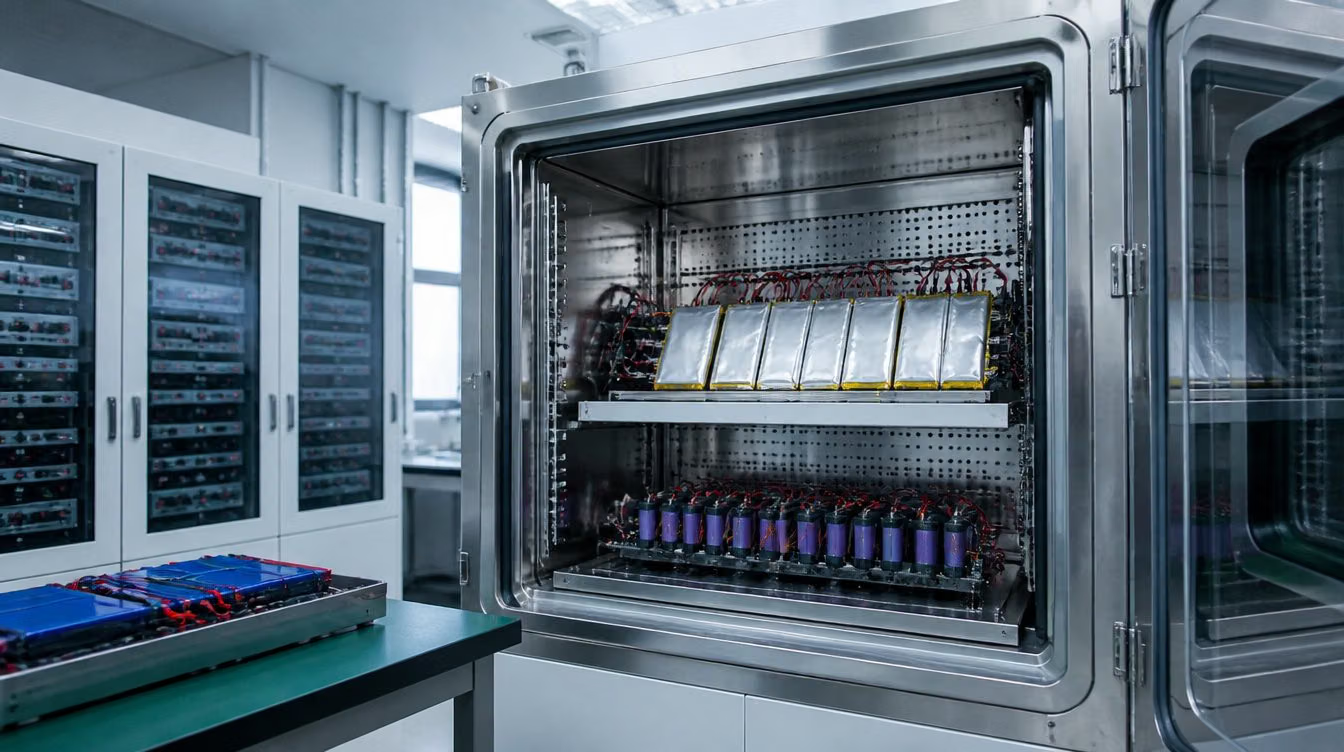
The text addresses cell-level testing and system-level design requirements together. On the cell side there are short circuit, overcharge, forced discharge and thermal abuse; on the system side, overcurrent protection, temperature monitoring, voltage window control, cell balancing and preventing a single cell failure from propagating to its neighbours.
Why Does This Standard Exist?
The growth of energy storage made this standard necessary. The variability of renewable generation created a need for storage at grid scale and lithium-ion technology became the dominant solution to that need. But standards written for portable products were not designed for systems at megawatt-hour scale.
As the scale grew, new questions arose. The safety of a single cell was no longer a sufficient question; the real question was the behaviour of the system. With hundreds of cells side by side, what happens if one fails? How does temperature distribute when the cooling system stops? What can the fire service do when a fire starts?
THERMAL RUNAWAY PROPAGATION is the most important subject arising from these questions. The modern approach treats thermal runaway of a single cell as an unavoidable fault scenario and changes the question: does the event propagate to neighbouring cells, what does it release outside the pack, and how long does the system stay under control? This approach shifted design from cell quality to system architecture.
The role of the battery management system changed in the same process. Once seen as a monitoring board, the BMS is now assessed as a SAFETY FUNCTION: the accuracy of protection thresholds, its behaviour of falling to the safe side in a fault and the verification of its software have come within the scope of the standard.
IEC 63056 later introduced additional requirements for energy storage applications and is now applied together with IEC 62619. In North America, UL 1973 and, at system level, UL 9540 form the corresponding frameworks.
Which Products Require It
- Grid-scale and commercial energy storage systems (ESS)
- Uninterruptible power supplies and telecom backup power systems
- Forklift, automated guided vehicle and industrial vehicle batteries
- Stationary in-plant backup and buffer battery applications
- Stationary battery systems in marine and rail applications
Related Legislation and Schemes
- Together with IEC 62477-1, the safety requirements on the power converter side are completed
- IEC 63056 introduces additional safety requirements for energy storage applications
- Battery Regulation (EU) 2023/1542 — carbon footprint, recovered content and performance declaration obligations for industrial and ESS batteries
- UL 1973 and UL 9540 are the corresponding assessment frameworks in the North American market
- On the installation side, local electrical and fire legislation also applies
How the Assessment Runs
- 1Determining the application classThe industrial intended use of the battery and the system architecture are defined; the scope is built accordingly.
- 2Cell-level testsShort circuit, overcharge, forced discharge, thermal abuse and mechanical tests are applied.
- 3BMS and protection verificationProtection thresholds, temperature monitoring, cell balancing and fault response are verified; software safety is assessed.
- 4System-level testsOvercurrent, overtemperature and single fault conditions are applied on the system.
- 5Thermal runaway propagationThermal runaway is triggered in a defined cell and propagation to neighbouring cells and the effect released outside the pack are monitored.
Neighbouring Standards and the Differences
IEC 62133-2
Portable applications. The classification is determined by intended use rather than size.
IEC 63056
Additional requirements for energy storage; applied together with IEC 62619.
UL 1973 / UL 9540
The battery-level and system-level assessment frameworks in North America.
UN 38.3
Transport safety; also required if the system is to be shipped.
What the Report Must Contain
To be usable, a report must carry the information below. An incomplete report may not be accepted in the supply chain or in an inspection even when its result is correct.
- The application class and system architecture description
- Cell description: manufacturer, model, chemistry, capacity and configuration
- BMS description, protection thresholds and fault responses
- The tests applied and the levels at which they were applied
- The scope of the thermal runaway propagation test and the observations
- The edition of the standard applied and the other standards applied alongside it
Commonly Confused Points
- IEC 62619 alone is not an ESS certification. At system level IEC 63056, on the converter IEC 62477-1 and on the installation side local legislation also apply.
- The thermal runaway propagation test is not applied with the same scope in every project; the scope is determined by the system architecture and the customer specification.
- Industrial classification is determined not by the size of the product but by its INTENDED USE; even a small pack falls under this standard if it is part of an industrial system.
- A change to BMS software affects the safety assessment; it is not a silent update.
- A change of cell supplier reopens both the safety and the performance assessment.
- Fire response plans and installation requirements are outside the scope of the standard but are required at site acceptance.
Structure of the Code
- Published by
- IEC
- Serial number
- 62619
- Part
- without partition
Codes in the library without release year is kept. The current version changes over time; If the year is specified in your specification, that version is taken as basis, if not specified, the most current version is applied.
Scope
- Test
- Environmental and Climatic Testing
- Vibration and Shock
- Battery Testing
- Battery Testing
Related Tests and Services
Of the 46 pieces of content this code is referenced in, the 22 with their own published page are listed below.
Test · 22
- Kapasite – IEC 62619
- Charge-Discharge – IEC 62619
- Cycle Life – IEC 62619
- Calendar Life – IEC 62619
- Internal Resistance – IEC 62619
- Overcharge – IEC 62619
- Overdischarge – IEC 62619
- External Short Circuit – IEC 62619
- Crush – IEC 62619
- Impact – IEC 62619
- Nail Penetration – IEC 62619
- Thermal Abuse – IEC 62619
- Thermal Runaway – IEC 62619
- Thermal Propagation – IEC 62619
- Fire Resistance – IEC 62619
- Vibration – IEC 62619
- Mechanical Shock – IEC 62619
- Altitude – IEC 62619
- Thermal Cycling – IEC 62619
- Immersion – IEC 62619
- Drop – IEC 62619
- BMS Functional – IEC 62619
Technical Requirements
Standard texts are copyright of the relevant organization; test condition, sample and acceptance criteria cannot be fitted here.
Basis: The IEC 62619 scope statement in the IEC catalogue; the related series references (IEC 63056, IEC 62477-1) and the North American counterparts (UL 1973, UL 9540); the obligations of (EU) 2023/1542.
Technical requirements specific to your product, once we clarify the scope At offer stage shared in writing.
Relevant Product Groups and Legislation
This code is included in the standard tag of the product pages below.
These product pages carry notes for the following markets: European Union, United Kingdom, USA, China. Whether the standard is mandatory in the relevant market varies depending on the product group and the applicable legislation.
Regulations published with this code on the same product pages:
- (EU) 2023/1542Batteries RegulationSustainability, safety and transparency for batteries. Carbon footprint declaration, recycled content and the battery passport apply on a staged timetable.
- UN Manual of Tests and CriteriaUN 38.3Transport safety of lithium cells and batteries. The T1–T8 test series is applied in the defined order; shipment cannot proceed without a report.
- 2014/35/EULVD / SafetyIf the charging circuit connects to the mains, it falls under the Low Voltage Directive; for DC-input-only models, the general product safety framework applies.
- 2014/30/EUEMCThe Electromagnetic Compatibility Directive. Emission and immunity are covered together.
- 2011/65/EURoHSRestriction of certain hazardous substances in electrical and electronic equipment; an integral part of the CE declaration.
- 2012/19/ABWEEEWaste electrical and electronic equipment. Requires marking and registration with the collection system.
- (EU) 2023/988GPSRThe General Product Safety Regulation. Establishes a safety framework for aspects not covered by sector-specific legislation.
Related Standards
Frequently Asked Questions About IEC 62619
Our system is small — is the portable standard sufficient?
What matters is not size but intended use. If it is part of an industrial system it falls under IEC 62619.
Is the thermal runaway propagation test mandatory?
The scope depends on the system architecture and the specification. In energy storage applications it has increasingly become a standard expectation.
We have a UL 1973 report — is it sufficient for Europe?
It is not. The assessment frameworks differ; a European file requires IEC 62619 and, where applicable, IEC 63056.
We design the BMS ourselves — are there additional obligations?
Yes. The BMS is assessed as a safety function; the accuracy of protection thresholds, the fault response and software verification come within the scope.
Frequently Asked Questions
Is this standard mandatory for my product?
Whether it is mandatory depends on the product group, the target market and the applicable legislation. Once you tell us your product and market, we clarify in writing whether this standard is required.
How long does the test process take?
Duration depends on the scope of the standard, the number of specimens and current capacity. The exact duration is shared, together with the specimen and scope details, at the quote stage.
Do you issue certification against this standard?
Which activity is carried out under which accreditation scope is separately confirmed at the application stage. Up-to-date scope information is published on our corporate page.
What happens if the standard I need is not here?
The library is based on a continuously growing inventory. If you cannot find the code you are looking for, you can send it through the quote form; we will assess the relevant scope and get back to you.