
About the Standard
Scope title: environmental conditions for vehicle electrical and electronic equipment
ISO 16750 is a standard published by International Organization for Standardization (ISO). The international standards organisation; it publishes the widest body of management system, test method and product standards.
See the other 310 codes from ISOCoverage areas
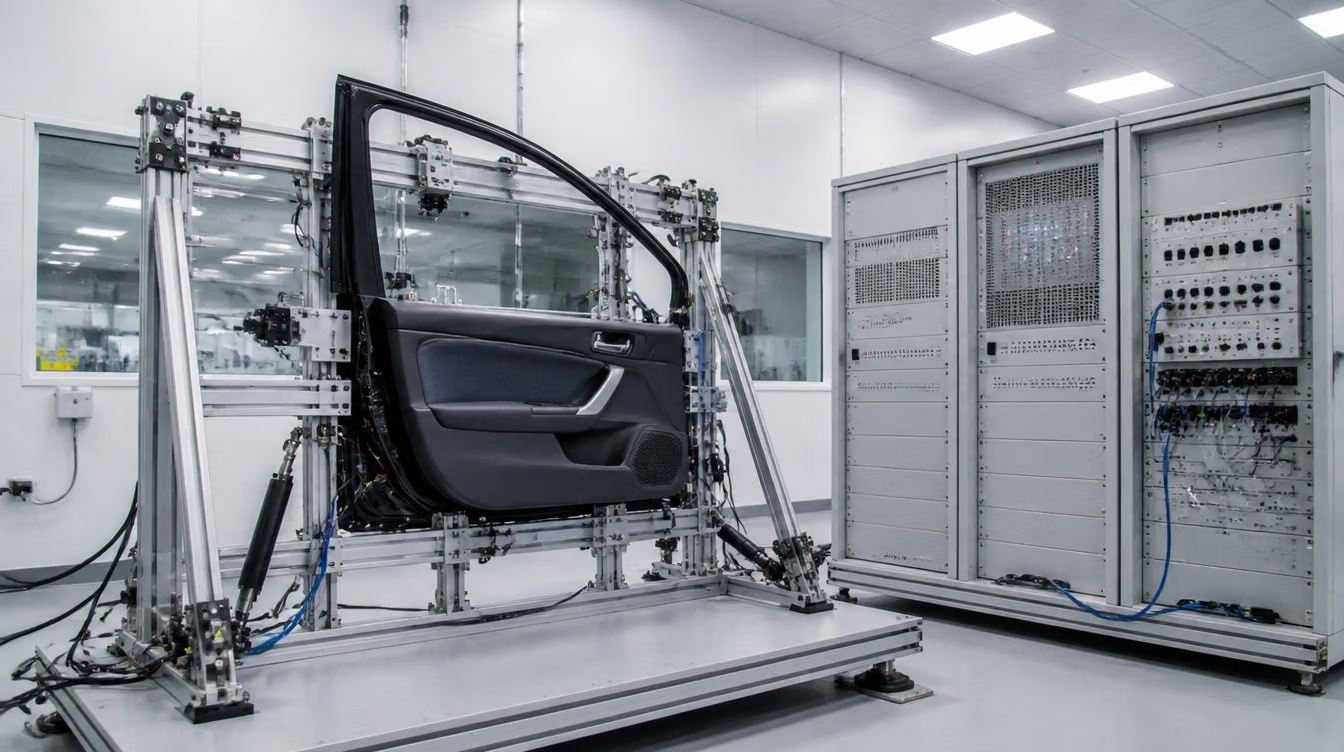
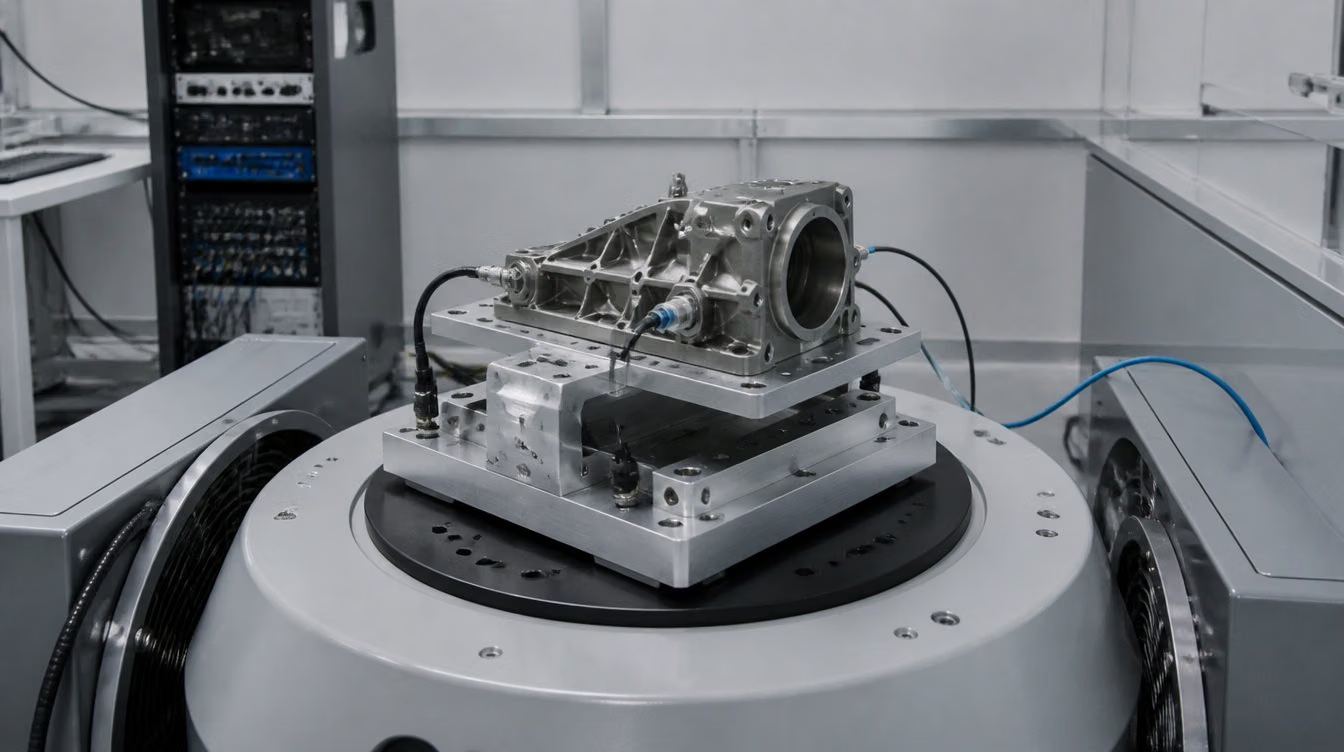
Vibration and Shock — What Does This Testing Field Cover?
The section below describes the field that code ISO 16750 belongs to; it is not the text of the standard or the regime itself. The scope title of the code is given above, and technical requirements are shared at the quotation stage.
Vibration and shock testing shows whether a product withstands mechanical dynamic loads. The two phenomena are distinct: vibration is a continuous and repeated loading, while shock is a single instantaneous impact at high acceleration. They produce different failure modes and are required separately.
The failure produced by vibration is FATIGUE: a solder joint cracks, a cable sheath abrades, a screw loosens, a connector loses contact. The failure produced by shock is FRACTURE: a brittle component shatters, a bracket breaks, a board comes out of its holder. Testing a product under vibration therefore does not show that it also withstands shock.
Vibration is applied in three forms, each giving different information. Sine vibration sweeps at a single frequency; it is used to find the resonant frequencies of the product and is very valuable at the design stage. Random vibration represents the broadband nature of the real environment and is preferred as evidence of durability. Sine-on-random and random-on-random profiles simulate together the broadband noise superimposed on dominant frequencies from engines and rotors — this is necessary in helicopter and turboprop applications.
RESONANCE is the concept at the centre of the field. Every structure has its own natural frequencies; as the excitation frequency approaches one of them the amplitude grows and the product is exposed to an acceleration many times the input level. A resonance search is therefore carried out before the test, and a design change often takes the form of shifting the resonance rather than lowering the level.
In this family the FIXTURE is part of the result, and this is the most frequently overlooked point. How the specimen is attached to the shaker directly changes the energy transmitted and the resonance behaviour. A poorly designed fixture brings its own resonances into play and imposes a load the product would not otherwise see, or conversely damps the real load and protects the product. Results obtained with different fixtures cannot be compared.
The choice of measurement point also determines the result. The control accelerometer is placed on the fixture and monitoring accelerometers at critical points of the product; the report must document these positions. Accelerations measured at different points in the same test can differ markedly.
Profiles are divided by application area: transport vibration (packaging and shipping), vehicle vibration (by mounting location), rail (EN 61373 categories), aviation (DO-160 sections), military (MIL-STD-810 methods) and battery transport (UN 38.3 T3). The same product passes through different profiles under different programmes.
Method groups in this field
Sine vibration
Determining resonances by frequency sweep and withstand at defined frequencies; the most informative test at the design stage.
Random vibration
Durability with a broadband power spectral density profile; the approach that best represents the real environment.
Combined profiles
Sine-on-random and random-on-random; for dominant frequencies arising from rotating machinery.
Classical shock
Defined acceleration and duration with half-sine, sawtooth and trapezoidal pulse shapes.
Free fall and toppling
Realistic drop scenarios arising from handling; decisive for portable products.
Resonance search and monitoring
Detection of structural change (cracking, loosening) by sweeps before and after the test.
Commonly confused in this field
- Shock and vibration are not the same test; one produces fracture and the other fatigue, and they are required separately.
- A report that does not document the fixture cannot be compared; a fixture can bring its own resonance into play.
- Levels come from the product standard or the programme specification; the standard does not define a single universal level.
- Without a resonance sweep before and after the test, structural damage can go unnoticed; the product may appear to work while being cracked internally.
- The position of the measurement point must be reported; accelerations measured at different points in the same test differ markedly.
- If the product is not operated during the test, intermittent loss of contact remains invisible.
Which decisions these results support
- Verification of transport and in-use durability
- Transport and vehicle vibration conformity for batteries
- Rail, aviation and defence qualification files
- Root cause analysis of solder, connector and joint failures
- The decision to shift a resonance through a design change
Structure of the Code
- Published by
- ISO
- Serial number
- 16750
- Part
- without partition
Codes in the library without release year is kept. The current version changes over time; If the year is specified in your specification, that version is taken as basis, if not specified, the most current version is applied.
Scope
- Vibration and Shock
- Automotive Testing
Related Tests and Services
A separate test page based on this code has not yet been released. The code falls within the scope of the following test families.
Technical Requirements
Standard texts are copyright of the relevant organization; test condition, sample and acceptance criteria cannot be fitted here.
Technical requirements specific to your product, once we clarify the scope At offer stage shared in writing.
Relevant Product Groups and Legislation
This code is included in the standard tag of the product pages below.
These product pages carry notes for the following markets: European Union, United Kingdom, USA. Whether the standard is mandatory in the relevant market varies depending on the product group and the applicable legislation.
Regulations published with this code on the same product pages:
- (AB) 2018/858Vehicle Type-Approval FrameworkApproval of motor vehicles and their components. Component and separate technical unit approval run under this framework; the E mark arises from it.
- UNECEUNECE 1958 AgreementType-approval under component-specific UNECE regulations (e.g. R10 EMC, R30/R54 tyres, R43 glazing).
- UNECE R10UNECE R10Electromagnetic compatibility approval for vehicles and their components.
- 2011/65/EURoHSRestriction of hazardous substances in electrical and electronic equipment.
- 2000/53/ATELVEnd-of-life vehicles. Sets heavy-metal restrictions and recoverability targets.
Other Parts of the Same Series
ISO 16750 series is also present in the library with the following parts.
Related Standards
Frequently Asked Questions
Is this standard mandatory for my product?
Whether it is mandatory depends on the product group, the target market and the applicable legislation. Once you tell us your product and market, we clarify in writing whether this standard is required.
How long does the test process take?
Duration depends on the scope of the standard, the number of specimens and current capacity. The exact duration is shared, together with the specimen and scope details, at the quote stage.
Do you issue certification against this standard?
Which activity is carried out under which accreditation scope is separately confirmed at the application stage. Up-to-date scope information is published on our corporate page.
What happens if the standard I need is not here?
The library is based on a continuously growing inventory. If you cannot find the code you are looking for, you can send it through the quote form; we will assess the relevant scope and get back to you.