
About the Standard
Scope title: flammability classification of plastic materials
UL 94 is a standard published by UL Standards & Engagement / UL Solutions (UL). It publishes product safety standards for the North American market and carries out product safety certification.
See the other 11 codes from ULCoverage areas
What Is UL 94?
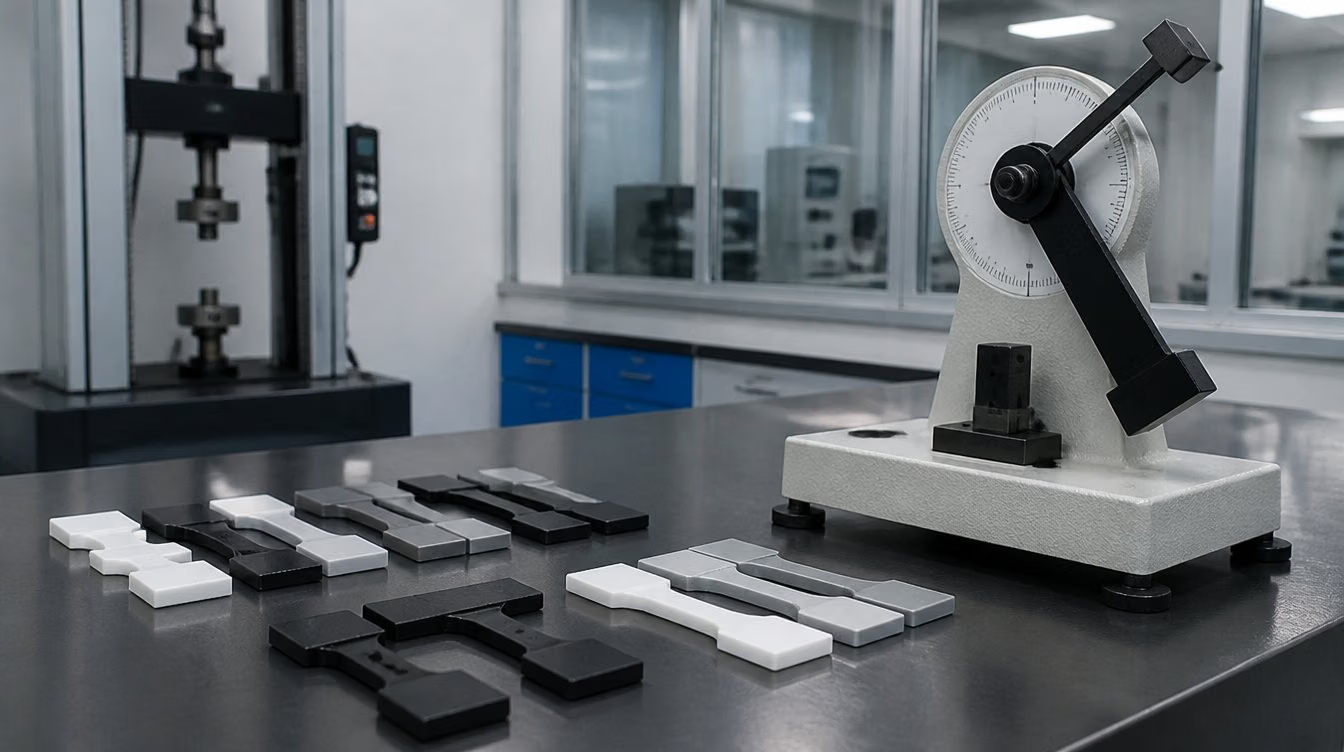
UL 94 classifies the burning behaviour of plastic materials used in appliance and equipment parts. It is not a product standard but a MATERIAL classification standard. Its output is a class designation written into the material data sheet and referred to by product standards — the line "enclosure material V-0" in the safety file of an electrical appliance rests on this standard.
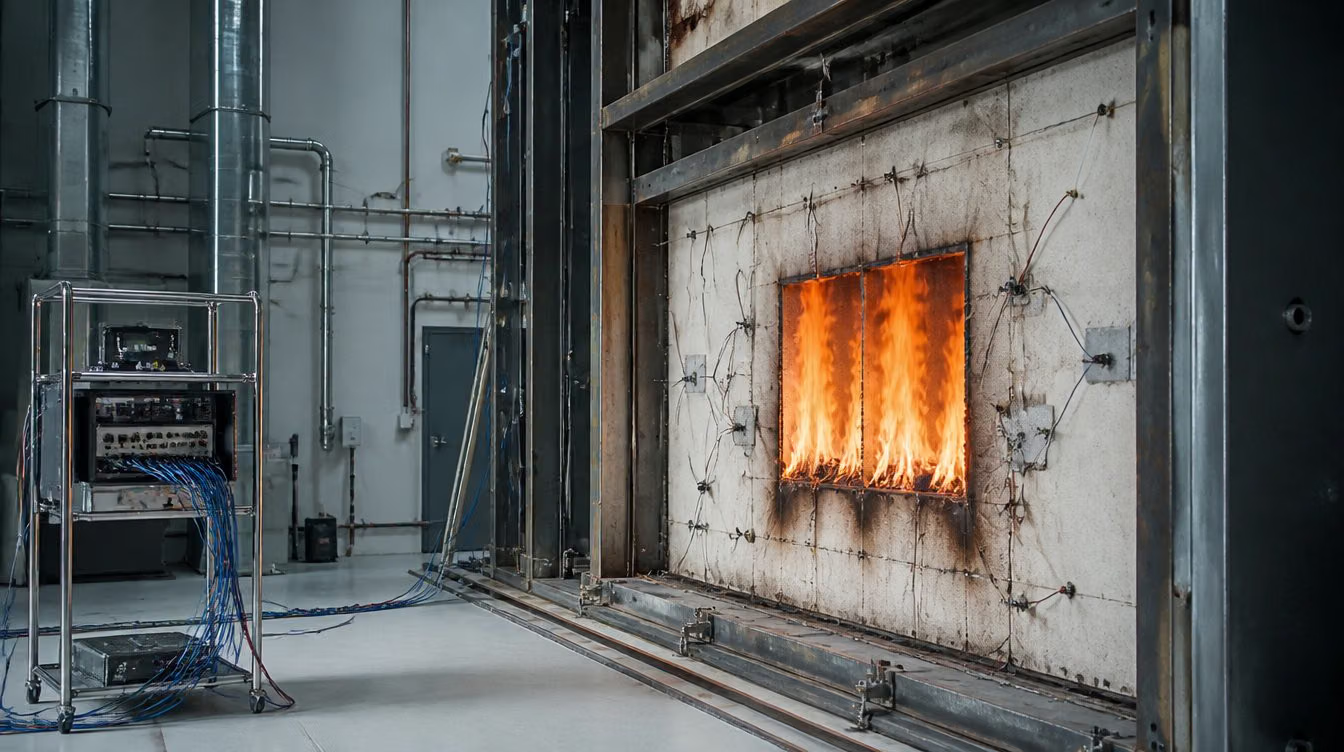
Classification is based on how the specimen behaves after exposure to a flame. What is looked at is not whether the material burns but what happens once the flame source is withdrawn: did the flame self-extinguish, how long did it take, was there dripping, and did the dripping material ignite the cotton beneath? The horizontal and vertical burning arrangements produce separate groups of classes.
The classes are distributed across three material groups. For enclosures and structural parts there are six classes, from least to most flame retardant: HB, V-2, V-1, V-0, 5VB, 5VA. For thin films and sheets (materials such as flexible printed circuits that cannot support themselves horizontally), VTM-0, VTM-1 and VTM-2 are defined. For low-density foams, HBF, HF-1 and HF-2 are used.
The class designation DEPENDS ON MATERIAL THICKNESS, and this is the point most often skipped in the field. The same resin may be classed V-2 at 1.5 mm and V-0 at 3.0 mm; as thickness falls the class falls with it. Saying that a material "is V-0" is therefore incomplete: a class is meaningful together with the thickness and the colour/filler composition at which it was obtained.
Why Does This Standard Exist?
The standard arose from an observation about how fires most often start in electrical appliances. A fire usually does not come from outside; a component overheating inside the appliance, a loose connection arcing or a short circuit creates a source of flame. What is then decisive is whether the flame spreads to the plastic surfaces inside the appliance.
Two questions follow. The first is whether the material sustains the flame — that is, whether burning self-extinguishes once the flame source is gone. The second is dripping: a plastic that melts and drips can carry the flame to the lower parts of the appliance or to the surface it stands on. Most of the distinction between the vertical classes of UL 94 rests precisely on this second question; the difference between V-1 and V-2 is whether the dripping particle is flaming.
On the IEC side the same test arrangements are published as IEC 60695-11-10 and IEC 60695-11-20. European files therefore often show IEC 60695 codes rather than a UL 94 class; the test arrangement is the same, the designation and the publishing body differ.
Classification Scheme
HB
Material that stays below a defined burning rate in the horizontal arrangement or extinguishes before reaching the marked point; the lowest step of the classification.
V-2
Material that self-extinguishes in the vertical arrangement; FLAMING dripping is accepted.
V-1
Material that self-extinguishes in the vertical arrangement; dripping may occur but the dripping particle must not be flaming.
V-0
The same arrangement as V-1 but with stricter criteria; the extinguishing time and total burning time are shorter.
5VB / 5VA
Classification made with a more severe flame application. The difference between the two is whether the plaque is penetrated; with 5VA, penetration is not accepted.
VTM-0 / VTM-1 / VTM-2
The vertical arrangement counterparts for thin films and sheets; because the specimen cannot support itself horizontally, a different preparation is used.
HBF / HF-1 / HF-2
Classes defined for low-density foam materials (loudspeaker grilles, acoustic insulation and the like).
Which Products Require It
- Enclosures and housings of electrical and electronic appliances
- Connectors, terminal blocks, cable trunking and insulating parts
- Printed circuit board carriers and on-board insulators
- Internal components and motor covers in white goods
- Automotive interior and engine bay plastics (in supplier material data sheets)
- Plastic components of furniture and lighting fittings
Assessment Approach
Classification is by material: different colour and filler compositions of the same resin are assessed separately. Because pigments and fillers can change burning behaviour, a change of colour can affect the class.
Specimens are conditioned and the conditioning is part of the result: the standard assesses together groups of specimens held at different temperature and humidity conditions. For moisture-absorbing polymers this step becomes decisive.
A class is valid at the THICKNESS tested. If the wall thickness in your product is thinner than the tested thickness, the class does not carry over automatically.
Related Legislation and Schemes
- IEC 62368-1 and the IEC 60335 series may require a minimum flammability class for enclosures and internal parts
- IEC 60695-11-10 and IEC 60695-11-20 are the IEC counterparts of the same test arrangements
- For construction products, burning behaviour is classified by EN 13501-1 rather than UL 94
- In North America, material data sheets under NRTL listing rest on these classes
Neighbouring Standards and the Differences
IEC 60695-11-10 / -11-20
The IEC counterparts of the horizontal/vertical and 5V test arrangements of UL 94. The same arrangement, a different publication.
The IEC 60695-2-10 series (glow wire)
A different hazard scenario: not a flame but a glowing conductor touching the plastic. Product standards often require both together.
IEC 60695-11-5 (needle flame)
Simulates the effect of a small flame source inside an appliance; used in assessment at product level.
EN 13501-1
Reaction-to-fire classification of construction products. There is no conversion between it and UL 94; the scale and the set-up differ.
What the Report Must Contain
To be usable, a report must carry the information below. An incomplete report may not be accepted in the supply chain or in an inspection even when its result is correct.
- Material description: resin type, trade name, colour and filler composition
- The class obtained and the thickness at which it is valid
- The test arrangement applied (horizontal, vertical, 5V, thin film, foam)
- Specimen conditioning conditions
- Observation of dripping and information on cotton ignition
- The edition of the standard used
Commonly Confused Points
- A UL 94 class does not prove the fire safety of the product. Fire behaviour at product level is addressed separately in the product standard; the material class is only one input.
- A class is valid together with the thickness and the colour/composition. For a part produced at a different thickness the class must be re-verified.
- Requiring UL 94 in construction material projects is usually the wrong choice of standard; in Europe construction products carry an EN 13501-1 class.
- V-0 is not always necessary. Whichever class the product standard requires for a given part is the one that applies; demanding an unnecessarily high class increases material cost and lead time.
- When the proportion of recycled content changes, burning behaviour can change too; the class must be re-verified.
Structure of the Code
- Published by
- UL
- Serial number
- 94
- Part
- without partition
Codes in the library without release year is kept. The current version changes over time; If the year is specified in your specification, that version is taken as basis, if not specified, the most current version is applied.
Scope
- Test
- Standard-Based Tests
- Fire Testing
- Fire Testing
- Plastics Testing
Related Tests and Services
Of the 3 pieces of content this code is referenced in, the 1 with their own published page are listed below.
Test · 1
Technical Requirements
Standard texts are copyright of the relevant organization; test condition, sample and acceptance criteria cannot be fitted here.
Basis: The UL 94 class designation scheme and its distribution across three material groups (enclosure, thin film, foam); the dependence of the class on thickness is the standard's own designation rule. The IEC 60695-11-10 / -11-20 counterparts.
Technical requirements specific to your product, once we clarify the scope At offer stage shared in writing.
Relevant Product Groups and Legislation
This code is included in the standard tag of the product pages below.
These product pages carry notes for the following markets: European Union, United Kingdom, USA, China. Whether the standard is mandatory in the relevant market varies depending on the product group and the applicable legislation.
Regulations published with this code on the same product pages:
- (EU) 2023/1542Batteries RegulationSustainability, safety and transparency for batteries. Carbon footprint declaration, recycled content and the battery passport apply on a staged timetable.
- UN Manual of Tests and CriteriaUN 38.3Transport safety of lithium cells and batteries. The T1–T8 test series is applied in the defined order; shipment cannot proceed without a report.
- 2014/35/EULVD / SafetyIf the charging circuit connects to the mains, it falls under the Low Voltage Directive; for DC-input-only models, the general product safety framework applies.
- 2014/30/EUEMCThe Electromagnetic Compatibility Directive. Emission and immunity are covered together.
- 2011/65/EURoHSRestriction of certain hazardous substances in electrical and electronic equipment; an integral part of the CE declaration.
- 2012/19/ABWEEEWaste electrical and electronic equipment. Requires marking and registration with the collection system.
- (EU) 2023/988GPSRThe General Product Safety Regulation. Establishes a safety framework for aspects not covered by sector-specific legislation.
- (AB) 2018/858Vehicle Type-Approval FrameworkApproval and market surveillance of motor vehicles. The battery system is assessed as part of vehicle type-approval.
- UNECE R100UNECE R100Vehicle and battery system approval under requirements specific to electric drivetrains.
Related Standards
Frequently Asked Questions About UL 94
What is the difference between V-0 and 5VA?
The severity and duration of the flame application differ; the 5V group applies a more severe exposure. The distinction between 5VA and 5VB is whether the plaque is penetrated.
I changed the colour of my material — is the class still valid?
Not automatically. Pigments and fillers can affect burning behaviour; the class must be verified for the colour.
Does an IEC 60695 report take the place of UL 94?
The test arrangements are the same and in many files they are accepted interchangeably; but if the customer specification requests by code, that code is what is required.
Is UL 94 sufficient for my construction material?
No. In Europe construction products must carry an EN 13501-1 class, and a UL 94 class cannot be converted into it.
Frequently Asked Questions
Is this standard mandatory for my product?
Whether it is mandatory depends on the product group, the target market and the applicable legislation. Once you tell us your product and market, we clarify in writing whether this standard is required.
How long does the test process take?
Duration depends on the scope of the standard, the number of specimens and current capacity. The exact duration is shared, together with the specimen and scope details, at the quote stage.
Do you issue certification against this standard?
Which activity is carried out under which accreditation scope is separately confirmed at the application stage. Up-to-date scope information is published on our corporate page.
What happens if the standard I need is not here?
The library is based on a continuously growing inventory. If you cannot find the code you are looking for, you can send it through the quote form; we will assess the relevant scope and get back to you.