
About the Standard
Scope title: surface flame spread
ASTM E84 is a standard published by ASTM International (ASTM). It publishes material, product and test method standards; it is the body most often turned to in corrosion, mechanical and materials testing.
See the other 199 codes from ASTMCoverage areas
What Is ASTM E84?
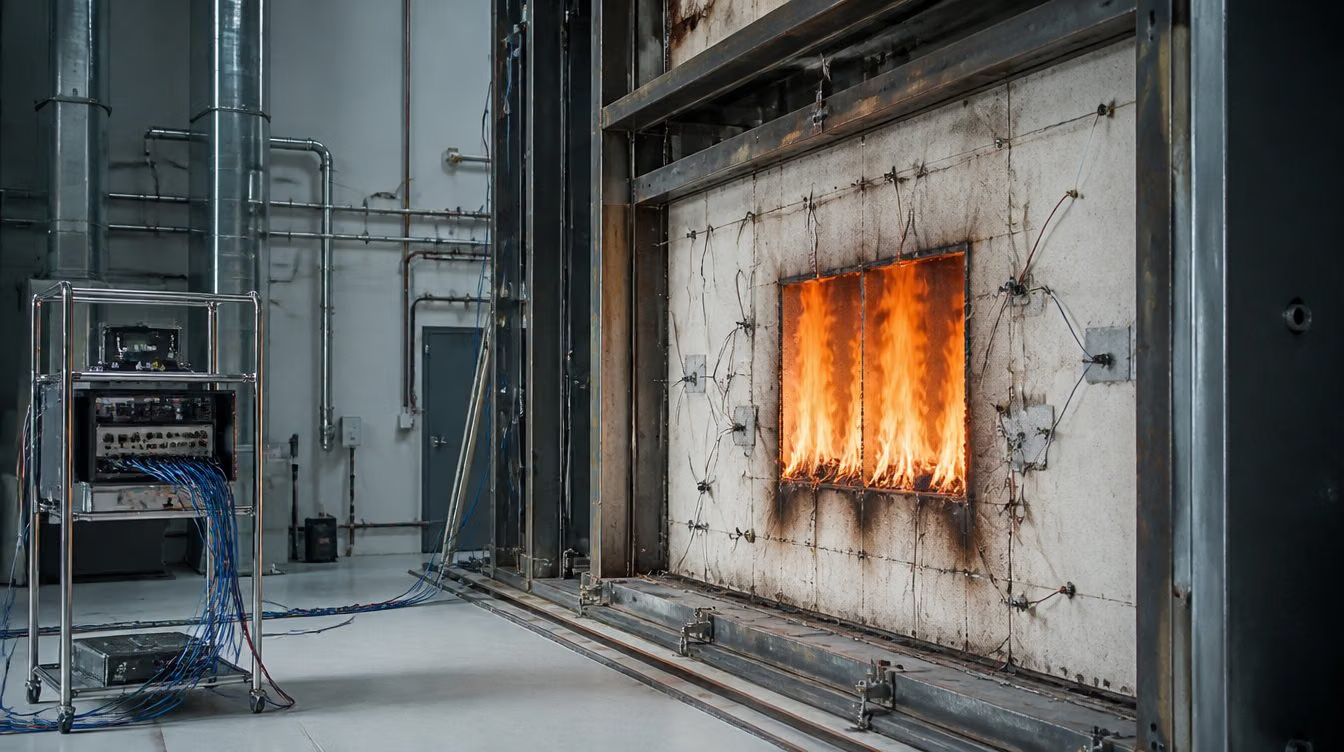
Steiner tunnel
The test produces TWO INDICES. The flame spread index (FSI) describes how quickly flame advances over the specimen surface and the smoke developed index (SDI) the optical density of the smoke produced during burning. The two indices are reported together and building codes base their classification on these values.
The indices are RELATIVE, and this is the key to understanding the logic of the method. The scale is calibrated to two reference points: cement asbestos board is taken as zero and red oak as one hundred. If a material's FSI is 25, it means it behaves as a quarter of red oak in terms of flame spread. This is a comparative indicator rather than an absolute physical quantity.
passed Class A
The method has a known limitation: the specimen is mounted horizontally on the CEILING of the tunnel. For materials that do not melt, drip or lose their shape the result is meaningful; for materials that melt and fall, shrink or detach from the tunnel, the test may not represent real behaviour, and that is noted in the report.
Why Does This Standard Exist?
The Steiner tunnel was developed in the 1940s and has been at the backbone of North American building codes for decades. The longevity of the method comes from its results being comparable against a database built up over decades: an architect or code writer knows from experience what an FSI of 25 means in practice.
But the limits of the method have also long been debated. Mounting the specimen on the ceiling is not realistic for some material types: foam insulation materials melt and fall out of the tunnel; in that case the test measures not the material's real fire behaviour but how quickly it leaves the tunnel.
That limitation became a serious problem as plastic-based insulation materials spread. Codes had to define large-scale alternatives for such materials (the NFPA 286 room corner test, the NFPA 285 facade test). Today many codes do not accept E84 as sufficient for certain classes of material.
The second debate concerns THE SMOKE INDEX. SDI rests on the loss of light transmission measured in the tunnel and says nothing about the toxicity of the smoke. Because most deaths in a fire are smoke-related, that limitation matters; toxicity is addressed by separate methods.
The European counterpart is EN 13501-1 and it uses an entirely different approach: the medium-scale SBI test examines the specimen in a vertical corner arrangement and measures heat release. There is NO conversion between the two systems; the same material can rank differently in each.
Which Products Require It
- Interior wall and ceiling lining materials
- Insulation materials and sandwich panel surfaces
- Acoustic panels and suspended ceiling elements
- Decorative wood, composite and textile finishes
- Cable trunking and service covering materials
Related Legislation and Schemes
- It is the basis of interior finish classification in the IBC and IRC building codes
- NFPA 255 and UL 723 are equivalent publications defining the same test arrangement
- The corresponding framework in Europe is EN 13501-1 classification; the test arrangements differ
- For certain classes of material, codes may require large-scale testing such as NFPA 286 or NFPA 285
How the Assessment Runs
- 1Specimen preparationThe specimen is prepared to tunnel dimensions and set up to represent the end use installation; the substrate and mounting arrangement are recorded.
- 2Tunnel calibrationThe arrangement is calibrated with reference materials; the index scale rests on that calibration.
- 3The testThe specimen is mounted on the tunnel ceiling, the flame source is applied and flame advance and smoke density are recorded over the defined period.
- 4Index calculationThe flame spread and smoke developed indices are calculated and normalised against the reference points.
- 5ReportingThe indices, installation arrangement, observations and any melting/falling behaviour of the material are reported.
Neighbouring Standards and the Differences
EN 13501-1
The European reaction-to-fire classification. A different arrangement and scale; the results cannot be converted.
NFPA 286
The room corner test. Preferred over E84 for materials that melt and drip.
NFPA 285
A large-scale test for facade systems; it assesses them as a system.
UL 723 / NFPA 255
Equivalent publications of the same arrangement; the results are mutually accepted.
What the Report Must Contain
To be usable, a report must carry the information below. An incomplete report may not be accepted in the supply chain or in an inspection even when its result is correct.
- The flame spread index (FSI) and smoke developed index (SDI)
- The specimen installation arrangement: substrate, mounting, thickness
- The behaviour of the specimen during the test: melting, falling, shrinking
- Tunnel calibration information
- The test duration and the observations
- The basis for any matching to a code class
Commonly Confused Points
- An ASTM E84 result cannot be converted into an EN 13501-1 class; the two systems work with different test arrangements and scales.
- The result is valid together with the way the specimen was installed in the test arrangement; a different installation requires reassessment.
- The method has limits for materials that melt and drip; for such products the room corner test (NFPA 286) is preferred.
- The indices are relative; they should not be interpreted as absolute physical quantities.
- SDI gives no information about the TOXICITY of the smoke; it measures only optical density.
- The class designation comes from the code; the laboratory reports the indices and the class assignment is matched by the code.
Structure of the Code
- Published by
- ASTM
- Serial number
- E84
- Part
- without partition
Codes in the library without release year is kept. The current version changes over time; If the year is specified in your specification, that version is taken as basis, if not specified, the most current version is applied.
Scope
- Test
- Standard-Based Tests
- Fire Testing
- Fire Testing
- Construction Materials Testing
Related Tests and Services
Of the 3 pieces of content this code is referenced in, the 1 with their own published page are listed below.
Test · 1
Technical Requirements
Standard texts are copyright of the relevant organization; test condition, sample and acceptance criteria cannot be fitted here.
Basis: The ASTM E84 Steiner tunnel arrangement and the FSI/SDI indices it produces together with the relative scale of those indices; the NFPA 255 and UL 723 equivalence; its non-convertibility with EN 13501-1 and the NFPA 286 / 285 alternatives.
Technical requirements specific to your product, once we clarify the scope At offer stage shared in writing.
Related Standards
Frequently Asked Questions About ASTM E84
Can we get a Class A report?
The laboratory reports the indices; the Class A assignment is made according to the FSI and SDI ranges defined by the building code.
We have an EN 13501-1 class — is it sufficient for the United States?
It is not. The two systems use different arrangements and scales; US codes require ASTM E84 (or an equivalent).
Is E84 suitable for our foam insulation?
The method has limits for materials that melt and fall. Your code may require a large-scale test such as NFPA 286 for that class of material.
We changed the installation arrangement — is the report still valid?
The result is valid together with the test installation; a change of substrate, air cavity or mounting requires reassessment.
Frequently Asked Questions
Is this standard mandatory for my product?
Whether it is mandatory depends on the product group, the target market and the applicable legislation. Once you tell us your product and market, we clarify in writing whether this standard is required.
How long does the test process take?
Duration depends on the scope of the standard, the number of specimens and current capacity. The exact duration is shared, together with the specimen and scope details, at the quote stage.
Do you issue certification against this standard?
Which activity is carried out under which accreditation scope is separately confirmed at the application stage. Up-to-date scope information is published on our corporate page.
What happens if the standard I need is not here?
The library is based on a continuously growing inventory. If you cannot find the code you are looking for, you can send it through the quote form; we will assess the relevant scope and get back to you.