
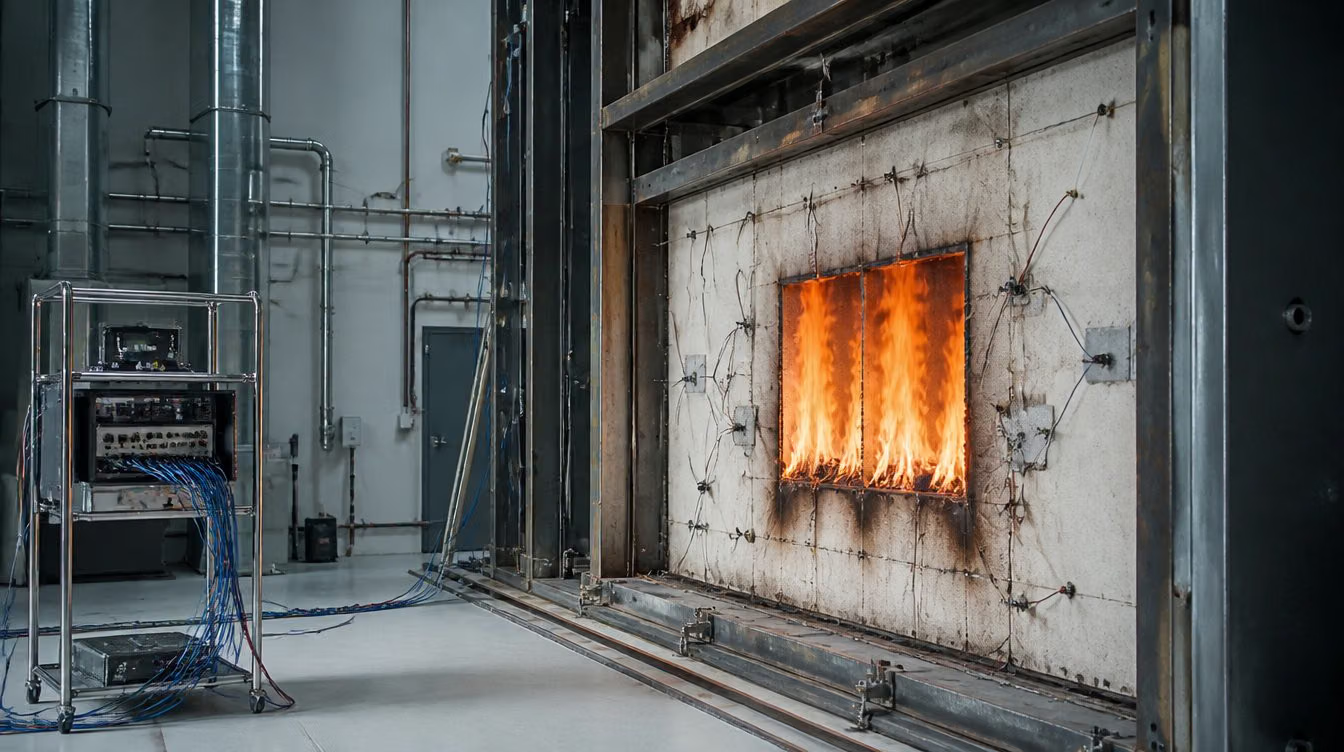
About the Standard
Scope title: reaction to fire class of construction materials
EN 13501-1 is a standard published by European Standard (EN) (EN). Standards published by the European standardisation organisations and adopted as national standards in member states; they are used as harmonised standards under EU directives.
See the other 194 codes from ENCoverage areas
What Is EN 13501-1?
EN 13501-1 classifies the REACTION to fire performance of construction products. It is not itself a test method; it converts data from different test standards into a single class designation. Under construction products legislation this class is one of the mandatory items of the declaration of performance, and project specifications call for this designation directly.
The classification consists of three components read together. The main class letter describes the material's contribution to the growth of a fire, the additional classification beginning with s describes smoke production and the one beginning with d the formation of flaming droplets and particles. The designation "B-s1,d0" carries all three pieces of information; specifications require this whole rather than a single letter.
Different scales apply according to the place of use. Floor coverings are classified with the fl (floorings) suffix and pipe insulation with the L (linear pipe insulation) suffix. The same material is assessed on a different class scale on a wall and on a floor; a class obtained for a wall is not valid when the product is used as a floor covering.
A class is valid together with the product's END USE CONDITION. The method of installation, the substrate, the air cavity behind it and the joint details all change fire behaviour. The test report therefore describes the installation arrangement in detail, and if a different installation is used in the field the class is reassessed.
Why Does This Standard Exist?
Before a common fire classification was established in Europe, each country used its own national system: the DIN 4102 classes in Germany, the M classes in France and the BS 476 classes in Britain. The same product was retested in every country and labelled with different designations; that was unsustainable for free movement in the internal market.
The EN 13501 series brought this fragmented structure under one roof and defined the classification together with the tests that feed it: EN ISO 1182 for non-combustibility, EN ISO 1716 for gross calorific value, EN ISO 11925-2 for ignitability with a single flame source and EN 13823 for the single burning item (SBI) test.
The logic of the system is a ladder of scale. For classes A1 and A2, the small-scale non-combustibility and calorific value tests are decisive. For classes B, C and D the medium-scale SBI test comes into play; it exposes the product to a real flame source in a corner arrangement and measures heat release, flame spread and smoke production together. Class E is determined by the small flame test alone. F means a product whose performance has not been determined.
Keeping the smoke and droplet additional classifications separate is a deliberate choice: most deaths in a fire are caused by smoke rather than flame, and a flaming droplet is a mechanism that carries fire to the floors below. A product may be good on flame spread and poor on smoke production; a single-letter designation would hide that.
Classification Scheme
A1
Products making no contribution to fire; they meet the non-combustibility criteria.
A2
Products whose contribution to fire is very limited; close to A1 but they may carry a limited organic content.
B
Limited contribution; low heat release and flame spread in the SBI test.
C and D
Increasing contribution to fire in that order; as the class falls, heat release and flame spread rise.
E
A product that withstands only the small flame test; the lower step of the classification.
F
A product whose performance has not been determined or that does not meet the E criteria.
s1 / s2 / s3
The smoke production additional classification; s1 indicates the lowest smoke production.
d0 / d1 / d2
The flaming droplets and particles additional classification; d0 indicates no droplets.
The fl and L suffixes
Separate scales for floor coverings (Afl, Bfl…) and pipe insulation (BL, CL…).
Which Products Require It
- Wall and ceiling lining materials
- Thermal insulation products and sandwich panels
- Floor coverings — with the fl designation
- Pipe and service insulation — with the L designation
- Suspended ceiling elements and acoustic panels
- Cladding and insulation components used in facade systems
Related Legislation and Schemes
- It is one of the essential characteristics of the declaration of performance under Construction Products Regulation (EU) 2024/3110
- The classification data comes from the EN ISO 1182, EN ISO 1716, EN 13823 and EN ISO 11925-2 tests
- Fire resistance is classified separately by EN 13501-2; reaction and resistance are different concepts
- For facade systems, national regulations may require additional large-scale testing
- For cables, EN 13501-6 defines a separate classification scale
How the Assessment Runs
- 1Defining the product and end useWhere, with which installation and on which substrate the product will be used is determined. The classification depends on that definition.
- 2Selecting tests according to the target classNon-combustibility and calorific value for A1/A2, SBI for B–D and the small flame test for E.
- 3Carrying out the testsSpecimens are prepared with an installation arrangement representing the end use condition and tested to the relevant standards.
- 4The classification reportThe test data is compared against the EN 13501-1 criteria and the main class and additional classifications are assigned together.
- 5Transferring to the declaration of performanceThe class is published as an essential characteristic in the product's declaration of performance (DoP).
Neighbouring Standards and the Differences
EN 13501-2
Fire RESISTANCE classification. It describes how long a building element holds a fire back (designations such as EI, REI); it must not be confused with the reaction class.
EN 13823 (SBI)
The single burning item test. It is the primary source of data for determining classes B, C and D.
ASTM E84
The North American counterpart. It produces FSI and SDI indices in a Steiner tunnel arrangement; it cannot be converted into an EN class.
UL 94
Flammability classification of plastic materials inside appliances. It is not suitable for construction products.
What the Report Must Contain
To be usable, a report must carry the information below. An incomplete report may not be accepted in the supply chain or in an inspection even when its result is correct.
- Product description: composition, density, thickness, surface treatment
- Description of the end use and installation arrangement, including substrate and air cavity
- The tests applied and the results of each
- The main class and additional classifications assigned (s and d)
- The field of application for which the classification is valid
- The classification report's references to the test reports
Commonly Confused Points
- REACTION to fire and RESISTANCE to fire get confused. Reaction describes the material's contribution to a fire, resistance how long a building element holds the fire back (EN 13501-2).
- A class is valid together with the product's end use condition. A different installation, substrate or air cavity may invalidate the class.
- UL 94 or ASTM E84 results cannot be converted into an EN 13501-1 class; they are different test arrangements and scales.
- class B
- For floor coverings the fl designation is mandatory; a wall class cannot be used for a floor.
Structure of the Code
- Published by
- EN
- Serial number
- 13501
- Part
- 1
The last "1" is the section number of the standard. Chapters organize different coverages of the same series; The requirements of whichever section is written in the specification are applied.
Codes in the library without release year is kept. The current version changes over time; If the year is specified in your specification, that version is taken as basis, if not specified, the most current version is applied.
Scope
- Test
- Fire Testing
- Fire Testing
- Construction Materials Testing
Related Tests and Services
Of the 2 pieces of content this code is referenced in, the 1 with their own published page are listed below.
Test · 1
Technical Requirements
Standard texts are copyright of the relevant organization; test condition, sample and acceptance criteria cannot be fitted here.
Basis: The EN 13501-1 class and additional classification designation scheme; the references of the test standards feeding it (EN ISO 1182, EN ISO 1716, EN 13823, EN ISO 11925-2); its distinction from EN 13501-2 and the fl / L sub-scales.
Technical requirements specific to your product, once we clarify the scope At offer stage shared in writing.
Relevant Product Groups and Legislation
This code is included in the standard tag of the product pages below.
These product pages carry notes for the following markets: European Union, United Kingdom, USA. Whether the standard is mandatory in the relevant market varies depending on the product group and the applicable legislation.
Regulations published with this code on the same product pages:
- (EU) 2024/3110Construction Products RegulationDeclaration of performance and CE marking for construction products. Most provisions apply from 8 January 2026; it progressively replaces (EU) 305/2011.
- (AB) 305/2011CPR (transition)Continues to apply during the transition period for product groups where a new harmonised standard has not been published.
- EN 13501-1Reaction-to-Fire ClassificationReaction-to-fire class for construction products; a mandatory item of the declaration of performance.
- (EC) 1907/2006REACHRegistration, evaluation, authorisation and restriction of chemicals; SVHC notification.
- (EU) 2023/1115Deforestation (wood-based)A deforestation-free supply declaration for wood and derived construction materials.
Other Parts of the Same Series
EN 13501 series is also present in the library with the following parts.
Related Standards
Frequently Asked Questions About EN 13501-1
What does B-s1,d0 mean?
Main class B (limited contribution to fire), s1 (lowest smoke production), d0 (no flaming droplets or particles). The three are read together.
Is testing required for class A1?
Some products are deemed A1 without testing under lists defined in legislation; other products require non-combustibility and calorific value testing.
I will use my product on a different substrate — is the class still valid?
Not automatically. The field of application defined in the classification report governs; an installation outside that field requires reassessment.
I have an ASTM E84 Class A report — is it sufficient in Europe?
No. The two systems use different test arrangements and scales; Europe requires EN 13501-1 classification.
Frequently Asked Questions
Is this standard mandatory for my product?
Whether it is mandatory depends on the product group, the target market and the applicable legislation. Once you tell us your product and market, we clarify in writing whether this standard is required.
How long does the test process take?
Duration depends on the scope of the standard, the number of specimens and current capacity. The exact duration is shared, together with the specimen and scope details, at the quote stage.
Do you issue certification against this standard?
Which activity is carried out under which accreditation scope is separately confirmed at the application stage. Up-to-date scope information is published on our corporate page.
What happens if the standard I need is not here?
The library is based on a continuously growing inventory. If you cannot find the code you are looking for, you can send it through the quote form; we will assess the relevant scope and get back to you.