
About the Standard
Scope title: conducted radio-frequency immunity
IEC 61000-4-6 is a standard published by International Electrotechnical Commission (IEC). It publishes international standards for electrical, electronic and related technologies; it is the foundation of the EMC and electrical safety body of work. CISPR publications belong to a special committee within the IEC.
See the other 102 codes from IECCoverage areas
EMC Tests — What Does This Testing Field Cover?
The section below describes the field that code IEC 61000-4-6 belongs to; it is not the text of the standard or the regime itself. The scope title of the code is given above, and technical requirements are shared at the quotation stage.
EMC testing answers a question with two sides: does the device emit an unacceptable level of electromagnetic interference into its surroundings (emission), and does it withstand the interference coming from them (immunity)? The two sides are measured with separate tests and separate set-ups, and both are required.
The field exists because of a simple physical fact: every conductor carrying current behaves like an antenna. A switched-mode power supply, a motor drive or the clock signal of a microcontroller radiates radio frequency energy even though it was never designed to. The same conductor also works in reverse: an external field induces a voltage across it. In an environment crowded with devices, this mutual effect means devices disturbing one another.
On the emission side, conducted and radiated emission are measured separately. Conducted emission is the interference the device imposes on its mains and communication cables and dominates at lower frequencies. Radiated emission is the field the device releases into the air and comes to the fore at higher frequencies. The two are measured in different set-ups, and the limits vary by product group.
On the immunity side, real-world sources of interference are simulated: electrostatic discharge (human touch), radiated radio frequency fields (a nearby transmitter), electrical fast transients (switching), surges (lightning and mains events), conducted radio frequency, power-frequency magnetic fields, voltage dips and short interruptions.
The standard to be applied depends on WHERE the product is used, and that choice determines the entire outcome. Residential and industrial environments carry different sets of limits; in vehicles the UNECE R10 regime applies rather than CE; for medical devices IEC 60601-1-2 brings additional requirements; and for products containing a radio, radio legislation comes into play and harmonised ETSI standards are used.
In immunity testing the acceptance criterion is a PERFORMANCE CRITERION class, not a binary pass/fail. A device continuing to function without interruption during the test, being temporarily affected and recovering by itself, or recovering only through user intervention are different classes. Which class is acceptable is defined in the product standard; the tolerance for a device carrying a safety function differs from that of a consumer device.
The most common shortcoming of an EMC file is that it covers only one side. A file carrying an emission report alone is not complete in terms of the EMC directive. The second common gap is a test set-up that does not represent actual use: if the device is measured on a bare bench with cables different from its real ones, the result does not carry over to the field.
Method groups in this field
Conducted emission
Interference imposed on the cable through mains and communication ports, measured via an artificial mains network (LISN).
Radiated emission
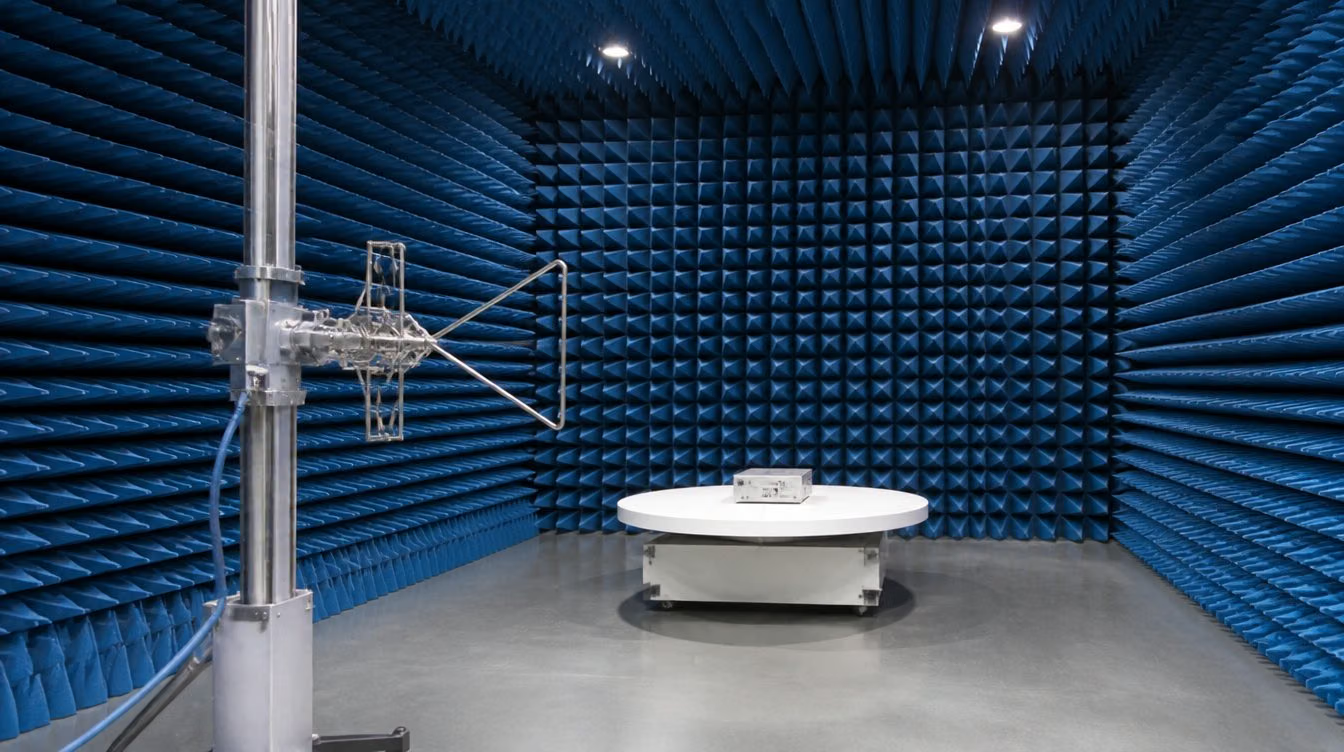
The field released into the air by the device, measured at a defined distance in an anechoic or semi-anechoic chamber.
Harmonics and flicker
The harmonic content of the current drawn from the mains and voltage fluctuation; the side that affects mains quality.
Electrostatic discharge
Contact and air discharge together with indirect discharge; the most frequently applied immunity test.
Radiated and conducted RF immunity
The device is exposed to a defined field strength and to an RF signal injected into the cable.
Mains-borne events
Electrical fast transients, surges, voltage dips and short interruptions.
Commonly confused in this field
- An emission report alone does not complete an EMC file; immunity must be demonstrated as well.
- An FCC report is not accepted in a CE file; the limits, measurement distances and set-ups are different.
- The EMC Directive does not apply to vehicles; the UNECE R10 regime does. Specifications requiring both together should be reviewed.
- The warning that a Class A device may cause interference in a residential environment is mandatory in the manual; market surveillance checks that this warning is present.
- The test set-up is part of the report. If cable type, length or routing changes, the result changes; measurement must be made in the series-production configuration.
- CISPR 22 and CISPR 13 have been withdrawn; their current counterparts are CISPR 32 and CISPR 35.
Which decisions these results support
- CE declaration under the EMC Directive
- The EMC part of radio equipment conformity
- A UNECE R10 file for a vehicle component
- Resolving field interference complaints and correcting the design
- Assessing the EMC impact of a board or wiring-harness change
Structure of the Code
- Published by
- IEC
- Serial number
- 61000
- Part
- 4-6
The last "4-6" is the section number of the standard. Chapters organize different coverages of the same series; The requirements of whichever section is written in the specification are applied.
Codes in the library without release year is kept. The current version changes over time; If the year is specified in your specification, that version is taken as basis, if not specified, the most current version is applied.
Scope
- Test
- EMC / EMI Testing
- EMC Tests
Related Tests and Services
Of the 2 pieces of content this code is referenced in, the 1 with their own published page are listed below.
Technical Requirements
Standard texts are copyright of the relevant organization; test condition, sample and acceptance criteria cannot be fitted here.
Technical requirements specific to your product, once we clarify the scope At offer stage shared in writing.
Other Parts of the Same Series
IEC 61000 series is also present in the library with the following parts.
- IEC 61000-3-2harmonic current emission
- IEC 61000-3-3voltage fluctuation and flicker
- IEC 61000-4-2electrostatic discharge (ESD) immunity
- IEC 61000-4-3radiated radio-frequency field immunity
- IEC 61000-4-4electrical fast transient/burst (EFT) immunity
- IEC 61000-4-5surge immunity
- IEC 61000-4-8power frequency magnetic field immunity
- IEC 61000-4-11voltage dip and short interruption immunity
- IEC 61000-6-1generic immunity for residential environments
- IEC 61000-6-2generic immunity for industrial environments
- IEC 61000-6-3generic emission for residential environments
- IEC 61000-6-4generic emission for industrial environments
Related Standards
Frequently Asked Questions
Is this standard mandatory for my product?
Whether it is mandatory depends on the product group, the target market and the applicable legislation. Once you tell us your product and market, we clarify in writing whether this standard is required.
How long does the test process take?
Duration depends on the scope of the standard, the number of specimens and current capacity. The exact duration is shared, together with the specimen and scope details, at the quote stage.
Do you issue certification against this standard?
Which activity is carried out under which accreditation scope is separately confirmed at the application stage. Up-to-date scope information is published on our corporate page.
What happens if the standard I need is not here?
The library is based on a continuously growing inventory. If you cannot find the code you are looking for, you can send it through the quote form; we will assess the relevant scope and get back to you.