
About the Standard
Scope title: radio disturbance from in-vehicle components
CISPR 25 is a standard published by International Electrotechnical Commission (IEC). It publishes international standards for electrical, electronic and related technologies; it is the foundation of the EMC and electrical safety body of work. CISPR publications belong to a special committee within the IEC.
See the other 102 codes from IECCoverage areas
What Is CISPR 25?
CISPR 25 defines limits and measurement methods for the radio disturbance a component or module may emit, for the protection of receivers on board a vehicle. It answers a different question from civil EMC standards: is this module disturbing the radio, GPS, communications and keyless entry receivers operating in the same vehicle?
The logic of the standard comes from VEHICLE ARCHITECTURE. In a car, dozens of electronic control units operate a few metres from the receiving antenna and run parallel within the same wiring harness. The limits therefore take as their reference not ambient noise but THE SENSITIVITY OF ON-BOARD RECEIVERS, and the frequency bands are divided according to the communication services used in the vehicle: AM and FM radio, DAB, GPS, GSM, LTE, Bluetooth and remote control bands are each addressed separately.
Measurement is carried out at COMPONENT LEVEL on a defined test bench: the module is set up with a real wiring harness length and a defined supply arrangement. Because the length and routing of the harness directly affect the result, the standard governs them separately; the harness behaves like an antenna and most of the radiated emission comes from it.
Limit CLASSES are defined from 1 to 5; the higher the class, the stricter the limit. Which class applies is stated by THE VEHICLE MANUFACTURER in its own specification — when reading a CISPR 25 report, the targeted class is therefore essential. The difference between class 1 and class 5 can be of the order of tenfold.
The standard covers only the EMISSION side. For immunity, the ISO 11452 series (radiated and conducted fields) and the ISO 7637 series (transients on the supply line) apply in addition. A component file containing only a CISPR 25 report is incomplete.
Why Does This Standard Exist?
The reason vehicle EMC requires a separate standard is physical proximity. In a house a radio receiver and a power supply sit metres apart and distance provides protection. In a vehicle the antenna is on the roof, the module generating interference is behind the dashboard and the harness connecting them runs through the same channel.
The second factor is the SENSITIVITY of the receivers. An AM radio receiver is designed to detect signals at microvolt level; a GPS receiver resolves a satellite signal below the noise floor. That sensitivity means that even very small disturbances produce noticeable degradation.
Dividing the limits by frequency band is the consequence of this logic. Rather than restricting a wide band with a flat limit, the standard applies stricter limits in the bands of the services actually used in the vehicle. Producing noise in an unused band is harmless; the same level in the GPS band is unacceptable.
Electric vehicles have made the picture more demanding. Inverters and DC/DC converters switching at the hundred-kilowatt level are sources of interference many times more powerful than classical vehicle components. High-voltage cables are also long and run the length of the vehicle; shielding and earthing design has therefore become critical.
OEM specifications sit on top of the standard and in practice they are what counts. Volkswagen, BMW, Ford, Stellantis, Toyota and Renault define their own limit tables, additional bands and measurement details. A component may pass CISPR 25 class 5 and still fail the OEM specification.
Which Products Require It
- Electronic control units and driver modules
- Lighting and motor driver components
- Charging units, DC/DC converters and inverters
- In-cabin electronics and multimedia modules
- Sensor, actuator and communication modules
- Aftermarket-fitted electronic equipment
Related Legislation and Schemes
- It is referred to at component level in UNECE R10 vehicle type approval
- Vehicle manufacturer specifications (VW, BMW, Ford, Stellantis, Toyota) add their own limit and class sets
- On the immunity side, the ISO 11452 and ISO 7637 series are used
- Emission radiated from the vehicle (vehicle level) is addressed by CISPR 12
How the Assessment Runs
- 1Determining the class and scopeThe target limit class and any OEM specification are determined; the ports to be measured and the operating modes are defined.
- 2Setting up the test benchThe module is set up with a defined harness length, supply network and ground plane; the set-up determines the result.
- 3Choosing the operating modeThe operating mode of the module producing the worst emission is determined; this makes the measurement representative.
- 4Conducted emissionMeasurement is made on supply and signal lines by voltage and current probe methods.
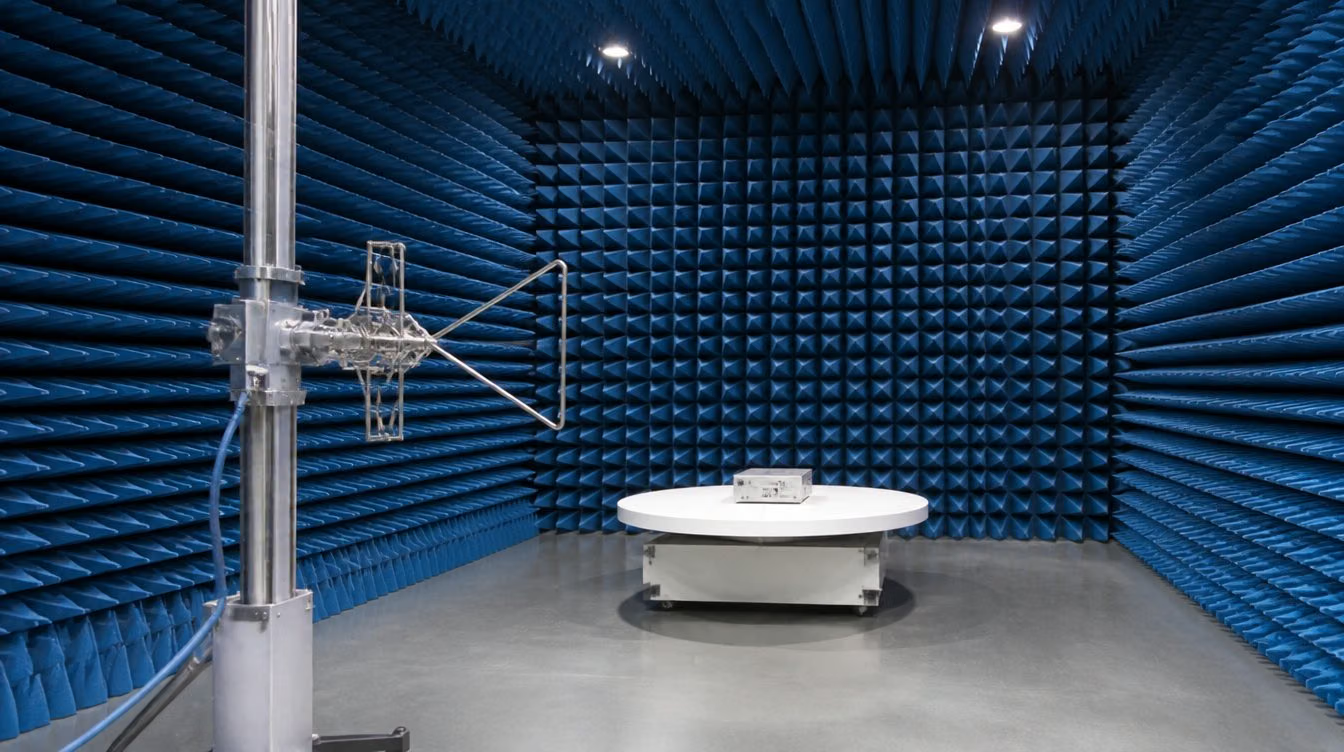
- 5Radiated emissionField strength is measured with an antenna at a defined distance in an anechoic chamber; the frequency bands are scanned.
- 6ReportingThe class, set-up, operating mode, comparisons against the limits and the margins are reported.
Neighbouring Standards and the Differences
CISPR 12
Radiated emission at vehicle level; it protects receivers outside the vehicle. CISPR 25 protects receivers on board.
ISO 11452 series
Component immunity tests; radiated and conducted field immunity.
The ISO 7637 series
Conducted transients on the supply line; surges arising from switching.
ISO 10605
Electrostatic discharge in vehicle applications; a different waveform from IEC 61000-4-2.
What the Report Must Contain
To be usable, a report must carry the information below. An incomplete report may not be accepted in the supply chain or in an inspection even when its result is correct.
- The targeted limit class (1–5) and the OEM specification reference if any
- The length, type and routing arrangement of the wiring harness
- The definition of the supply network and ground plane
- The operating modes of the module and the justification for the choice
- The ports measured, frequency bands and detector types
- Comparisons against the limits, the margins and the measurement uncertainty
Commonly Confused Points
- CISPR 25 covers only the EMISSION side. For immunity, the ISO 11452 and ISO 7637 series apply in addition.
- A conformity claim without a stated class cannot be verified; the difference between class 1 and class 5 is large.
- The harness arrangement is an inseparable part of the report; a result obtained with a different harness arrangement does not carry over to the series production vehicle.
- Conformity to CISPR 25 does not mean conformity to the OEM specification; an OEM may define additional bands and stricter limits.
- It gets confused with CISPR 12: one addresses emission radiated outward at vehicle level, the other interference on board at component level.
- If the worst-case operating mode is not selected, the measurement does not represent the real emission.
Structure of the Code
- Published by
- CISPR
- Serial number
- 25
- Part
- without partition
Codes in the library without release year is kept. The current version changes over time; If the year is specified in your specification, that version is taken as basis, if not specified, the most current version is applied.
Scope
- Test
- Standard-Based Tests
- EMC Tests
- Automotive Testing
Related Tests and Services
Of the 2 pieces of content this code is referenced in, the 1 with their own published page are listed below.
Test · 1
Technical Requirements
Standard texts are copyright of the relevant organization; test condition, sample and acceptance criteria cannot be fitted here.
Basis: The CISPR 25 scope statement, the limit class scheme (1–5) and the component-level measurement approach with the harness arrangement governed by the standard; the ISO 11452 and ISO 7637 immunity references and the CISPR 12 vehicle-level reference.
Technical requirements specific to your product, once we clarify the scope At offer stage shared in writing.
Relevant Product Groups and Legislation
This code is included in the standard tag of the product pages below.
These product pages carry notes for the following markets: European Union, United Kingdom, USA. Whether the standard is mandatory in the relevant market varies depending on the product group and the applicable legislation.
Regulations published with this code on the same product pages:
- (AB) 2018/858Vehicle Type-Approval FrameworkApproval of motor vehicles and their components. Component and separate technical unit approval run under this framework; the E mark arises from it.
- UNECEUNECE 1958 AgreementType-approval under component-specific UNECE regulations (e.g. R10 EMC, R30/R54 tyres, R43 glazing).
- UNECE R10UNECE R10Electromagnetic compatibility approval for vehicles and their components.
- 2011/65/EURoHSRestriction of hazardous substances in electrical and electronic equipment.
- 2000/53/ATELVEnd-of-life vehicles. Sets heavy-metal restrictions and recoverability targets.
Related Standards
Frequently Asked Questions About CISPR 25
Which class should we target?
Your OEM specification states it. Without a specification it is determined together, based on the target vehicle segment and the module's proximity to the antenna; the higher the class, the higher the design cost.
We passed CISPR 25 — does that count as R10 approval?
It does not. CISPR 25 is a measurement standard; R10 is a type approval regime granted by an approval authority.
Who provides the wiring harness?
The harness must represent the type and length to be used in series production; the information comes from the manufacturer and the set-up is documented in the report.
Is an immunity test also required?
Yes. In a vehicle, immunity is at least as critical as emission; the ISO 11452 and ISO 7637 series are applied.
Frequently Asked Questions
Is this standard mandatory for my product?
Whether it is mandatory depends on the product group, the target market and the applicable legislation. Once you tell us your product and market, we clarify in writing whether this standard is required.
How long does the test process take?
Duration depends on the scope of the standard, the number of specimens and current capacity. The exact duration is shared, together with the specimen and scope details, at the quote stage.
Do you issue certification against this standard?
Which activity is carried out under which accreditation scope is separately confirmed at the application stage. Up-to-date scope information is published on our corporate page.
What happens if the standard I need is not here?
The library is based on a continuously growing inventory. If you cannot find the code you are looking for, you can send it through the quote form; we will assess the relevant scope and get back to you.