
About the Standard
Scope title: emission from multimedia equipment
CISPR 32 is a standard published by International Electrotechnical Commission (IEC). It publishes international standards for electrical, electronic and related technologies; it is the foundation of the EMC and electrical safety body of work. CISPR publications belong to a special committee within the IEC.
See the other 102 codes from IECCoverage areas
What Is CISPR 32?
CISPR 32 defines the electromagnetic EMISSION requirements for multimedia equipment. It has replaced two earlier standards: CISPR 22 for information technology equipment and CISPR 13 for audio/video equipment. Here too the convergence of device categories brought two texts under one roof; the European counterpart is EN 55032.
The standard defines two ENVIRONMENT CLASSES. Class A is for industrial and commercial environments, Class B for residential environments. The Class B limits are stricter because in a residential environment a device operates closer to radio and television receivers and the intervening distance provides no protection.
The choice of class is a commercial decision with consequences. The instructions for use of a Class A device must carry a warning that it may cause interference in a residential environment; that warning is checked in market surveillance. Declaring a device Class A means an easier pass but effectively closes the residential market.
Measurement runs along two routes: CONDUCTED emission (interference coupled onto cables at the mains and telecommunication ports) and RADIATED emission (the field radiated into the air from the device). The two are measured with different set-ups and in different frequency bands, and both must be met. Conducted emission dominates at low frequencies and radiated emission comes to the fore at high frequencies.
Emission is HALF of EMC. The immunity side is addressed by a separate standard: CISPR 35 / EN 55035. A file containing only an emission report is incomplete for the EMC Directive, and this is the most frequently seen defect in files.
Why Does This Standard Exist?
Keeping CISPR 22 and CISPR 13 separate made sense for a time: information technology equipment and audio/video equipment had different architectures, different frequency content and different environments of use. A printer and a television were too different to be assessed under the same standard.
Convergence made that separation meaningless. A smart television is a computer; a networked loudspeaker is a network device; a set-top box is both a receiver and a computer. Which of the two standards governed the same device became a matter of debate and manufacturers tended to choose the standard with the looser limits.
which category does this device fall into?in which ENVIRONMENT will this device be used?
The counterpart on the immunity side merged with the same logic: CISPR 35 replaced CISPR 24 and CISPR 20. This reduced the EMC file to two standards: 32 for emission and 35 for immunity.
Its relationship with FCC Part 15 often raises questions. The FCC also uses a similar class distinction (Class A and Class B), but the limits, measurement distances, detector types and reporting differ. An FCC report is not accepted in a CE file, and the reverse holds too.
Classification Scheme
Class A
Industrial and commercial environments. The limits are looser but a residential environment warning in the instructions for use is mandatory.
Class B
Residential environments. The limits are stricter; products to be sold into the residential market must meet this class.
Which Products Require It
- Computers, servers, network equipment and data centre hardware
- Televisions, monitors, audio systems
- Set-top boxes, games consoles and similar consumer electronics
- Power adapters and external power supply units
- Printers, scanners and office equipment
- Digital signage and interactive display systems
Related Legislation and Schemes
- It is harmonised as EN 55032 under the EMC Directive (2014/30/EU)
- It is used for the EMC requirement of Article 3.1(b) of the Radio Equipment Directive (2014/53/EU)
- The immunity side is met by CISPR 35 / EN 55035
- In the United States, FCC Part 15 is the corresponding national regime; the limits and measurement arrangements differ
- On the harmonics and flicker side, IEC 61000-3-2 and -3-3 apply in addition
How the Assessment Runs
- 1Determining the class and scopeThe environment of use of the device is determined and Class A or B is chosen; the decision is justified in the technical file.
- 2Choosing the configurationThe operating mode and cable arrangement producing the worst emission are determined; this makes the measurement representative.
- 3Conducted emissionMeasurement is made at the mains and telecommunication ports through an artificial mains network (LISN) or a coupling device.
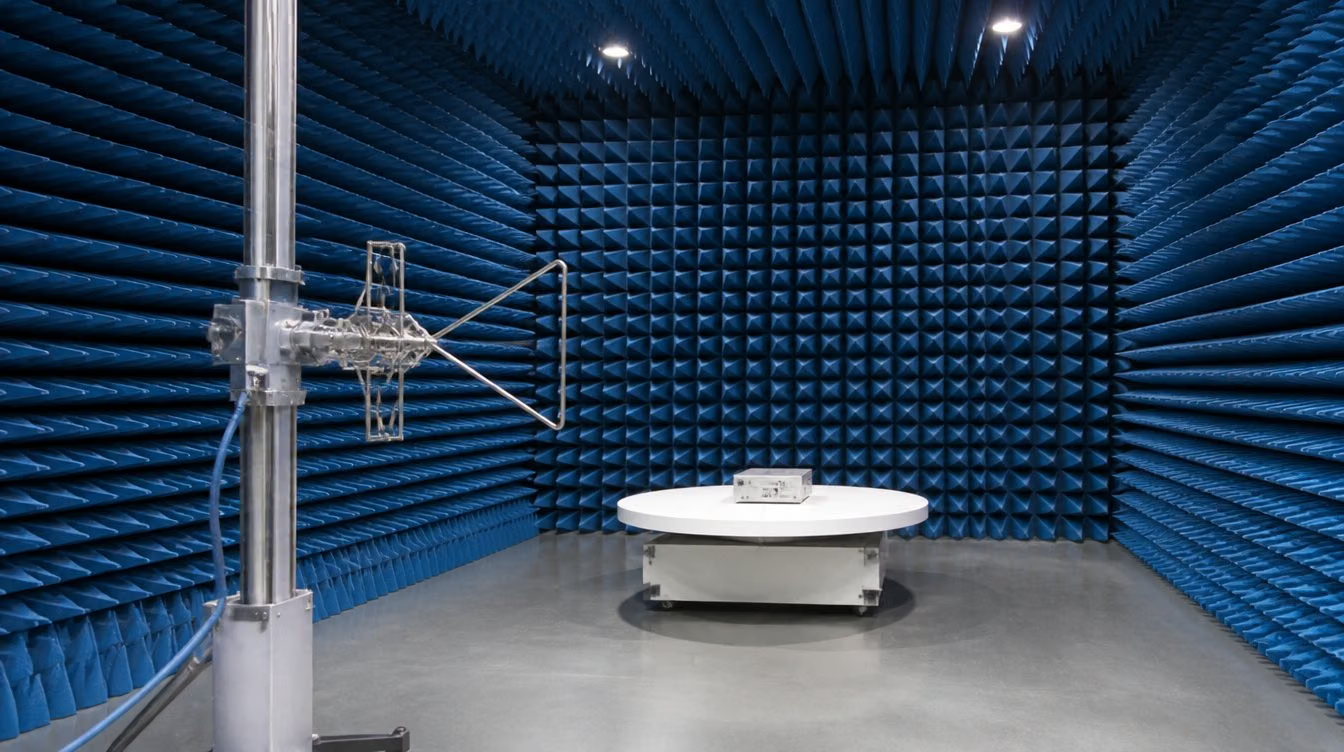
- 4Radiated emissionField strength is measured at a defined distance in a semi-anechoic chamber; antenna height and turntable rotation are scanned.
- 5Assessment and reportingThe measured values are compared against the class limits; the closest margins and the measurement uncertainty are reported.
Neighbouring Standards and the Differences
CISPR 35 / EN 55035
The immunity counterpart. An EMC file requires both; emission alone is an incomplete file.
CISPR 22 / CISPR 13
WITHDRAWN. CISPR 32 has replaced them; specifications referring to these codes must be updated.
CISPR 14-1
The emission standard for household appliances and electric tools; a different product group.
IEC 61000-3-2 / -3-3
Harmonic current and voltage flicker; the side affecting supply quality, required in addition.
What the Report Must Contain
To be usable, a report must carry the information below. An incomplete report may not be accepted in the supply chain or in an inspection even when its result is correct.
- The declared class (A or B) and the justification for the choice
- The ports measured and the measurement methods applied
- The operating mode and cable arrangement of the device
- Frequency bands, detector types and comparisons against the limits
- The closest margins and the measurement uncertainty
- If Class A, the wording of the warning in the instructions for use
Commonly Confused Points
- CISPR 22 and CISPR 13 HAVE BEEN WITHDRAWN; specifications referring to these codes and old reports must be updated.
- Class A does not mean a device cannot be sold into a residential environment; but the warning in the manual is mandatory and its presence is checked in market surveillance.
- An FCC Part 15 report is not accepted in a CE file; the limits and measurement distances differ.
- An emission report alone does not complete an EMC file; immunity must be demonstrated as well.
- The measurement configuration is part of the report; if cable type and length change, the result changes.
- Harmonics and flicker requirements are outside the scope of this standard and are met separately.
Structure of the Code
- Published by
- CISPR
- Serial number
- 32
- Part
- without partition
Codes in the library without release year is kept. The current version changes over time; If the year is specified in your specification, that version is taken as basis, if not specified, the most current version is applied.
Scope
- Test
- EMC / EMI Testing
- EMC Tests
Related Tests and Services
Of the 4 pieces of content this code is referenced in, the 2 with their own published page are listed below.
Technical Requirements
Standard texts are copyright of the relevant organization; test condition, sample and acceptance criteria cannot be fitted here.
Basis: The CISPR 32 class scheme (A and B) and its replacement of CISPR 22 and CISPR 13; the EN 55032 adoption and the CISPR 35 immunity reference; its distinction from FCC Part 15.
Technical requirements specific to your product, once we clarify the scope At offer stage shared in writing.
Relevant Product Groups and Legislation
This code is included in the standard tag of the product pages below.
These product pages carry notes for the following markets: European Union, United Kingdom, USA. Whether the standard is mandatory in the relevant market varies depending on the product group and the applicable legislation.
Regulations published with this code on the same product pages:
- (AB) 2018/858Vehicle Type-Approval FrameworkApproval of motor vehicles and their components. Component and separate technical unit approval run under this framework; the E mark arises from it.
- UNECEUNECE 1958 AgreementType-approval under component-specific UNECE regulations (e.g. R10 EMC, R30/R54 tyres, R43 glazing).
- UNECE R10UNECE R10Electromagnetic compatibility approval for vehicles and their components.
- 2011/65/EURoHSRestriction of hazardous substances in electrical and electronic equipment.
- 2000/53/ATELVEnd-of-life vehicles. Sets heavy-metal restrictions and recoverability targets.
Related Standards
Frequently Asked Questions About CISPR 32
Should we declare Class A or Class B?
Your environment of use determines it. If you will sell into the residential market, Class B is mandatory; a Class A declaration effectively closes the residential market and requires a warning in the manual.
We have an FCC report — is it enough for CE?
It is not. The limits, measurement distances and detector types differ; measurement to EN 55032 is required.
Is an immunity test also required?
Yes. The EMC Directive requires both emission and immunity; CISPR 35 / EN 55035 is applied for immunity.
Our adapter is separately certified — is that enough for the device?
It is not. Measurement is made on the system formed by the device together with its power supply.
Frequently Asked Questions
Is this standard mandatory for my product?
Whether it is mandatory depends on the product group, the target market and the applicable legislation. Once you tell us your product and market, we clarify in writing whether this standard is required.
How long does the test process take?
Duration depends on the scope of the standard, the number of specimens and current capacity. The exact duration is shared, together with the specimen and scope details, at the quote stage.
Do you issue certification against this standard?
Which activity is carried out under which accreditation scope is separately confirmed at the application stage. Up-to-date scope information is published on our corporate page.
What happens if the standard I need is not here?
The library is based on a continuously growing inventory. If you cannot find the code you are looking for, you can send it through the quote form; we will assess the relevant scope and get back to you.