
About the Standard
Scope title: mechanical shock test
IEC 60068-2-27 is a standard published by International Electrotechnical Commission (IEC). It publishes international standards for electrical, electronic and related technologies; it is the foundation of the EMC and electrical safety body of work. CISPR publications belong to a special committee within the IEC.
See the other 102 codes from IECCoverage areas
What Is IEC 60068-2-27?
IEC 60068-2-27 defines the test examining a product's resistance to mechanical SHOCK. It is one of the mechanical parts of the environmental testing series (IEC 60068) and simulates a different phenomenon from vibration: a single short-duration, high-acceleration pulse.
The failures produced by shock and vibration differ, and that is why both tests are needed. Vibration produces FATIGUE: a solder joint cracks after thousands of cycles, a screw loosens gradually. Shock produces FRACTURE: a brittle component shatters instantly, a bracket breaks, a board comes out of its slot. A product that withstands vibration may fail under shock.
The test is defined by acceleration amplitude, pulse duration and pulse shape (half-sine, sawtooth, trapezoidal). This triad comes from the product's exposure profile; the standard imposes no list of profiles, and the levels to be applied are set by the product standard or the specification.
The choice of PULSE SHAPE is a technical decision. The half-sine represents an impact against a hard surface and is the most widely used. The sawtooth pulse excites a wide frequency band more evenly and is therefore preferred in some specifications. The trapezoidal pulse produces a longer acceleration plateau and is closer to launch or sudden braking scenarios.
The other parts of the series address different mechanical and climatic factors: -2-6 sine vibration, -2-64 random vibration, -2-31 free fall and toppling, -2-1 cold, -2-2 dry heat, -2-14 change of temperature, -2-30 cyclic damp heat and -2-78 steady damp heat.
Why Does This Standard Exist?
The need for shock testing comes from the nature of the events a product meets over its life. A product is dropped during transport, knocked during installation, driven over a pothole on a vehicle and jolted as a door closes. These events are not continuous; each is a single short pulse.
The importance of the distinction lies in the failure mechanism. A fatigue failure is cumulative and develops over time; a shock failure is instantaneous and occurs in a single event. Testing a product only under vibration says nothing about a drop scenario.
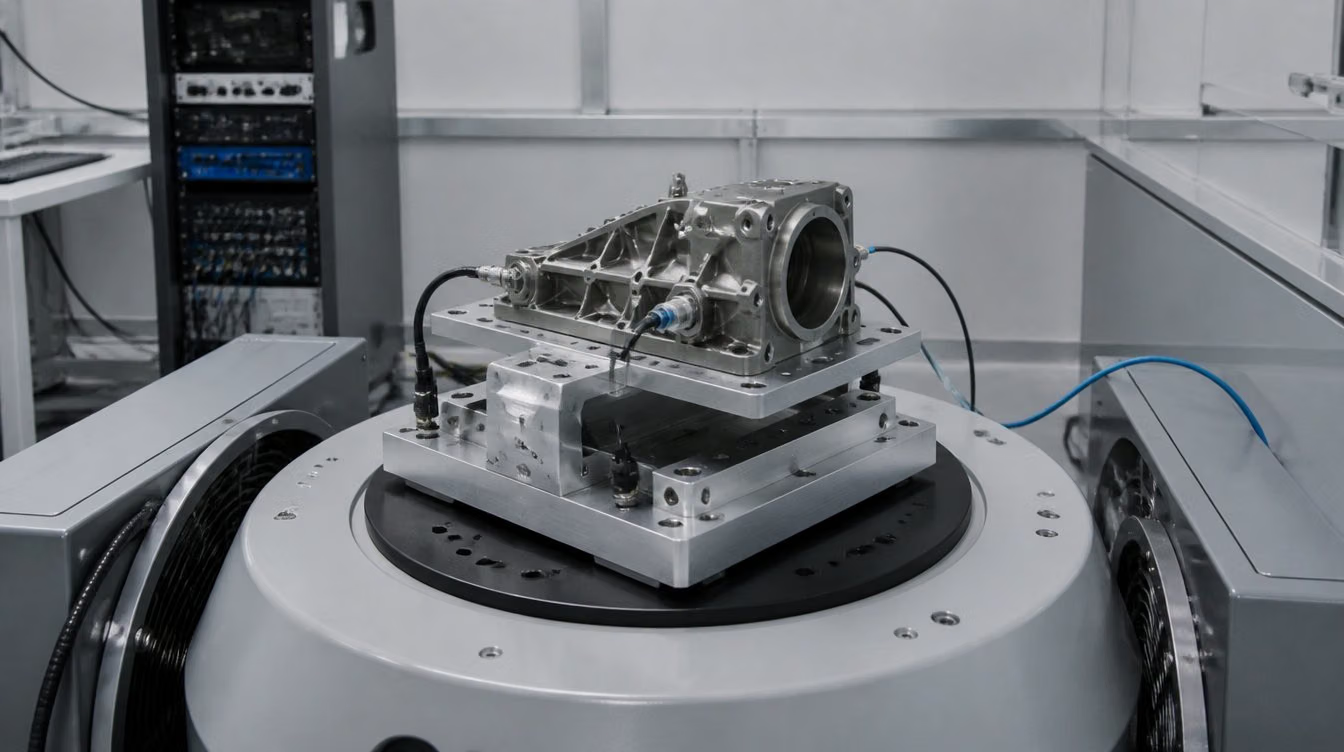
In the test set-up the FIXTURE determines the result. A shock machine produces a defined pulse, but how much of that pulse reaches the product depends on the mounting arrangement. A flexible fixture damps the pulse and protects the product; a stiff, resonant fixture amplifies it. Fixture design and verification are therefore part of the test.
The choice of measurement point is the second determining subject. The control accelerometer is placed on the fixture and monitoring accelerometers at critical points of the product. Accelerations measured at different points in the same test can differ markedly; the report must document those positions.
A RESONANCE SWEEP before and after the test is a critical check. Shock can leave a crack or loosening invisible to the eye; the product may appear to keep working while being structurally weakened. A shift in resonant frequencies reveals that change.
Which Products Require It
- Electronic boards, modules and enclosures
- Batteries and power electronics components
- Automotive, rail and aviation electronics
- Portable devices and handheld terminals
- Sensor, actuator and connector components
Related Legislation and Schemes
- Product standards (IEC 62133-2, IEC 62619, rail and automotive standards) refer to this test
- The T4 shock test of UN 38.3 addresses a similar phenomenon in the transport context
- On the military side the MIL-STD-810 shock methods and in aviation the DO-160 shock section are the corresponding provisions
- In rail, the EN 61373 categories define shock and vibration together
How the Assessment Runs
- 1Determining the profileThe acceleration amplitude, pulse duration and pulse shape are determined from the product standard or the exposure profile.
- 2Fixture design and verificationThe mounting arrangement is designed to represent the product's real installation; the fixture's own resonances are checked.
- 3Reference resonance sweepThe product's resonant frequencies are recorded by a low-level sweep before the test.
- 4Applying the shockA defined number of pulses is applied in the required axes and directions; the product is monitored in an operating state where required.
- 5Final resonance sweep and inspectionThe sweep is repeated after the test; a shift in frequency indicates structural change. Visual and functional inspection is carried out.
Neighbouring Standards and the Differences
IEC 60068-2-6
Sine vibration. Resonance search and withstand at defined frequencies; a different failure mechanism from shock.
IEC 60068-2-64
Random vibration. It represents the broadband nature of the real environment.
IEC 60068-2-31
Free fall and toppling. It simulates realistic drop scenarios arising from handling.
MIL-STD-810 / DO-160
The military and aviation shock methods; different profiles and different acceptance approaches.
What the Report Must Contain
To be usable, a report must carry the information below. An incomplete report may not be accepted in the supply chain or in an inspection even when its result is correct.
- The pulse shape, acceleration amplitude and duration applied
- The number of pulses per axis and direction
- Description of the fixture and the verification results
- The positions of the control and monitoring accelerometers
- Resonance sweep results before and after the test
- The operating state of the product and the parameters monitored
Commonly Confused Points
- Shock and vibration are not the same test; one applies an instantaneous and the other a continuous load, and they are required separately.
- The levels come from the product standard; the standard does not define a single universal level.
- The mounting arrangement determines the result; results obtained with different mountings cannot be compared and the fixture must be documented in the report.
- Without a resonance sweep before and after the test, structural damage can go unnoticed.
- The position of the measurement point must be reported; accelerations measured at different points in the same test differ.
- A test carried out without operating the product does not show temporary functional disturbances.
Structure of the Code
- Published by
- IEC
- Serial number
- 60068
- Part
- 2-27
The last "2-27" is the section number of the standard. Chapters organize different coverages of the same series; The requirements of whichever section is written in the specification are applied.
Codes in the library without release year is kept. The current version changes over time; If the year is specified in your specification, that version is taken as basis, if not specified, the most current version is applied.
Scope
- Test
- Mechanical Testing
- Vibration and Shock
Related Tests and Services
Of the 3 pieces of content this code is referenced in, the 1 with their own published page are listed below.
Technical Requirements
Standard texts are copyright of the relevant organization; test condition, sample and acceptance criteria cannot be fitted here.
Basis: The IEC 60068-2-27 scope statement and the pulse shape definitions (half-sine, sawtooth, trapezoidal); the references of the other parts of the series. Levels and pulse counts are defined in the product standard.
Technical requirements specific to your product, once we clarify the scope At offer stage shared in writing.
Other Parts of the Same Series
IEC 60068 series is also present in the library with the following parts.
- IEC 60068series of environmental test methods
- IEC 60068-2-1low temperature (cold) test
- IEC 60068-2-2high temperature (dry heat) test
- IEC 60068-2-6sinusoidal vibration test
- IEC 60068-2-11series of environmental test methods
- IEC 60068-2-14change of temperature test
- IEC 60068-2-18series of environmental test methods
- IEC 60068-2-30cyclic damp heat test
- IEC 60068-2-31drop and topple test
- IEC 60068-2-38series of environmental test methods
- IEC 60068-2-52series of environmental test methods
- IEC 60068-2-64random vibration test
- IEC 60068-2-75series of environmental test methods
- IEC 60068-2-78steady-state damp heat test
Related Standards
Frequently Asked Questions About IEC 60068-2-27
How many g should be applied?
The level comes from your product standard or your exposure profile. Transport, on-vehicle and military applications prescribe markedly different levels.
Which pulse shape should we choose?
The half-sine is the most common and represents an impact against a hard surface. If your specification names a shape, that one is applied.
Our vibration test passed — is shock also required?
Yes, where applicable. The two tests examine different failure mechanisms; neither replaces the other.
Should we supply the fixture?
The fixture must represent the product's real installation. It is usually designed and verified together with the laboratory; the mounting interface information comes from you.
Frequently Asked Questions
Is this standard mandatory for my product?
Whether it is mandatory depends on the product group, the target market and the applicable legislation. Once you tell us your product and market, we clarify in writing whether this standard is required.
How long does the test process take?
Duration depends on the scope of the standard, the number of specimens and current capacity. The exact duration is shared, together with the specimen and scope details, at the quote stage.
Do you issue certification against this standard?
Which activity is carried out under which accreditation scope is separately confirmed at the application stage. Up-to-date scope information is published on our corporate page.
What happens if the standard I need is not here?
The library is based on a continuously growing inventory. If you cannot find the code you are looking for, you can send it through the quote form; we will assess the relevant scope and get back to you.