
About the Standard
Scope title: compostability and biodegradability of packaging
EN 13432 is a standard published by European Standard (EN) (EN). Standards published by the European standardisation organisations and adopted as national standards in member states; they are used as harmonised standards under EU directives.
See the other 194 codes from ENCoverage areas

Ambalaj Testleri — What Does This Testing Field Cover?
The section below describes the field that code EN 13432 belongs to; it is not the text of the standard or the regime itself. The scope title of the code is given above, and technical requirements are shared at the quotation stage.
Packaging testing examines two different functions separately: does the packaging protect the product during transport, and does the packaging material transfer harmful substances into its contents? These two questions require different laboratory infrastructure and must not be confused.
On the protection side, distribution simulation is carried out: drop, vibration, compression, stacking and, where needed, low pressure tests are applied in sequences representing the real shipping chain. These tests are meaningful as a SEQUENCE rather than individually; in real life too, packaging is exposed to successive loads and each load builds on the damage left by the previous one. Specifications such as ISTA and ASTM D4169 define these sequences by shipment type.
The shipment type determines the sequence itself. The exposure of a palletised load differs from that of a parcel shipped individually: the latter sees far more handling, more drops and impacts in a wider variety of orientations. The growth of e-commerce has brought this second scenario to the fore and turned parcel shipping simulation into a specification group of its own.
On the food contact side, MIGRATION is what counts: the amount of substance passing from the packaging material into the food is compared against overall and specific migration limits. For plastic packaging the list of permitted substances and the limits are defined in separate legislation; the declaration of conformity (DoC) rests on this assessment and is a document that every link in the supply chain must carry.
In a migration test the choice of SIMULANT is critical. Because testing with real food is not practical, liquids representing food are used: different simulants for aqueous foods, for fatty foods and for acidic foods. Choosing the wrong simulant invalidates the result; the choice depends on which food type the packaging will contact and at what temperature.
Barrier properties are a third axis. Oxygen and water vapour permeability directly determine the shelf life of the product; in pharmaceutical and food packaging these values are a design input. Barrier performance is sensitive to temperature and relative humidity, so the measurement conditions are part of the report.
Sterile medical device packaging is the most tightly regulated sub-body of this family. Here the packaging is a barrier maintaining sterility; seal strength, leak testing, distribution simulation and shelf-life studies run together as a validation package.
The packaging legislation side is becoming rapidly more demanding. Recyclability, recovered content ratio, packaging reduction and reuse targets must now be measurable and declarable; this turns packaging design from a material selection exercise into a conformity exercise.
Method groups in this field
Distribution simulation
Drop, random and fixed frequency vibration, compression, stacking, low pressure; as ISTA and ASTM D4169 sequences.
Mechanical strength
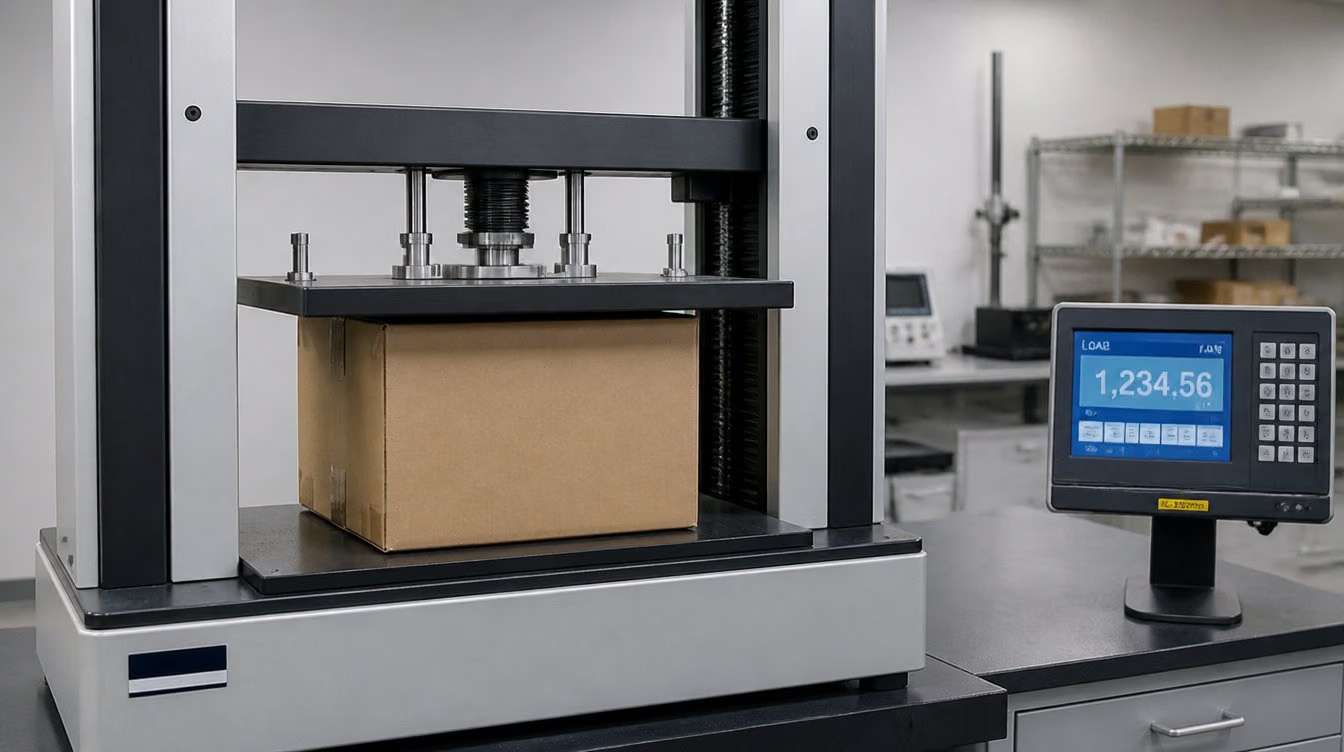
Edge crush (ECT) in corrugated board, bursting strength, box compression strength, tape peel adhesion.
Barrier measurements
Oxygen transmission rate (OTR), water vapour transmission rate (WVTR), permeability in film and sheet materials.
Migration
Overall and specific migration tests; simulant and temperature conditions are chosen according to the use scenario.
Seal and integrity
Seal peel strength, leak detection by dye penetration, bubble test, headspace analysis.
Shelf life
Real-time and accelerated ageing; part of the validation package in sterile packaging.
Commonly confused in this field
- A single drop test is not a distribution simulation; the tests are applied as the sequence defined in the specification.
- A migration test carried out with the wrong simulant or the wrong contact temperature is invalid.
- Accelerated ageing does not replace real-time ageing; a shelf life claim is supported by real-time data.
- Barrier values are valid together with the measurement temperature and relative humidity; an OTR/WVTR value given without conditions cannot be compared.
- A packaging change (film supplier, seal parameter, box design) may require the validation to be repeated.
- A food contact declaration of conformity is not a test report; it is a document that rests on reports but summarises a broader assessment.
Which decisions these results support
- Reducing shipping damage and verifying the packaging design
- Declaration of conformity for food contact packaging
- Supporting the shelf-life claim
- Validation of sterile device packaging
- Recyclability and content declarations under packaging legislation
Structure of the Code
- Published by
- EN
- Serial number
- 13432
- Part
- without partition
Codes in the library without release year is kept. The current version changes over time; If the year is specified in your specification, that version is taken as basis, if not specified, the most current version is applied.
Scope
Related Tests and Services
A separate test page based on this code has not yet been released. The code falls within the scope of the following test families.
Technical Requirements
Standard texts are copyright of the relevant organization; test condition, sample and acceptance criteria cannot be fitted here.
Technical requirements specific to your product, once we clarify the scope At offer stage shared in writing.
Relevant Product Groups and Legislation
This code is included in the standard tag of the product pages below.
- Air conditioning
- Television
- LED lighting
- adapter/charger
- power bank
- router/modem
- IoT device
- mobile phone
- laptop
- EV charger
- Compressor
- Pump
- valve
- pressure vessel
- Toy
- Furniture
- textile product
- Food contact packaging
- building material
- food product
These product pages carry notes for the following markets: European Union, United Kingdom, USA, Saudi Arabia, China. Whether the standard is mandatory in the relevant market varies depending on the product group and the applicable legislation.
Regulations published with this code on the same product pages:
- 2014/35/EULVDThe Low Voltage Directive. Governs the electrical safety of equipment operating in the 50–1000 V AC range; the manufacturer makes the declaration, with no notified body involvement.
- 2014/30/EUEMCThe Electromagnetic Compatibility Directive. Covers both the interference a device emits into its environment (emission) and its resistance to interference from outside (immunity).
- (AB) 206/2012EcodesignEcodesign requirements for air conditioners and comfort fans. Sets minimum thresholds and a declaration obligation for seasonal efficiency and sound power level.
- (AB) 626/2011Energy LabelEnergy labelling for air conditioners. The class on the label is based on measurement and is one of the first points examined in market surveillance.
- (EU) 2024/573F-GasThe Fluorinated Greenhouse Gases Regulation. The refrigerant type and its GWP value directly affect the product's placement on the market and labelling obligation.
- 2011/65/EURoHSRestriction of certain hazardous substances in electrical and electronic equipment; an integral part of the CE declaration.
- 2000/14/ATOutdoor NoiseNoise emitted into the environment by outdoor equipment. Whether the outdoor unit falls within scope is assessed according to product type.
- (AB) 2019/2021EcodesignEcodesign requirements for electronic displays. Includes on-mode power consumption, standby mode and repairability requirements.
- (AB) 2019/2013Energy LabelEnergy labelling for electronic displays. Requires a separate class declaration for SDR and HDR modes and EPREL registration.
- 2014/53/EUREDThe Radio Equipment Directive. For a product with a radio interface, spectrum, EMC and electrical safety are assessed together; the 3.3(d)(e)(f) cybersecurity articles also apply.
- 2012/19/ABWEEEWaste electrical and electronic equipment. Requires product marking and registration with the collection system.
- (AB) 2019/2020EcodesignEcodesign requirements for light sources. Covers efficiency, colour consistency, switching-cycle durability and product-information requirements.
- (AB) 2019/2015Energy LabelEnergy labelling for light sources. An A–G class and EPREL registration are mandatory.
- (EC) 1907/2006REACHRegistration, evaluation, authorisation and restriction of chemicals. Creates a notification obligation for SVHC substances in the product's content.
- (AB) 2019/1782Ecodesign (external power supplies)Ecodesign requirements for external power supplies. Sets minimum thresholds for loaded efficiency and no-load power consumption.
- (AB) 2022/2380Common Charging InterfaceA common charging solution for certain radio equipment. Requires a USB-C interface and declaration of charging information on the label.
- (EU) 2023/1542Batteries RegulationSustainability, safety and transparency for batteries. Carbon footprint declaration, recycled content and the battery passport apply on a staged timetable.
- UN Manual of Tests and CriteriaUN 38.3Transport safety of lithium cells and batteries. The T1–T8 test series is applied in the defined order; shipment cannot proceed without a report.
- (EU) 2023/988GPSRThe General Product Safety Regulation. Establishes a safety framework for aspects not covered by sector-specific legislation.
- (EU) 2024/2847CRAThe Cyber Resilience Act. Cybersecurity requirements for products with digital elements; reporting from 11 September 2026, full application from 11 December 2027.
- (AB) 1275/2008Ecodesign (networked standby)Minimum requirements for standby and off-mode power consumption in networked equipment.
- (EU) 2022/2555NIS2 (indirect)Cybersecurity risk management for essential and important entities; a network-equipment supplier is affected through its customers' obligations.
- (EU) 2016/679GDPR (indirect)Devices that process personal data incur a data-protection-by-design obligation.
- (AB) 2023/1670Ecodesign (smartphones)Ecodesign requirements for smartphones and tablets. Sets requirements for durability, repairability, spare parts and software-update duration.
- (AB) 2023/1669Energy Label (smartphones)Energy labelling for smartphones and tablets; battery life, drop resistance and a repair score are declared on the label.
- (AB) 617/2013Ecodesign (computers)Ecodesign requirements for computers and servers. Includes requirements for annual energy consumption, standby mode and power management.
- (AB) 2023/1804Alternative Fuels InfrastructureThe Regulation on the deployment of alternative fuels infrastructure. Governs connector type, payment and data-sharing requirements at public charging points.
- 2006/42/ATMachinery DirectiveRisk assessment, essential health and safety requirements and a technical-file obligation.
- (EU) 2023/1230Machinery RegulationReplaces 2006/42/EC, mandatory on 20 January 2027 with no further transition period.
- 2014/68/EUPEDThe Pressure Equipment Directive for pressurised parts; the category is determined by pressure and volume.
- 2014/34/ABATEXEquipment and protective systems used in explosive atmospheres. The category and conformity route are determined by zone classification.
- (AB) 547/2012Ecodesign (water pumps)Ecodesign requirements for water pumps. Sets minimum efficiency index and product-information requirements.
- (AB) 2019/1781Ecodesign (electric motors)Efficiency class requirements for electric motors and variable-speed drives.
- (AT) 1935/2004Food Contact MaterialsGeneral requirements for equipment in contact with food; material conformity is required for valves in food lines.
- (AB) 2020/2184Drinking Water Contact ProductsHygiene requirements for materials in contact with water under the Drinking Water Directive.
- 2014/29/ABSimple Pressure VesselsA separate directive for series-produced simple pressure vessels; its scope must be distinguished from the PED.
- 2010/35/ABTransportable Pressure EquipmentThe pi mark and periodic inspection regime for transportable pressure equipment.
- 2009/48/ECToy SafetyThe Toy Safety Directive. Regulates mechanical, physical, flammability, chemical and electrical safety requirements together; a technical file and safety assessment are mandatory.
- EN 62115Electrical toysSafety for electric toys; applies to mains-connected or battery-powered toys.
- (AT) 1907/2006 Annex XVII item 51-52Phthalate RestrictionRestriction of certain phthalates in toys and childcare articles.
- (AB) 2023/1464Formaldehyde EmissionRestriction on formaldehyde emission from wood-based products (an amendment to REACH Annex XVII).
- (EU) 2023/1115Wood and Forest ProductsThe Deforestation Regulation. A deforestation-free supply declaration for wood and derived products; 30 December 2026 for large operators.
- (EU) 2024/3110Construction Products (fixed furniture)The Construction Products Regulation's scope is assessed for furniture permanently fixed to a building.
- (AB) 1007/2011Textile LabellingTextile fibre names and labelling. Declaration of fibre composition and regulation of the label language.
- (AT) 1907/2006 Annex XVII item 43Azo Dye RestrictionRestriction of certain azo dyes in textiles in contact with skin.
- (AB) 2019/1021PFAS / PFOA RestrictionRestriction of PFOA and its derivatives under the Persistent Organic Pollutants Regulation.
- (EU) 2016/425Personal Protective Equipment (overlap)The PPE Regulation's scope and category are determined for textiles with a protective function.
- (AB) 10/2011Plastics in Food ContactPlastic materials in contact with food. The list of authorised substances, and overall and specific migration limits.
- (AT) 2023/2006Good Manufacturing PracticeGood manufacturing practice (GMP) for food-contact materials.
- (AB) 2025/40Packaging and Packaging WasteThe Packaging and Packaging Waste Regulation. Recyclability, recycled-content and packaging-reduction obligations; replaces 94/62/EC.
- (AB) 2022/1616Recycled PlasticRecycled plastic materials in contact with food.
- (AB) 305/2011CPR (transition)Continues to apply during the transition period for product groups where a new harmonised standard has not been published.
- EN 13501-1Reaction-to-Fire ClassificationReaction-to-fire class for construction products; a mandatory item of the declaration of performance.
- (AT) 178/2002General Food LawThe general principles of food law, traceability and food safety responsibility.
- (AT) 852/2004Food HygieneHygiene rules for food businesses and the obligation for a HACCP-based system.
- (AB) 1169/2011Food Information to ConsumersFood labelling; nutrition declaration, allergen information and origin information.
- (AB) 2023/915ContaminantsMaximum levels of contaminants in food.
- (AT) 396/2005Pesticide residuesMaximum residue limits in food of plant and animal origin.
- (AT) 2073/2005Microbiological CriteriaMicrobiological criteria for foodstuffs.
Related Standards
Frequently Asked Questions
Is this standard mandatory for my product?
Whether it is mandatory depends on the product group, the target market and the applicable legislation. Once you tell us your product and market, we clarify in writing whether this standard is required.
How long does the test process take?
Duration depends on the scope of the standard, the number of specimens and current capacity. The exact duration is shared, together with the specimen and scope details, at the quote stage.
Do you issue certification against this standard?
Which activity is carried out under which accreditation scope is separately confirmed at the application stage. Up-to-date scope information is published on our corporate page.
What happens if the standard I need is not here?
The library is based on a continuously growing inventory. If you cannot find the code you are looking for, you can send it through the quote form; we will assess the relevant scope and get back to you.