
About the Standard
Scope title: non-destructive testing — magnetic particle testing
ISO 9934 is a standard published by International Organization for Standardization (ISO). The international standards organisation; it publishes the widest body of management system, test method and product standards.
See the other 310 codes from ISOCoverage areas

Metal and Metallurgy Testing — What Does This Testing Field Cover?
The section below describes the field that code ISO 9934 belongs to; it is not the text of the standard or the regime itself. The scope title of the code is given above, and technical requirements are shared at the quotation stage.
Metal and metallurgical testing determines the load a metal or a welded joint can carry, how it fails and what its internal structure looks like. The output of this family is often not about the product itself but about the identity of the MATERIAL: is the steel really of the declared grade, does the weld seam deliver the strength the design assumes, does the casting contain an unacceptable internal defect?
The practical importance of the field comes from the fact that a metal part rarely fails gradually. A plastic part deforms, ages, cracks and usually gives warning. A weld seam or a fastener, by contrast, often breaks without warning — especially where fatigue and brittle fracture are involved. That is why in fields such as pressure equipment, lifting gear, structural steel and pipelines, material testing is a requirement of REGULATION rather than of design.
The family brings together three groups of methods, and each answers a different question. Mechanical tests quantify how the material behaves under load. Non-destructive examination looks for defects without damaging the part. Metallography and chemical analysis explain why the material behaves the way it does — through grain structure, phase distribution, inclusion content and alloy composition.
The acceptance criterion for these tests almost never comes from the test standard, and this is the key to understanding the field. The test standard says how the measurement is to be made; the acceptable values come from the product standard, the material grade or the fabrication code. ISO 6892-1 tells you how to run a tensile test; EN 10025 tells you what yield strength that steel must deliver. When reading a report, the product standard it was assessed against is essential.
Sampling is an inseparable part of the result in this field. Two specimens taken from the same heat may give different values depending on the direction and location they were taken from; in rolled products, specimens parallel and perpendicular to the rolling direction produce different results. Product standards therefore also govern sampling location and orientation, and the report must document this.
Method groups in this field
Mechanical tests
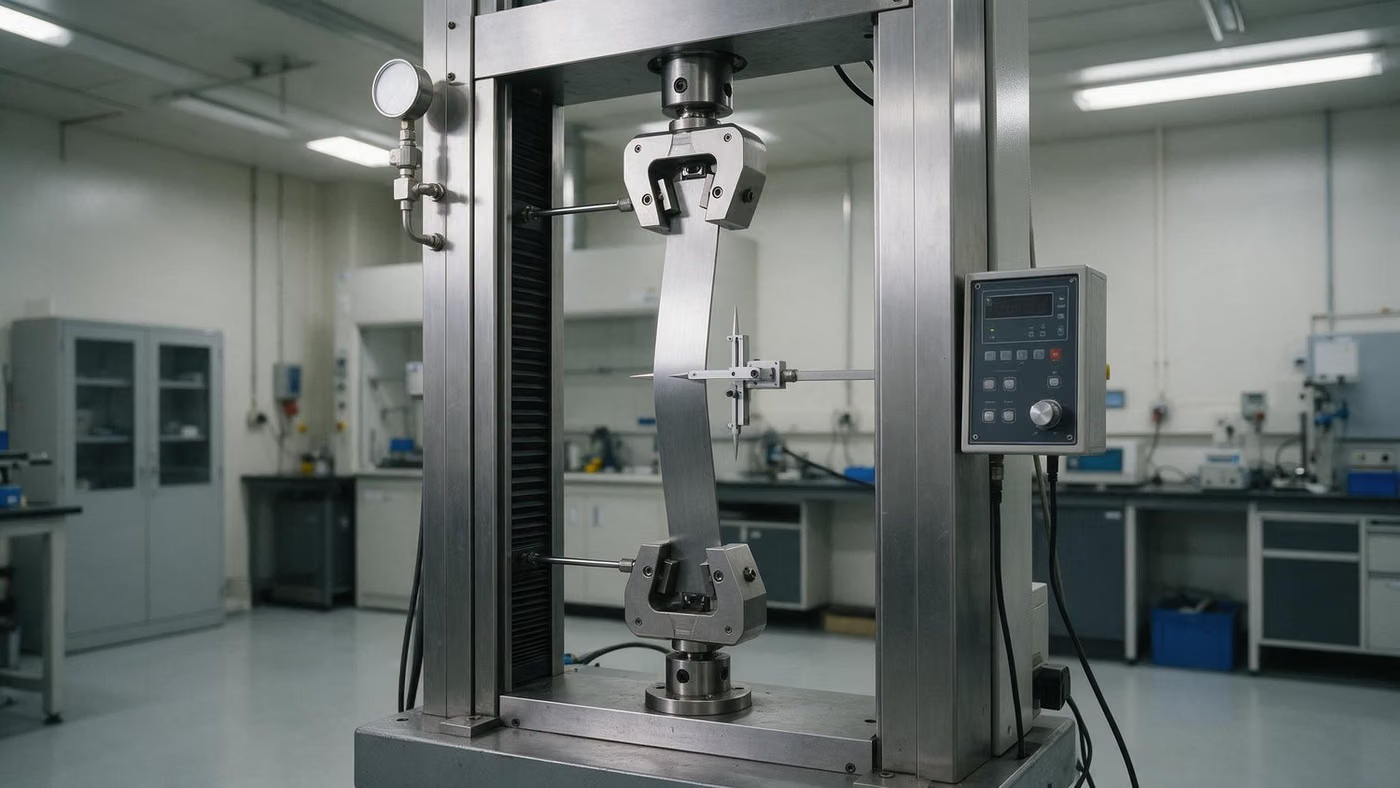
Tensile, compression, bending, notch impact (Charpy), hardness (Brinell, Vickers, Rockwell), fatigue, creep and fracture toughness. These give the behaviour of the material under load in numerical form.
Non-destructive examination
Radiography, ultrasonic examination, penetrant, magnetic particle and visual examination. It looks for surface and internal defects without damaging the part and is an indispensable step in welded fabrication.
Metallography
Specimen preparation, etching and microscopic examination. Grain size, phase distribution, inclusion content, case depth and the weld heat-affected zone are assessed.
Chemical analysis
Alloy composition is verified by optical emission spectrometry and wet chemistry; confirmation of the material grade runs through this step.
Corrosion behaviour
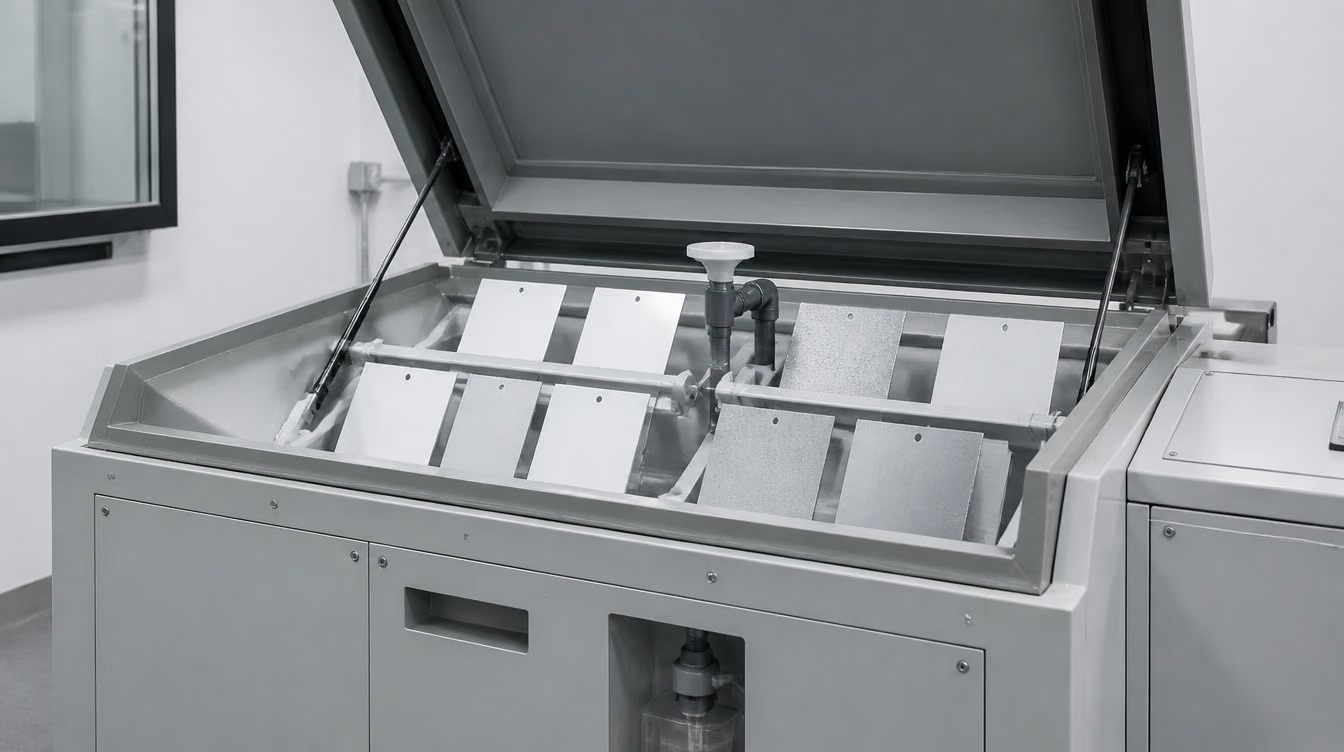
Salt spray, pitting and crevice corrosion and intergranular corrosion tests. In stainless steels these can indicate the quality of the heat treatment.
Commonly confused in this field
- A material certificate (such as EN 10204 3.1) is not a test report; it is the manufacturer's declaration. In critical applications independent verification is carried out, and the two must not be confused.
- ASTM and ISO tensile tests measure the same quantities but use different specimen geometries; the results are not treated as directly equivalent, and whichever the specification calls for is the one applied.
- Conversion tables between hardness and strength are APPROXIMATE. Calculating yield strength from hardness is not sufficient evidence for material acceptance.
- In non-destructive examination, "no defect found" does not mean there is no defect; defects below the detection limit of the method may be present. The report must state the method applied and the sensitivity level.
- A weld seam passing does not show that the welder or the procedure is qualified; these are separate processes.
Which decisions these results support
- Verifying the material certificate and accepting incoming material
- Approving welded fabrication; welder and procedure qualification
- Manufacturing control of pressure equipment and structural components
- Failure analysis and determining the root cause of field damage
- Verifying heat treatment and surface treatment processes
Structure of the Code
- Published by
- ISO
- Serial number
- 9934
- Part
- without partition
Codes in the library without release year is kept. The current version changes over time; If the year is specified in your specification, that version is taken as basis, if not specified, the most current version is applied.
Scope
Related Tests and Services
A separate test page based on this code has not yet been released. The code falls within the scope of the following test families.
Technical Requirements
Standard texts are copyright of the relevant organization; test condition, sample and acceptance criteria cannot be fitted here.
Technical requirements specific to your product, once we clarify the scope At offer stage shared in writing.
Relevant Product Groups and Legislation
This code is included in the standard tag of the product pages below.
- automotive part
- medical device
- Machinery
- Compressor
- Pump
- valve
- pressure vessel
- Toy
- textile product
- Food contact packaging
- building material
- cosmetic product
- food product
These product pages carry notes for the following markets: European Union, United Kingdom, USA. Whether the standard is mandatory in the relevant market varies depending on the product group and the applicable legislation.
Regulations published with this code on the same product pages:
- (AB) 2018/858Vehicle Type-Approval FrameworkApproval of motor vehicles and their components. Component and separate technical unit approval run under this framework; the E mark arises from it.
- UNECEUNECE 1958 AgreementType-approval under component-specific UNECE regulations (e.g. R10 EMC, R30/R54 tyres, R43 glazing).
- UNECE R10UNECE R10Electromagnetic compatibility approval for vehicles and their components.
- 2011/65/EURoHSRestriction of hazardous substances in electrical and electronic equipment.
- 2000/53/ATELVEnd-of-life vehicles. Sets heavy-metal restrictions and recoverability targets.
- (EU) 2017/745MDRThe Medical Device Regulation. Classification (I, IIa, IIb, III), clinical evaluation, technical documentation and post-market surveillance obligations; the notified body's role grows as the class rises.
- (EU) 2017/746IVDRThe In Vitro Diagnostic Medical Devices Regulation. In vitro diagnostic devices fall under this regulation instead of the MDR.
- (AB) 2017/745 art. 33EUDAMEDThe European medical device database. From 28 May 2026, the actor registration, UDI/device, certificate and market surveillance modules are mandatory; placing on the market is not possible without a valid SRN.
- 2006/42/ATMachinery Directive (overlap)Relevant essential requirements also apply to medical devices that also qualify as machinery.
- (EC) 1907/2006REACHRegistration, evaluation, authorisation and restriction of chemicals; SVHC notification.
- (EU) 2023/1230Machinery RegulationReplaces 2006/42/EC and becomes mandatory on 20 January 2027 with no further transition period. Requires notified-body involvement for Annex I high-risk machinery.
- 2014/35/EULVDThe Low Voltage Directive. Governs electrical safety in the 50–1000 V AC range.
- 2014/30/EUEMCThe Electromagnetic Compatibility Directive. Emission and immunity are covered together.
- 2014/34/ABATEXEquipment and protective systems used in explosive atmospheres. The category and conformity route are determined by zone classification.
- 2000/14/ATNoise EmissionNoise emitted into the environment by outdoor equipment. Machinery within scope requires a sound-power-level declaration and marking.
- 2014/68/EUPEDThe Pressure Equipment Directive for pressurised parts; the category is determined by pressure and volume.
- (EU) 2024/573F-GasRefrigerant type, GWP value and leak-tightness obligations for systems containing a refrigerant.
- (AB) 547/2012Ecodesign (water pumps)Ecodesign requirements for water pumps. Sets minimum efficiency index and product-information requirements.
- (AB) 2019/1781Ecodesign (electric motors)Efficiency class requirements for electric motors and variable-speed drives.
- (AT) 1935/2004Food Contact MaterialsGeneral requirements for equipment in contact with food; material conformity is required for valves in food lines.
- (AB) 2020/2184Drinking Water Contact ProductsHygiene requirements for materials in contact with water under the Drinking Water Directive.
- 2014/29/ABSimple Pressure VesselsA separate directive for series-produced simple pressure vessels; its scope must be distinguished from the PED.
- 2010/35/ABTransportable Pressure EquipmentThe pi mark and periodic inspection regime for transportable pressure equipment.
- 2009/48/ECToy SafetyThe Toy Safety Directive. Regulates mechanical, physical, flammability, chemical and electrical safety requirements together; a technical file and safety assessment are mandatory.
- EN 62115Electrical toysSafety for electric toys; applies to mains-connected or battery-powered toys.
- (AT) 1907/2006 Annex XVII item 51-52Phthalate RestrictionRestriction of certain phthalates in toys and childcare articles.
- (EU) 2023/1542Batteries RegulationBattery obligations and a removability requirement for toys containing a battery.
- (AB) 1007/2011Textile LabellingTextile fibre names and labelling. Declaration of fibre composition and regulation of the label language.
- (AT) 1907/2006 Annex XVII item 43Azo Dye RestrictionRestriction of certain azo dyes in textiles in contact with skin.
- (AB) 2019/1021PFAS / PFOA RestrictionRestriction of PFOA and its derivatives under the Persistent Organic Pollutants Regulation.
- (EU) 2023/988GPSRThe General Product Safety Regulation. The safety framework for consumer products not covered by sector-specific legislation.
- (EU) 2016/425Personal Protective Equipment (overlap)The PPE Regulation's scope and category are determined for textiles with a protective function.
- (AB) 10/2011Plastics in Food ContactPlastic materials in contact with food. The list of authorised substances, and overall and specific migration limits.
- (AT) 2023/2006Good Manufacturing PracticeGood manufacturing practice (GMP) for food-contact materials.
- (AB) 2025/40Packaging and Packaging WasteThe Packaging and Packaging Waste Regulation. Recyclability, recycled-content and packaging-reduction obligations; replaces 94/62/EC.
- (AB) 2022/1616Recycled PlasticRecycled plastic materials in contact with food.
- (EU) 2024/3110Construction Products RegulationDeclaration of performance and CE marking for construction products. Most provisions apply from 8 January 2026; it progressively replaces (EU) 305/2011.
- (AB) 305/2011CPR (transition)Continues to apply during the transition period for product groups where a new harmonised standard has not been published.
- EN 13501-1Reaction-to-Fire ClassificationReaction-to-fire class for construction products; a mandatory item of the declaration of performance.
- (EU) 2023/1115Deforestation (wood-based)A deforestation-free supply declaration for wood and derived construction materials.
- (AT) 1223/2009Cosmetic Products RegulationThe Cosmetic Products Regulation. Appointing a responsible person, the product information file (PIF), the safety assessment (CPSR) and CPNP notification are mandatory; there is no product approval, and responsibility rests with the manufacturer.
- (AT) 1223/2009 Annexes II-VIProhibited and Restricted SubstancesLists of prohibited substances, restricted substances, and permitted preservatives, colorants and UV filters.
- (AT) 1223/2009 art. 16Nanomaterial NotificationA separate notification six months before placing on the market for products containing nanomaterials.
- (AT) 1223/2009 art. 18Animal Testing BanA ban on animal testing of finished products and ingredients, and on placing animal-tested products on the market.
- (AT) 178/2002General Food LawThe general principles of food law, traceability and food safety responsibility.
- (AT) 852/2004Food HygieneHygiene rules for food businesses and the obligation for a HACCP-based system.
- (AB) 1169/2011Food Information to ConsumersFood labelling; nutrition declaration, allergen information and origin information.
- (AB) 2023/915ContaminantsMaximum levels of contaminants in food.
- (AT) 396/2005Pesticide residuesMaximum residue limits in food of plant and animal origin.
- (AT) 2073/2005Microbiological CriteriaMicrobiological criteria for foodstuffs.
Related Standards
Frequently Asked Questions
Is this standard mandatory for my product?
Whether it is mandatory depends on the product group, the target market and the applicable legislation. Once you tell us your product and market, we clarify in writing whether this standard is required.
How long does the test process take?
Duration depends on the scope of the standard, the number of specimens and current capacity. The exact duration is shared, together with the specimen and scope details, at the quote stage.
Do you issue certification against this standard?
Which activity is carried out under which accreditation scope is separately confirmed at the application stage. Up-to-date scope information is published on our corporate page.
What happens if the standard I need is not here?
The library is based on a continuously growing inventory. If you cannot find the code you are looking for, you can send it through the quote form; we will assess the relevant scope and get back to you.