
About the Standard
Scope title: salt spray corrosion test
ASTM B117 is a standard published by ASTM International (ASTM). It publishes material, product and test method standards; it is the body most often turned to in corrosion, mechanical and materials testing.
See the other 199 codes from ASTMCoverage areas
What Is ASTM B117?
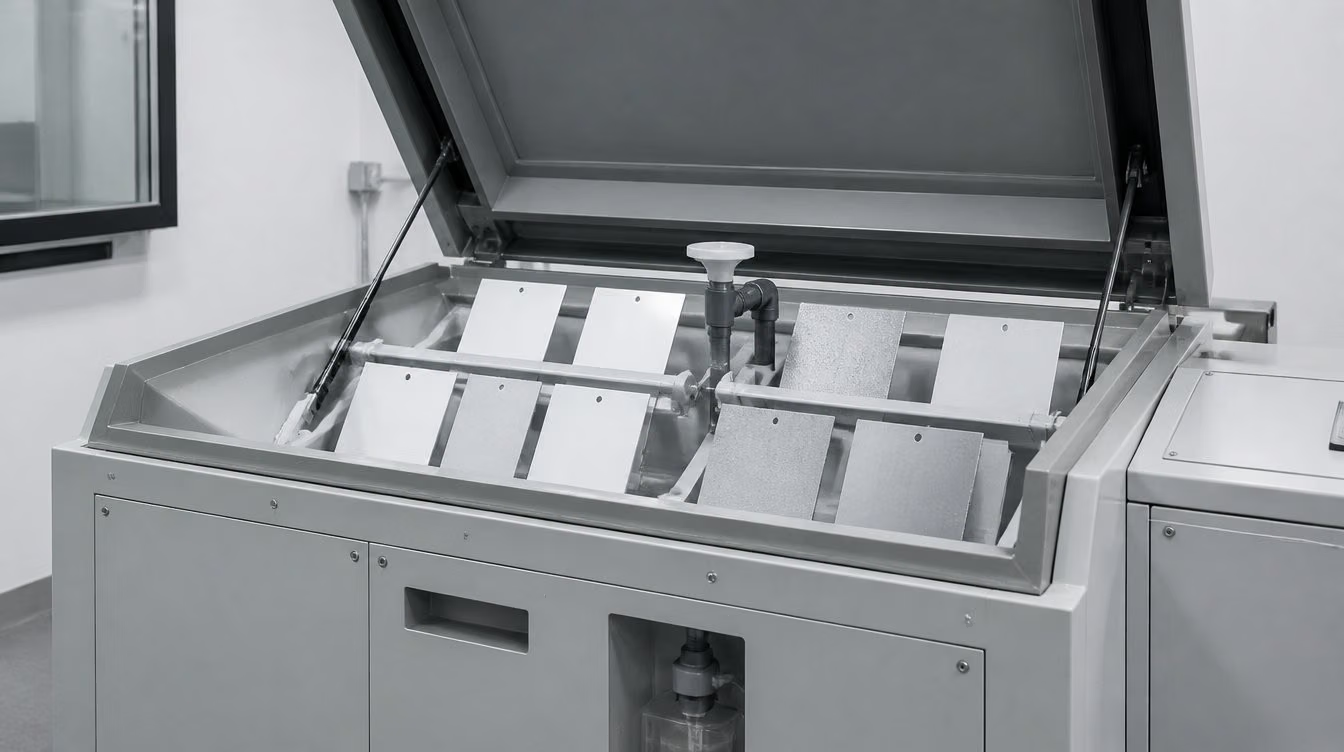
ASTM B117 is a PRACTICE standard defining how a salt spray chamber is to be operated. What its designation says is decisive: the standard is not a test method or an acceptance criterion but a description of how the chamber conditions are established and maintained. That is also why it is the most frequently cited corrosion reference in industry — if everyone operates the same chamber in the same way, results become comparable.
This distinction is the most misunderstood point in the field. ASTM B117 DOES NOT SPECIFY A TEST DURATION and GIVES NO PASS/FAIL CRITERION. Duration and acceptance criteria come from the product standard or the customer specification; depending on the coating type they range from tens of hours to thousands. The sentence "complies with ASTM B117" is therefore technically empty; what carries meaning is a statement such as "720 hours in an ASTM B117 chamber, rated 8 on the ASTM D1654 scale".
The standard defines the neutral salt spray condition: approximately 5% sodium chloride solution, a chamber temperature of 35 °C, a solution pH set in the neutral band and a defined collection rate. These conditions are the identity of the standard and do not vary with the product; what varies is how long the specimen is held under them and which scale the result is assessed against.
The test is accelerated, and that acceleration comes at a price: the results cannot be converted directly into real atmospheric life. How many years a coating that survives 500 hours in the chamber will last in the field cannot be derived from this test. The function of the test is not absolute life prediction but comparison and the monitoring of production consistency.
Why Does This Standard Exist?
The origin of salt spray testing goes back to the early twentieth century and to the problem of metal parts in marine environments deteriorating rapidly. The need to compress corrosion that takes years in the real environment into weeks in a laboratory gave rise to the idea of an enclosed chamber into which a salt-laden mist is sprayed continuously.
ASTM B117 is the standardised form of that idea and has been the common language of industry for decades. Its prevalence comes less from its power than from its CONSISTENCY: because the chamber conditions are tightly defined, results from different laboratories come out close to one another. That is exactly the property wanted for supplier comparison and incoming material control.
But a constant condition leaves out the most distinctive feature of the real atmosphere: its variability. Outdoors, a surface gets wet, dries, warms, cools and takes UV. The wet-dry cycle changes the corrosion mechanism; the form of damage on a continuously wet surface differs from that on a cyclically wetted one. For this reason the automotive sector has largely moved to cyclic tests (SAE J2334, VDA 233-102, ASTM G85). ASTM B117 has not lost its place but its role has narrowed: it is a tool for comparison and process control rather than an indicator of absolute life.
Which Products Require It
- Galvanised, zinc-nickel and chemical conversion coatings
- Paint, powder coating and electrophoretic coating systems
- Fasteners, springs and metal fittings
- Automotive body and chassis components
- White goods and outdoor equipment parts
- Marine and outdoor structural components
Assessment Approach
Assessment looks at different forms of damage according to the coating type: on metallic coatings, white rust (corrosion of the coating itself) and red rust (corrosion reaching the base metal) are reported separately; on painted surfaces, blistering, creep from a scribe and loss of adhesion come to the fore.
The assessment scales are defined in separate standards. Degree of rusting is rated by ASTM D610, blistering by ASTM D714 and creep from a scribe by ASTM D1654. If the report does not state which scale was used, the rating cannot be interpreted.
Monitoring chamber performance is part of the validity of the test: solution concentration, pH, temperature and collection rate are recorded regularly. Without those records it cannot be shown that a long exposure took place under defined conditions.
Duration and acceptance criteria come from the product standard; the laboratory does not set them itself, and if it did, the report could not produce a statement of conformity.
Related Legislation and Schemes
- It forms part of coating approval files in automotive supply specifications
- ISO 9227 is the ISO counterpart of the same chamber family and defines the NSS, AASS and CASS conditions together
- For cyclic corrosion, SAE J2334, VDA 233-102 and ASTM G85 offer different approaches
- For hot dip galvanised coatings, the product requirements of ASTM A123 and ISO 1461 apply in addition
How the Assessment Runs
- 1Specimen preparation and identificationSpecimens are cleaned, their edges masked where required, and identified. Coating thickness is measured at this stage; because the result is sensitive to thickness, the thickness is part of the report.
- 2ScribingFor paint systems most specifications require a controlled scribe. Assessment looks at the corrosion creeping from that scribe; on an unscribed surface the starting point of damage remains undefined.
- 3Placement in the chamberSpecimens are positioned within the angle range defined in the standard. Position affects the result: solution pools on a horizontal surface and runs off a vertical one.
- 4ExposureThe chamber is run continuously under the defined conditions. The duration comes from the specification; if interim assessments are to be made, the arrangement for removing and replacing specimens is agreed beforehand.
- 5AssessmentAt the end of the exposure the surface is assessed with the scale appropriate to the coating type. The scale is defined in separate standards and the report states which was used.
Neighbouring Standards and the Differences
ISO 9227
The same chamber family on the ISO side. It defines three conditions rather than one (NSS, AASS, CASS) and requires the aggressiveness of the chamber to be verified with reference specimens.
ASTM G85
Modified salt spray conditions. It defines acetic acid, cyclic and sulphur dioxide variants; used where the constant condition of B117 falls short.
SAE J2334 / VDA 233-102
Cyclic corrosion specifications. They combine wetting, drying, humidity and salt application in cycles and are considered closer to field behaviour in automotive.
ASTM D1654 / D610 / D714
Assessment scales. B117 provides the exposure; the rating comes from these standards.
What the Report Must Contain
To be usable, a report must carry the information below. An incomplete report may not be accepted in the supply chain or in an inspection even when its result is correct.
- Specimen description: base material, coating type and the measured coating thickness
- The exposure duration applied and the times of any interim assessments
- Chamber condition records: temperature, solution concentration, pH, collection rate
- The specimen positioning angle
- Whether a scribe was applied and its geometry
- The assessment scale used and the rating obtained
- Which product standard or specification the acceptance criterion comes from
Commonly Confused Points
- The phrase "passed ASTM B117" is meaningless on its own; the result cannot be interpreted until how many hours and against which acceptance criterion are answered.
- Constant-condition salt spray does not carry the cyclic nature of real atmospheric corrosion. Two coatings that rank well in the chamber may behave in the reverse order in the field.
- ISO 9227 and ASTM B117 define similar chamber conditions but are not the same standard; whichever the specification names is the one applied, and in most specifications the reports are not accepted in place of one another.
- If the coating thickness is not reported, the result cannot be compared; the same coating lasts markedly longer or shorter at a different thickness.
- Position within the chamber affects the result. Differences can arise between specimens on different shelves or at different angles; this is why positioning is governed by the standard.
Structure of the Code
- Published by
- ASTM
- Serial number
- B117
- Part
- without partition
Codes in the library without release year is kept. The current version changes over time; If the year is specified in your specification, that version is taken as basis, if not specified, the most current version is applied.
Scope
- Test
- Metal and Metallurgy Testing
- Corrosion Tests
- Corrosion Tests
Related Tests and Services
Of the 3 pieces of content this code is referenced in, the 1 with their own published page are listed below.
Test · 1
Technical Requirements
Standard texts are copyright of the relevant organization; test condition, sample and acceptance criteria cannot be fitted here.
Basis: ASTM B117 scope statement: it defines the chamber operating conditions (approximately 5% NaCl solution, 35 °C, a neutral pH band, a defined collection rate); duration and acceptance criteria are outside the scope of the standard. The assessment scales come from the ASTM D610, D714 and D1654 references.
Technical requirements specific to your product, once we clarify the scope At offer stage shared in writing.
Related Standards
Frequently Asked Questions About ASTM B117
How many hours of salt spray should I run?
The standard does not say. The duration comes from your product standard or your customer's specification. If you have no specification, it needs to be determined together, based on your target market and product group.
How many years of field life does 500 hours of salt spray correspond to?
There is no reliable conversion. The chamber runs under constant conditions while field conditions vary; a conversion can only be established with a material-specific model calibrated against field data.
Is an ISO 9227 report accepted in place of ASTM B117?
It depends on your specification. The conditions are similar but the standards are different; many customers request by code and do not accept a substitute.
Which matters, white rust or red rust?
They say different things. White rust is corrosion of the coating itself and shows that protection continues; red rust means the base metal has been reached. Specifications usually give a separate duration for each.
Frequently Asked Questions
Is this standard mandatory for my product?
Whether it is mandatory depends on the product group, the target market and the applicable legislation. Once you tell us your product and market, we clarify in writing whether this standard is required.
How long does the test process take?
Duration depends on the scope of the standard, the number of specimens and current capacity. The exact duration is shared, together with the specimen and scope details, at the quote stage.
Do you issue certification against this standard?
Which activity is carried out under which accreditation scope is separately confirmed at the application stage. Up-to-date scope information is published on our corporate page.
What happens if the standard I need is not here?
The library is based on a continuously growing inventory. If you cannot find the code you are looking for, you can send it through the quote form; we will assess the relevant scope and get back to you.