

About the Standard
Scope title: basic safety of medical electrical equipment
IEC 60601-1 is a standard published by International Electrotechnical Commission (IEC). It publishes international standards for electrical, electronic and related technologies; it is the foundation of the EMC and electrical safety body of work. CISPR publications belong to a special committee within the IEC.
See the other 102 codes from IECCoverage areas
What Is IEC 60601-1?
IEC 60601-1 is the standard for the basic safety and ESSENTIAL PERFORMANCE of medical electrical equipment. The second concept in its title carries the philosophy of the standard: in a medical device safety is not only about avoiding harm; a device failing to perform its expected function is also a risk. A defibrillator not delivering a shock, a monitor missing an alarm and an infusion pump stopping the flow are all safety events.
The structure of the standard has three layers, and a file cannot be built without knowing that structure. Part 1 carries the general requirements. The COLLATERAL standards alongside it develop a particular subject for all devices: IEC 60601-1-2 addresses electromagnetic compatibility, -1-6 usability engineering, -1-8 alarm systems, -1-11 the home healthcare environment and -1-12 the emergency medical services environment. The third layer, the PARTICULAR standards (IEC 60601-2-x), governs a single device type.
RISK MANAGEMENT is at the centre of the assessment. The standard requires a risk management process run under ISO 14971 and ties many of its requirements to that process. Conformity to 60601-1 cannot be demonstrated without a risk management file; this takes the standard out of being a classical checklist and makes it an engineering process.
The way the device contacts the patient determines its classification: the type of applied part (B, BF, CF), the protection class and the mode of operation. Type CF is for parts that may be applied directly to the heart and carries the strictest leakage current requirements. This classification is declared on the device label and in the instructions for use.
Why Does This Standard Exist?
What sets medical electrical equipment apart from other electrical equipment is that the patient is DEFENCELESS. An ordinary user notices an electric shock and pulls their hand away; a patient under anaesthesia or unconscious cannot. Skin resistance may also be absent because contact with the device is direct (catheters, electrodes), and a current that would normally be harmless can reach a level that disturbs the heart rhythm.
The standard therefore keeps leakage current limits far lower than other electrical safety standards and grades them by the type of applied part. The limit for a part applied to the heart (CF) is much stricter than for a part touching the body (B).
The concept of ESSENTIAL PERFORMANCE moved to the centre of the standard with the 3rd edition. Before that the focus was on avoiding harm; afterwards, the device failing to perform its function was also defined as a risk. This changed the EMC part too: a monitor is now expected not merely to survive electromagnetic interference but not to miss an alarm under it.
provided it is justified in the risk management file
The home healthcare and emergency services collateral standards (-1-11 and -1-12) emerged as devices moved outside the hospital. A device used at home meets an untrained user, an uncontrolled electrical installation and unpredictable ambient conditions; the emergency services environment brings vibration, temperature and rapid-intervention requirements.
Structure of the Standard
IEC 60601-1
General requirements; the basis of every assessment. Electrical, mechanical and thermal safety and essential performance.
IEC 60601-1-2
Electromagnetic compatibility. Essential performance is expected to be maintained under interference.
IEC 60601-1-6
Usability engineering; use-error focused assessment (linked to IEC 62366).
IEC 60601-1-8
Alarm systems; alarm priority, audible/visual indication and user attention.
IEC 60601-1-11
The home healthcare environment; the assumption of an untrained user and an uncontrolled installation.
IEC 60601-2-x
Particular standards; they govern a single device type and modify the general requirements.
Which Products Require It
- Patient monitors, ECG and imaging devices
- Infusion pumps and respiratory support devices
- Surgical and dental electrical equipment
- Medical devices used at home (together with IEC 60601-1-11)
- Physiotherapy and rehabilitation devices
- Point-of-care diagnostic devices outside the laboratory
Related Legislation and Schemes
- It is used to meet the general safety and performance requirements under Medical Device Regulation (EU) 2017/745
- Risk management runs through ISO 14971 and the quality system through ISO 13485
- For devices containing software, the IEC 62304 life cycle processes apply in addition
- In North America the ANSI/AAMI ES60601-1 and CSA adoptions are used
- Biocompatibility is assessed separately through the ISO 10993 series
How the Assessment Runs
- 1ClassificationThe type of applied part (B/BF/CF), protection class, mode of operation and environment of use are determined.
- 2The set of standards to be appliedWhich collateral (-1-x) and particular (-2-x) standards apply is determined and justified.
- 3The risk management fileRisk analysis, evaluation, control and residual risk assessment are established under ISO 14971.
- 4Definition of essential performanceWhich functions of the device count as essential performance is defined in writing; EMC and fault tests are assessed against that definition.
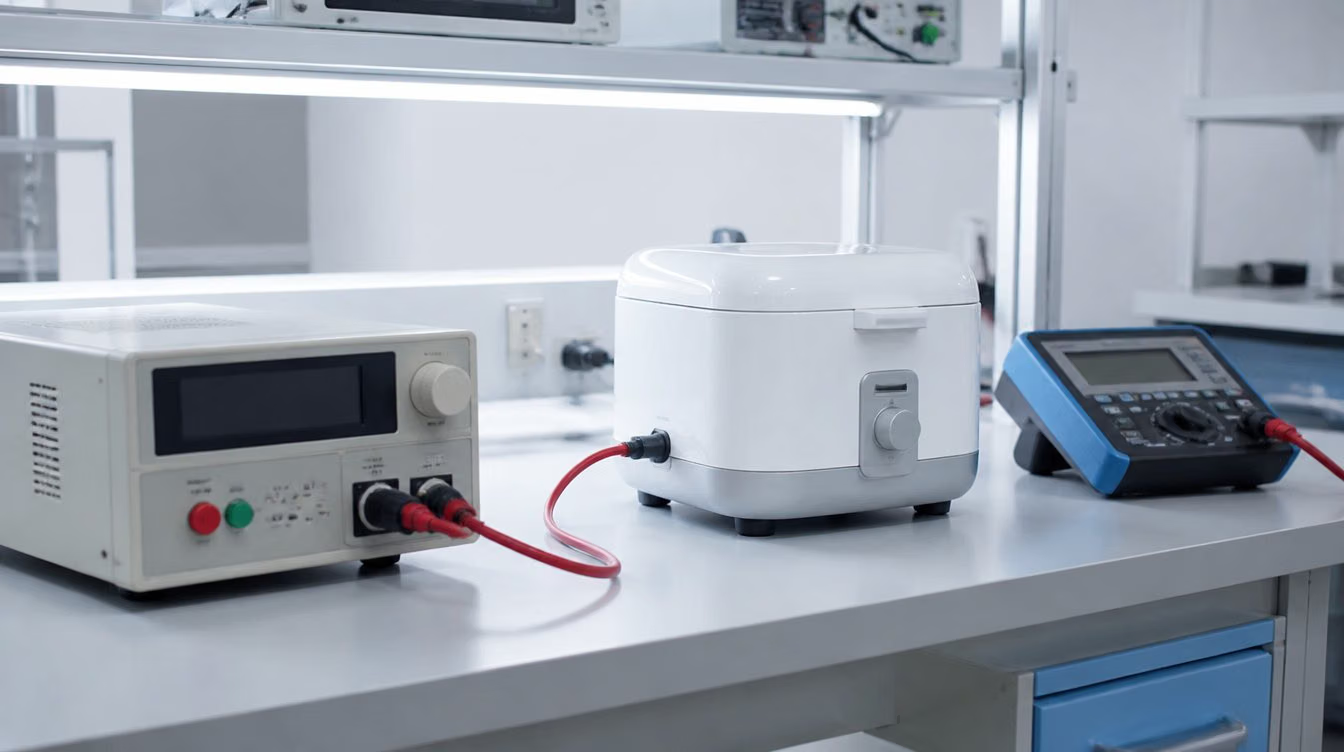
- 5TestingLeakage current, dielectric strength, temperature rise, mechanical strength, fault conditions and the tests of the relevant particular standard are carried out.
- 6EMC and usabilityThe EMC assessment under IEC 60601-1-2 and the usability assessment under IEC 62366 are completed.
Neighbouring Standards and the Differences
IEC 61010-1
Measurement and laboratory equipment. The laboratory hardware of in vitro diagnostic devices is mostly on the side of this standard.
ISO 14971
Risk management. IEC 60601-1 ties many of its requirements to this process; it is a precondition.
IEC 62304
The medical device software life cycle; applied in addition for devices containing software.
IEC 62366
Usability engineering; linked to the -1-6 collateral standard.
What the Report Must Contain
To be usable, a report must carry the information below. An incomplete report may not be accepted in the supply chain or in an inspection even when its result is correct.
- Device classification: type of applied part, protection class, mode of operation
- The collateral and particular standards applied
- Definition of essential performance
- References to the risk management file
- Leakage current, dielectric and temperature rise measurement results
- Fault condition tests and the observations
Commonly Confused Points
- An assessment made without the collateral and particular standards is incomplete; which -1-x and -2-x standards were applied must appear in the report.
- The risk management file is not a supplementary document but a precondition of conformity.
- Conformity to IEC 60601-1 does not by itself confer the CE marking; classification under the MDR, clinical evaluation and the technical file processes run separately.
- If essential performance is not defined, the EMC and fault tests cannot be assessed; the definition comes from the manufacturer.
- It gets confused with IEC 61010-1: a device used on a patient falls under 60601-1 and a laboratory instrument under 61010-1.
- A claim of home use brings the -1-11 collateral standard into play; an approval obtained for hospital use does not cover home use.
Structure of the Code
- Published by
- IEC
- Serial number
- 60601
- Part
- 1
The last "1" is the section number of the standard. Chapters organize different coverages of the same series; The requirements of whichever section is written in the specification are applied.
Codes in the library without release year is kept. The current version changes over time; If the year is specified in your specification, that version is taken as basis, if not specified, the most current version is applied.
Scope
- Test
- Medical Device Testing
- Medical Device Testing
- Electrical Safety
Related Tests and Services
Of the 2 pieces of content this code is referenced in, the 1 with their own published page are listed below.
Test · 1
Technical Requirements
Standard texts are copyright of the relevant organization; test condition, sample and acceptance criteria cannot be fitted here.
Basis: The three-layer structure of the IEC 60601 series (general, collateral, particular), the applied part designations (B/BF/CF) and the concept of essential performance; the ISO 14971, ISO 13485, IEC 62304 and IEC 62366 references.
Technical requirements specific to your product, once we clarify the scope At offer stage shared in writing.
Relevant Product Groups and Legislation
This code is included in the standard tag of the product pages below.
These product pages carry notes for the following markets: European Union, United Kingdom, USA. Whether the standard is mandatory in the relevant market varies depending on the product group and the applicable legislation.
Regulations published with this code on the same product pages:
- (EU) 2017/745MDRThe Medical Device Regulation. Classification (I, IIa, IIb, III), clinical evaluation, technical documentation and post-market surveillance obligations; the notified body's role grows as the class rises.
- (EU) 2017/746IVDRThe In Vitro Diagnostic Medical Devices Regulation. In vitro diagnostic devices fall under this regulation instead of the MDR.
- (AB) 2017/745 art. 33EUDAMEDThe European medical device database. From 28 May 2026, the actor registration, UDI/device, certificate and market surveillance modules are mandatory; placing on the market is not possible without a valid SRN.
- 2006/42/ATMachinery Directive (overlap)Relevant essential requirements also apply to medical devices that also qualify as machinery.
- 2011/65/EURoHSRestriction of hazardous substances in electrical and electronic equipment.
- (EC) 1907/2006REACHRegistration, evaluation, authorisation and restriction of chemicals; SVHC notification.
Other Parts of the Same Series
IEC 60601 series is also present in the library with the following parts.
Related Standards
Frequently Asked Questions About IEC 60601-1
Which collateral standards apply to us?
The function and environment of use of the device determine this. EMC (-1-2) applies to almost every device, alarms (-1-8) to devices that generate alarms and home healthcare (-1-11) to home use.
How is essential performance defined?
The manufacturer defines and justifies it: which functions, if lost, would give rise to unacceptable risk? That definition comes out of the risk management file.
For our in vitro diagnostic device, 60601-1 or 61010-1?
Usually IEC 61010-1 and its relevant particular parts; if there is a component connected directly to the patient, the assessment may change.
Can we use our old 2nd edition report?
The 3rd edition introduced the risk management and essential performance requirements; an old report does not satisfy those parts and a gap analysis is required.
Frequently Asked Questions
Is this standard mandatory for my product?
Whether it is mandatory depends on the product group, the target market and the applicable legislation. Once you tell us your product and market, we clarify in writing whether this standard is required.
How long does the test process take?
Duration depends on the scope of the standard, the number of specimens and current capacity. The exact duration is shared, together with the specimen and scope details, at the quote stage.
Do you issue certification against this standard?
Which activity is carried out under which accreditation scope is separately confirmed at the application stage. Up-to-date scope information is published on our corporate page.
What happens if the standard I need is not here?
The library is based on a continuously growing inventory. If you cannot find the code you are looking for, you can send it through the quote form; we will assess the relevant scope and get back to you.