
About the Standard
Scope title: tensile properties of plastics
ASTM D638 is a standard published by ASTM International (ASTM). It publishes material, product and test method standards; it is the body most often turned to in corrosion, mechanical and materials testing.
See the other 199 codes from ASTMCoverage areas
What Is ASTM D638?
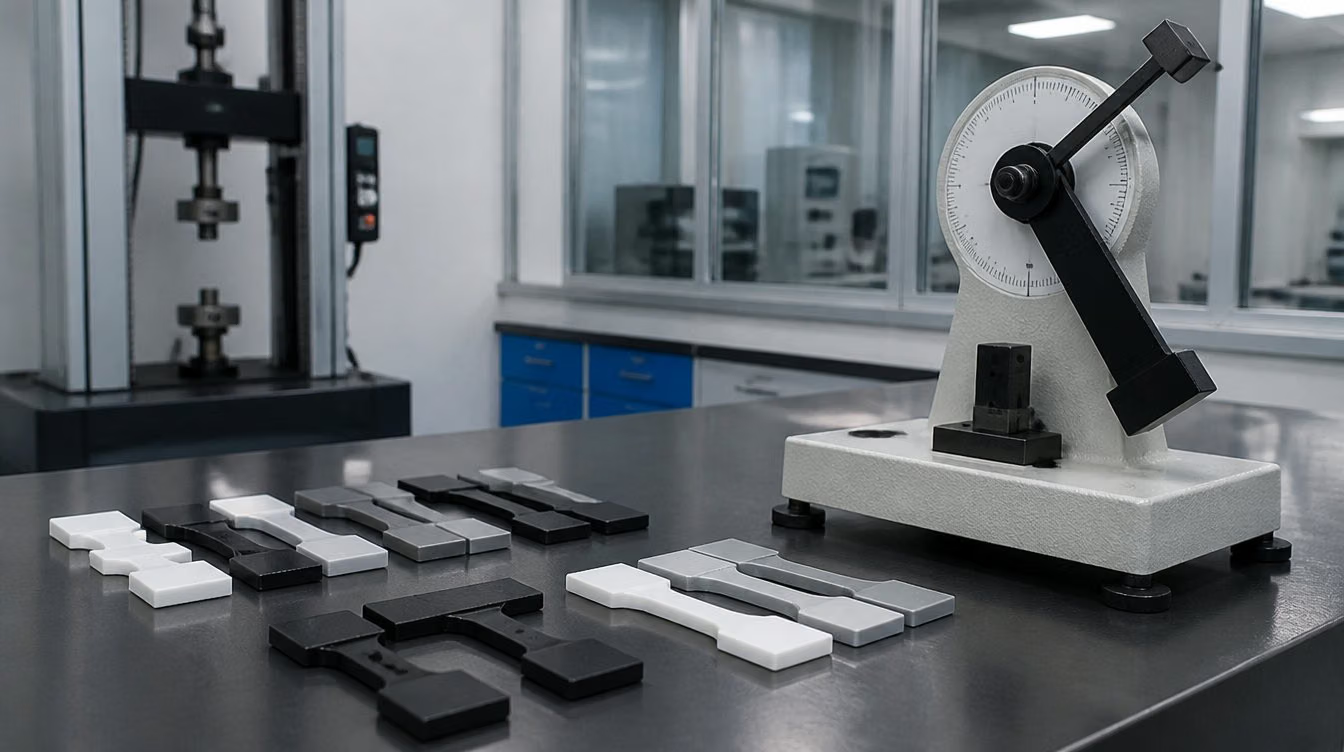
ASTM D638 is the test method measuring the tensile properties of plastics. It produces the most basic items of a plastic material data sheet: tensile strength, yield strength, elongation at break and tensile modulus. The first lines of a material data sheet usually come from this test.
The standard defines FIVE SPECIMEN TYPES (Type I–V) and the choice is made according to the thickness and availability of the material. Type I is the preferred geometry for moulded rigid plastics; Type IV is for thin materials and comparative studies and Type V where the amount of material is limited. For thin films and sheets, ASTM D882 is more appropriate.
THE TEST RATE directly affects the result, and this is the most marked difference of plastics from metals. Plastics behave viscoelastically; the same material gives different strength and elongation at different pulling rates. A specimen pulled quickly shows higher strength and less elongation, one pulled slowly the opposite. The rate is therefore always stated in the report and results obtained at different rates are not compared.
CONDITIONING is also part of the result. Holding the specimen at a defined temperature and relative humidity before the test changes the result markedly, particularly for moisture-absorbing polymers (polyamide, PET). A dry polyamide and one that has reached equilibrium moisture behave almost like different materials: one rigid and brittle, the other flexible and tough.
The output of the test is a material property, not product conformity. The acceptance criterion comes from the material specification or the customer requirement; ASTM D638 only says how the measurement is made.
Why Does This Standard Exist?
yield
The second difference is TIME DEPENDENCE. The behaviour of a metal at room temperature is indifferent to rate; the behaviour of a plastic is rate-sensitive because polymer chains need time to accommodate the load. A plastic pulled slowly enough yields and elongates; the same plastic pulled fast can fracture in a brittle manner.
The third difference is SENSITIVITY TO THE ENVIRONMENT. Moisture, temperature and even the previous loading history affect the result. In plastics testing, conditioning is therefore not a formality but a condition of the validity of the result.
Standardising the specimen geometry was essential for comparability. Specimens cut in different geometries from the same material give different results; the shoulder radius and the width of the gauge region in particular affect stress concentration. The Type I geometry is designed to minimise that effect.
The counterparts on the ISO side are ISO 527-1 and ISO 527-2. They measure the same quantities but the specimen geometries and rate definitions differ; the results are not treated as directly equivalent. This difference often causes problems in global supply chains: a value in a data sheet must be compared against the standard by which it was measured.
Which Products Require It
- Moulded thermoplastic and thermoset parts
- Engineering plastics and filled compounds
- Characterisation of recycled polymers
- Material development and incoming material control
- Plastic components of automotive and electrical products
Related Legislation and Schemes
- It is referred to in material supply specifications and automotive approval files
- The counterparts on the ISO side are ISO 527-1 and ISO 527-2
- ASTM D882 is used for films and thin sheets and ASTM D3039 for fibre-reinforced composites
- It is used as mechanical property data in UL material data sheets
How the Assessment Runs
- 1Specimen preparationSpecimens are produced by moulding or cutting; cut edges are finished so as not to form notches. Moulding conditions are recorded.
- 2ConditioningSpecimens are held at a defined temperature and relative humidity; for moisture-absorbing polymers this step is decisive.
- 3MeasurementThe width and thickness in the gauge region are measured; the calculations rest on these values.
- 4The testThe specimen is pulled at a defined rate until it breaks; force and extension are recorded. An extensometer is used for modulus measurement.
- 5AssessmentTensile strength, yield strength, elongation at break and modulus are calculated; the type and location of the fracture are observed.
Neighbouring Standards and the Differences
ISO 527-1 / -2
The ISO counterpart. The specimen geometries and rate definitions differ; the results are not treated as directly equivalent.
ASTM D882
Tension in thin plastic sheets and films; the D638 geometry is not suitable for these materials.
ASTM D3039
Tension in fibre-reinforced polymer composites; orientation and ply layup are decisive.
ASTM D790 / ISO 178
Flexural properties; together with tension they complete the material data sheet.
What the Report Must Contain
To be usable, a report must carry the information below. An incomplete report may not be accepted in the supply chain or in an inspection even when its result is correct.
- Specimen type (I–V) and dimensions
- The test rate and the justification for the choice
- Conditioning conditions: temperature, relative humidity, duration
- The test temperature and ambient conditions
- The quantities obtained, the number of specimens and the spread
- The type and location of the fracture; specimens deemed invalid
Commonly Confused Points
- ASTM D638 and ISO 527 results are not directly equivalent; the specimen geometries and rate definitions differ.
- A result without a stated specimen type and test rate cannot be interpreted.
- Moulding conditions (orientation, weld lines, cooling rate) affect the result; a test specimen and the actual part may not give the same value.
- For moisture-absorbing polymers, results are misleading unless conditioning is carried out.
- Modulus measurement requires an extensometer; a modulus calculated from crosshead movement also includes machine compliance and is incorrect.
- Specimens breaking outside the gauge region are invalid; the report must state the location of the fracture.
Structure of the Code
- Published by
- ASTM
- Serial number
- D638
- Part
- without partition
Codes in the library without release year is kept. The current version changes over time; If the year is specified in your specification, that version is taken as basis, if not specified, the most current version is applied.
Scope
Related Tests and Services
A separate test page based on this code has not yet been released. The code falls within the scope of the following test families.
Technical Requirements
Standard texts are copyright of the relevant organization; test condition, sample and acceptance criteria cannot be fitted here.
Basis: The ASTM D638 specimen types (I–V) and the dependence on rate and conditioning; the ISO 527-1/-2 counterpart and the scope distinctions from ASTM D882 / D3039. Acceptance criteria are outside the scope of the standard.
Technical requirements specific to your product, once we clarify the scope At offer stage shared in writing.
Related Standards
Frequently Asked Questions About ASTM D638
Which specimen type should we choose?
The thickness and availability of the material determine it. Type I is preferred for moulded rigid plastics; Type IV for thin materials and Type V where material is limited.
Our ISO 527 data sheet value and our ASTM D638 result differ — why?
The specimen geometries and rate definitions of the two standards differ. The values measure the same quantity but cannot be compared directly.
Why does our actual part behave differently from the specimen?
Orientation formed during moulding, weld lines and internal stresses make the part behave differently from the specimen. In critical applications, additional verification is carried out on the part itself.
How often should we measure with recycled material?
Recycled resin varies from lot to lot; lot-based measurement as incoming material control is recommended.
Frequently Asked Questions
Is this standard mandatory for my product?
Whether it is mandatory depends on the product group, the target market and the applicable legislation. Once you tell us your product and market, we clarify in writing whether this standard is required.
How long does the test process take?
Duration depends on the scope of the standard, the number of specimens and current capacity. The exact duration is shared, together with the specimen and scope details, at the quote stage.
Do you issue certification against this standard?
Which activity is carried out under which accreditation scope is separately confirmed at the application stage. Up-to-date scope information is published on our corporate page.
What happens if the standard I need is not here?
The library is based on a continuously growing inventory. If you cannot find the code you are looking for, you can send it through the quote form; we will assess the relevant scope and get back to you.