
What Is Sole Adhesion?
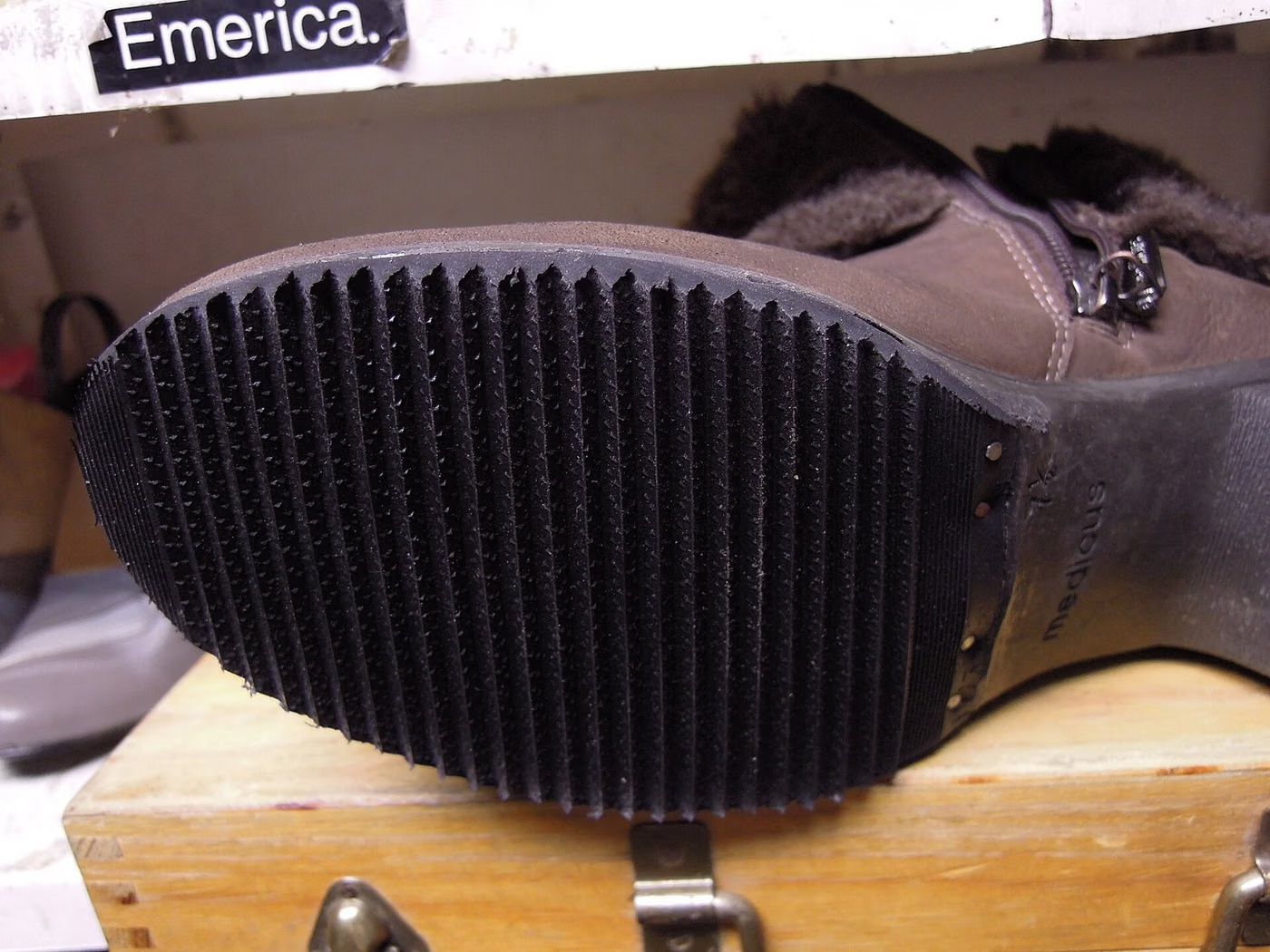
The sole adhesion strength test measures the force required to separate the bond between the sole and the upper on an assembled shoe. A strip of defined width is prepared on the specimen, peeled apart on a tensile tester, and the force per unit width is calculated.
Purpose of Sole Adhesion
The purpose is to determine whether the sole will separate from the upper in use. Sole separation is among the most common causes of footwear returns and usually stems from inadequate surface preparation before bonding.
Which Products Is Sole Adhesion Applied To?
- Cemented (adhesive-assembled) footwear
- Sports shoes
- Safety footwear
- Injection-moulded and stitched-assembly products
- Slippers and sandals
In Which Sectors Is Sole Adhesion Used?
Standards Related to Sole Adhesion
- TS EN ISO 17708 (footwear — upper/sole bond strength)
- TS EN ISO 20344 (protective footwear test methods)
- SATRA TM404
Sole Adhesion Conditions
- Conditioning
- At the temperature and relative humidity defined in the standard
- Tensile speed
- Constant speed defined in the standard
- Specimen width
- Defined in the standard; the result is converted to N/mm
Equipment for Sole Adhesion
- Tensile test machine with special jaws
- Specimen cutting tools
- Conditioning chamber
Sample Requirements for Sole Adhesion
- A fully assembled shoe is required; separate sole and upper pieces are not sufficient
- The specimen is prepared from the defined location on the shoe
- The right and left shoe may be assessed separately
- The post-bonding curing time must have been completed
Duration of Sole Adhesion
The test itself is short. Duration is governed by specimen preparation, conditioning, and completion of the adhesive's curing time.
Sole Adhesion Procedure
- 1The shoe is conditioned.
- 2A strip of defined width is cut to initiate separation.
- 3The strip is mounted in the jaws of the tensile tester.
- 4It is pulled at constant speed and the force is recorded.
- 5The average force is divided by unit width and converted to N/mm.
- 6The mode of separation (adhesive/material failure) is recorded.
Sole Adhesion Acceptance Criteria
The acceptance criterion is the minimum N/mm value given in the product standard or specification. For protective footwear, TS EN ISO 20345 defines its own minimum, confirmed from the standard's current edition.
Evaluation of Results
The mode of separation matters as much as the numeric value. If the material itself fails (cohesive failure), the bond is stronger than the material and the result is favourable; a clean separation at the bonding surface (adhesive failure) points to a surface-preparation problem.
Sole Adhesion Report
- Shoe identification and assembly method
- Standard applied and specimen width
- Measured force and N/mm result
- Mode and location of separation
- Photographs
Accreditation
EUROLAB holds internationally recognised accreditation obtained from accreditation bodies party to the IAF and ILAC multilateral recognition arrangements, under ISO/IEC 17025 for laboratory testing, ISO/IEC 17020 for inspection and surveillance, and ISO/IEC 17021-1 and ISO/IEC 17065 for system and product certification. This chain ensures the reports and certificates issued are accepted worldwide.
Whether this test can be offered within accredited scope depends on your product and the standard applied; since accreditation is method-based, the scope is confirmed in writing at the quotation stage.
Scope and authorisationsRelated Regulations
- (EU) 2016/425 Personal Protective Equipment Regulation (for protective footwear)
Footwear and Leather Testing — What Does This Testing Field Cover?
The section below describes the field that the Sole Adhesion test belongs to; the conditions and acceptance criteria of this particular test are given in the sections above. The scope specific to your product is confirmed in writing at the quotation stage.
Footwear and leather testing assesses the physical durability and chemical safety of a product together. Footwear is a MULTI-COMPONENT product: the sole, upper, lining, insole, heel and bonding line are tested both individually and together. One component being good does not mean the product is good; failure usually appears where components join.
On the physical side, the most common field failure is SOLE-UPPER SEPARATION. Bond strength is therefore the most critical measurement in the field and is a direct indicator of the bonding process (surface preparation, adhesive selection, pressing conditions). Next come sole abrasion and flex resistance: a shoe is flexed hundreds of thousands of times over its life.
Slip resistance is the most important parameter for safety and its measurement depends on the surface: wet ceramic, oily steel and dry floor give different results. Slip resistance is therefore reported not as a single number but with the surface and the direction of slip stated.
A separate body of work applies to protective footwear, and this is the most commercially critical distinction. Toe protection (impact and compression), penetration resistance, antistatic behaviour, heat and cold insulation, electrical insulation and fuel resistance are assessed under personal protective equipment requirements. CE is mandatory for these products and the category must be chosen correctly; an ordinary footwear test report does not satisfy that file.
On the chemical side, CHROMIUM (VI) has a special place in leather. The chromium (III) used in tanning can oxidise into chromium (VI) during storage and ageing; that is, a leather that was compliant at production may exceed the limit months later. The time of measurement and the history of the sample therefore affect the result, and measurement after ageing may be required.
Other chemical items are aromatic amines from azo dyes, pentachlorophenol, short-chain chlorinated paraffins, dimethyl fumarate and phthalates. These items come from REACH restrictions and brand restricted substance lists.
There is NO CE marking on consumer footwear; the obligation runs through material composition labelling, compliance with chemical restrictions and general product safety. Labelling has a rule of its own: the type of material used for the upper, the lining and insole and the outer sole is shown by pictograms.
Comfort and functional claims (waterproofness, moisture management, breathability) are supported by separate tests, and these claims require evidence if used in marketing copy.
Method groups in this field
Bonding and strength
Sole-upper bond strength, seam strength, heel attachment strength, strap and buckle strength.
Abrasion and flexing
Sole abrasion, flex resistance (dry and at low temperature), insole abrasion.
Slip resistance
Forward and backward slip measurements on wet ceramic, oily steel and dry floor.
Protective properties
Toe impact and compression resistance, penetration resistance, antistatic behaviour, heat and cold insulation, fuel and chemical resistance.
Leather chemistry
Chromium (VI), azo dye amines, pentachlorophenol, short-chain chlorinated paraffins, pH and fat content.
Comfort and function
Waterproofness, water vapour permeability, moisture management, colour fastness and the effect of perspiration.
Commonly confused in this field
- Footwear claiming a protective function falls under PPE legislation and requires CE; a consumer footwear test report does not satisfy that file.
- A chromium (VI) result depends on the age of the sample and its storage conditions; leather compliant at production may exceed the limit later.
- Slip resistance is not a single number; it cannot be interpreted without stating the surface and the direction.
- A result obtained for one component does not cover the whole product; the joints are tested separately.
- Labelling rules run on material pictograms; an incorrect pictogram causes problems in customs and market surveillance.
- A waterproofness claim is not verifiable unless the test used and the number of flex cycles after which it was measured are stated.
Which decisions these results support
- Compliance with the brand restricted substance list
- The PPE category and CE file for protective footwear
- Supplier and lot-based acceptance control
- Root cause analysis of field complaints (bond opening, sole separation)
- Substantiation of functional claims
Related Tests

Frequently Asked Questions About Sole Adhesion
Why is an assembled shoe required?
Because what is measured is assembly quality, not the material. Surface cleanliness, primer application, adhesive quantity and press pressure determine the result. A test done with separate sole and upper pieces does not represent the production line.
We got a low result — is the problem the adhesive?
Usually not. Most adhesion problems come from surface preparation: insufficient roughening, mould-release residue, or primer incompatibility. The mode of separation shows which step is at fault.