
What Is Ash?
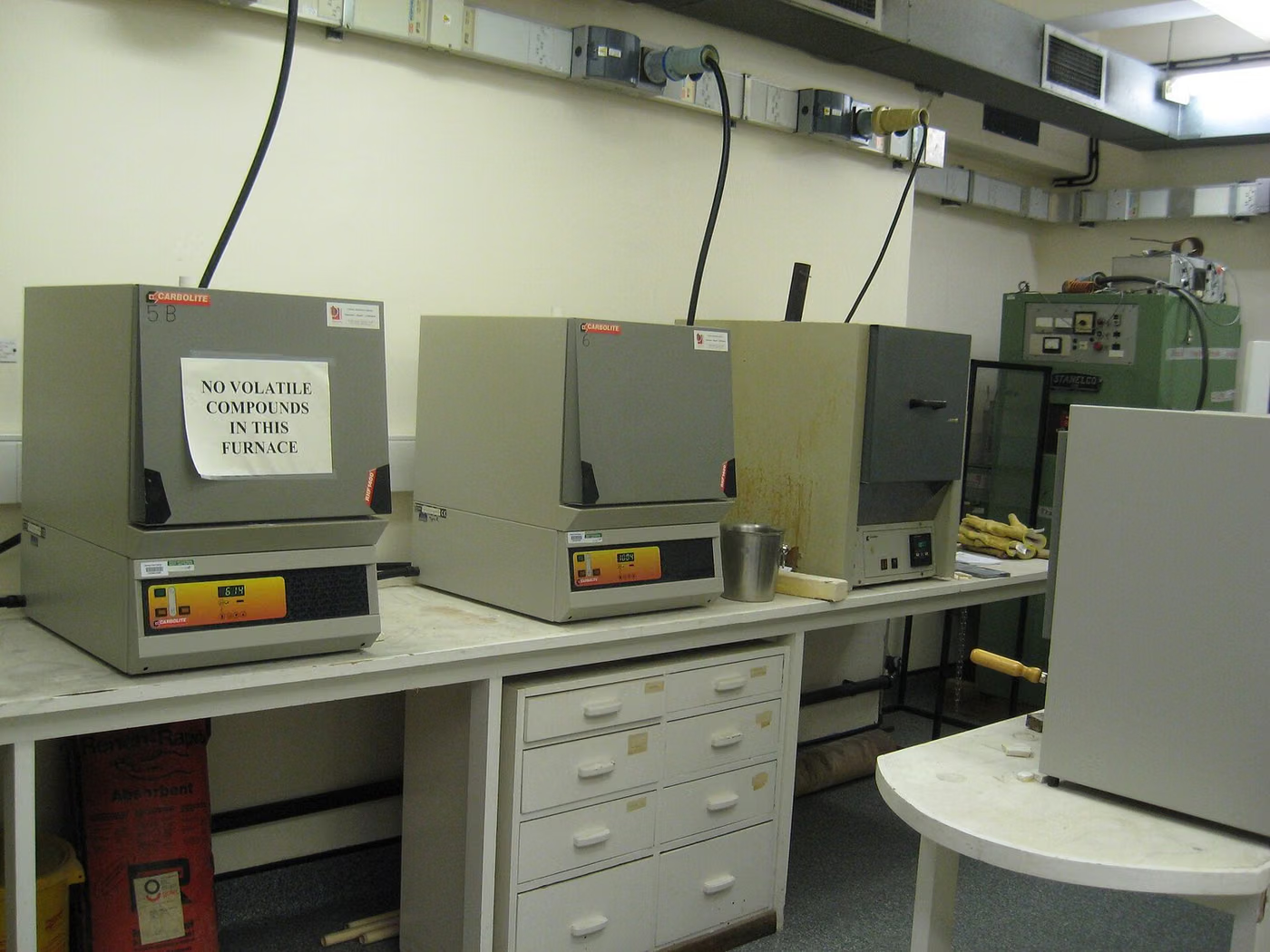
Ash determination is performed by burning the sample at a defined temperature to remove the organic part; It is the experiment in which the ratio of the remaining inorganic residue to the initial mass is determined.
Purpose of Ash
The aim is to determine the proportion of inorganic fillers or additives in the polymer and to monitor batch consistency.
Which Products Is Ash Applied To?
- Dolgulu termoplastikler
- Glass-fibre-reinforced plastics
- rubber compounds
- recycled polymers
In Which Sectors Is Ash Used?
Standards Related to Ash
- ISO 3451-1
- ISO 3451-4
- ASTM D5630
- ASTM D2584 (loss on combustion)
Ash Conditions
- Temperature
- Combustion temperature defined in the standard
- Time
- until constant mass is reached
- Pota
- Porcelain or platinum; pre-combusted and weighed
- sample mass
- Defined in the standard; typically a few grams
Equipment for Ash
- Muffle furnace (high temperature)
- Analytical balance
- Desiccator
- Porselen veya platin potalar
Sample Requirements for Ash
- The crucible must be pre-burned and of constant mass.
- The sample must be representative
- Weighing should be done after cooling in a desiccator.
- The number of specimens is defined in the standard
Duration of Ash
Typically 2–3 days.
Ash Procedure
- 1The crucible is pre-lit and brought to constant mass.
- 2The sample is weighed and placed in the crucible.
- 3It is burned at a defined temperature.
- 4It is cooled in a desiccator and weighed.
- 5It is repeated until a constant mass is reached.
- 6The ash content is calculated.
Ash Acceptance Criteria
The acceptance criterion is the ash content range given in the specification.
Evaluation of Results
The ash proportion does not equal the filler proportion: some fillers decompose at the combustion temperature (e.g. calcium carbonate loses carbon dioxide). Correction is required if the fill type is known; If unknown, it should be evaluated together with TGA.
Ash Report
- Standard applied
- Combustion temperature and time
- Sample and crucible masses
- Calculated ash content
- Evaluation notes
Accreditation
EUROLAB holds internationally recognised accreditation obtained from accreditation bodies party to the IAF and ILAC multilateral recognition arrangements, under ISO/IEC 17025 for laboratory testing, ISO/IEC 17020 for inspection and surveillance, and ISO/IEC 17021-1 and ISO/IEC 17065 for system and product certification. This chain ensures the reports and certificates issued are accepted worldwide.
Whether this test can be offered within accredited scope depends on your product and the standard applied; since accreditation is method-based, the scope is confirmed in writing at the quotation stage.
Scope and authorisationsRelated Regulations
- Material product standards
Plastics Testing — What Does This Testing Field Cover?
The section below describes the field that the Ash test belongs to; the conditions and acceptance criteria of this particular test are given in the sections above. The scope specific to your product is confirmed in writing at the quotation stage.
Plastics testing determines the mechanical, thermal and burning behaviour of a polymer material. Unlike metals, plastics are VISCOELASTIC: their behaviour depends on loading rate, temperature and moisture. The same material therefore gives different results under different conditions, and the test conditions are an inseparable part of the result.
The practical consequence of viscoelasticity is this: a plastic part continues to deform over time under a constant load (creep) and the stress it carries at constant deformation falls over time (stress relaxation). A screwed joint loosens, a clamp loses its clamping force, a shelf sags over time. A short-term tensile test does not show this behaviour; a long-term test or an accelerated model is needed.
Thermal behaviour is the second main axis. Melt flow rate indicates the processability of the material and lot-to-lot consistency; heat deflection temperature and the Vicat softening point give a rough limit for service temperature. Thermal analysis (DSC, TGA, DMA) reveals the identity of the material: glass transition temperature, melting behaviour, crystallinity, filler content and decomposition temperature.
Burning behaviour is the third axis and ties directly into product standards. The UL 94 class and the limiting oxygen index are written into the material data sheet; a particular class is required for the housing of an electrical appliance, while a different classification system applies to a construction product.
Ageing is the most frequently skipped part of the field. Plastics degrade under UV, heat, moisture and oxygen: colour changes, the surface cracks, impact strength falls. For a part intended for outdoor use, what matters is not its values on day one but its values after ageing. Xenon arc and fluorescent UV equipment accelerate this degradation and allow comparison.
The output of this family is usually written into the material data sheet, and product standards refer to that sheet. But there can be a difference between the data sheet value and the behaviour of the actual part: orientation formed during moulding, weld lines and internal stresses make the part behave differently from the specimen.
The use of recycled content has added a new question to the field. Recycled resin varies from lot to lot; mechanical properties, colour and burning behaviour can shift between batches. For a manufacturer using recycled material, incoming material control is therefore not a choice but a necessity.
Method groups in this field
Mechanical
Tension, compression, bending, Charpy and Izod impact, hardness (Shore), creep and environmental stress cracking.
Thermal
Melt flow index (MFI), heat deflection temperature (HDT), Vicat softening temperature, linear thermal expansion.
Thermal analysis
Transition temperatures and crystallinity by DSC, composition and decomposition by TGA, dynamic mechanical behaviour by DMA.
Burning
UL 94 classification, limiting oxygen index (LOI), glow wire and needle flame tests.
Ageing
Accelerated ageing by xenon arc and fluorescent UV, hot air ageing, humidity and condensation.
Physical
Density, water absorption, ash content, gas and water vapour permeability of films and sheets.
Commonly confused in this field
- A plastics result without a stated test rate and temperature cannot be interpreted; viscoelastic behaviour depends on these parameters.
- A specimen result does not transfer directly to the actual part; moulding orientation and weld lines are decisive.
- HDT and Vicat values are NOT service temperatures; they are a rough indication of an upper limit and do not apply under load.
- The UL 94 class depends on thickness; a different wall thickness requires re-verification.
- For moisture-absorbing polymers (such as polyamide), results are misleading unless conditioning is carried out.
- ASTM D638 and ISO 527 results are not directly equivalent; the specimen geometries and rate definitions differ.
Which decisions these results support
- Material selection and supplier approval
- Meeting the flammability and thermal requirements of the product standard
- Verifying the use of recycled content and lot control
- Moulding process control and lot consistency
- Demonstrating ageing resistance for outdoor use
Related Tests
Frequently Asked Questions About Ash
According to which standard is Ash made?
Ash is executed in scope ISO 3451-1, ISO 3451-4, ASTM D5630 and ASTM D2584 (loss on combustion). The limit values and acceptance criteria to be applied are defined in the product standard; The version valid for your product is confirmed in writing at the offer stage.
Which products does Ash apply to?
Mainly applied to Dolgulu termoplastikler, Glass-fibre-reinforced plastics, rubber compounds and recycled polymers. Whether your product is included in the scope is determined by examining its technical specifications and intended use.
Under what conditions is Ash done?
The determining parameters are: Temperature — Combustion temperature defined in the standard, Time — until constant mass is reached and Pota — Porcelain or platinum; pre-combusted and weighed. The full terms are in the "Test Conditions" section on the page and vary depending on the product standard.
What kind of sample is needed for Ash?
The crucible must be pre-burned and of constant mass., The sample must be representative and Weighing should be done after cooling in a desiccator.. The number of samples is determined according to the product standard and the scope to be reported.
How long does Ash take?
Typically 2–3 days. This duration belongs to the experiment itself; sample preparation, queuing and reporting are also evaluated. A realistic schedule for your product is given in the offer.
What is the Ash result called "appropriate"?
The acceptance criterion is the ash content range given in the specification.