
What Is Compression?
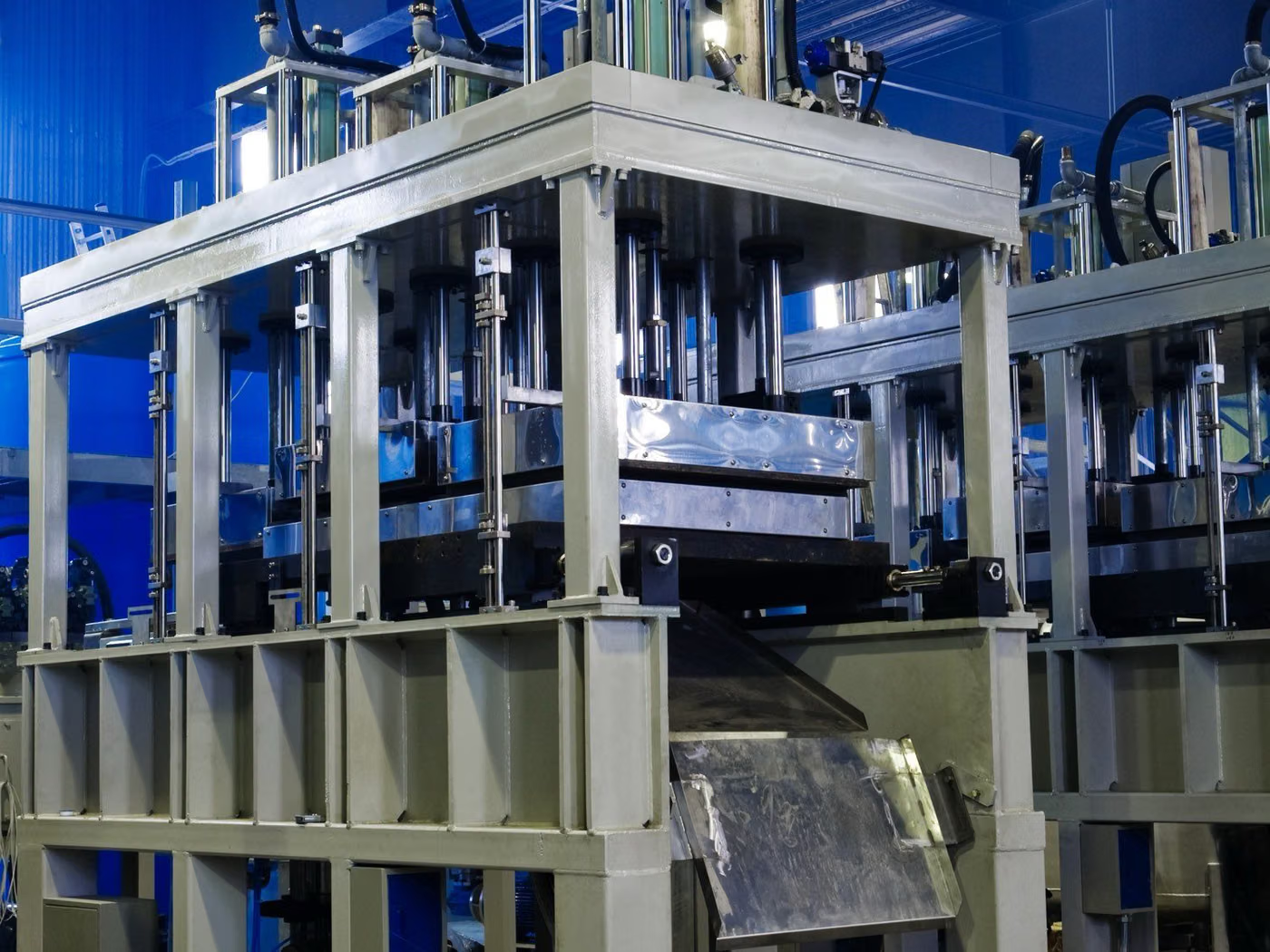
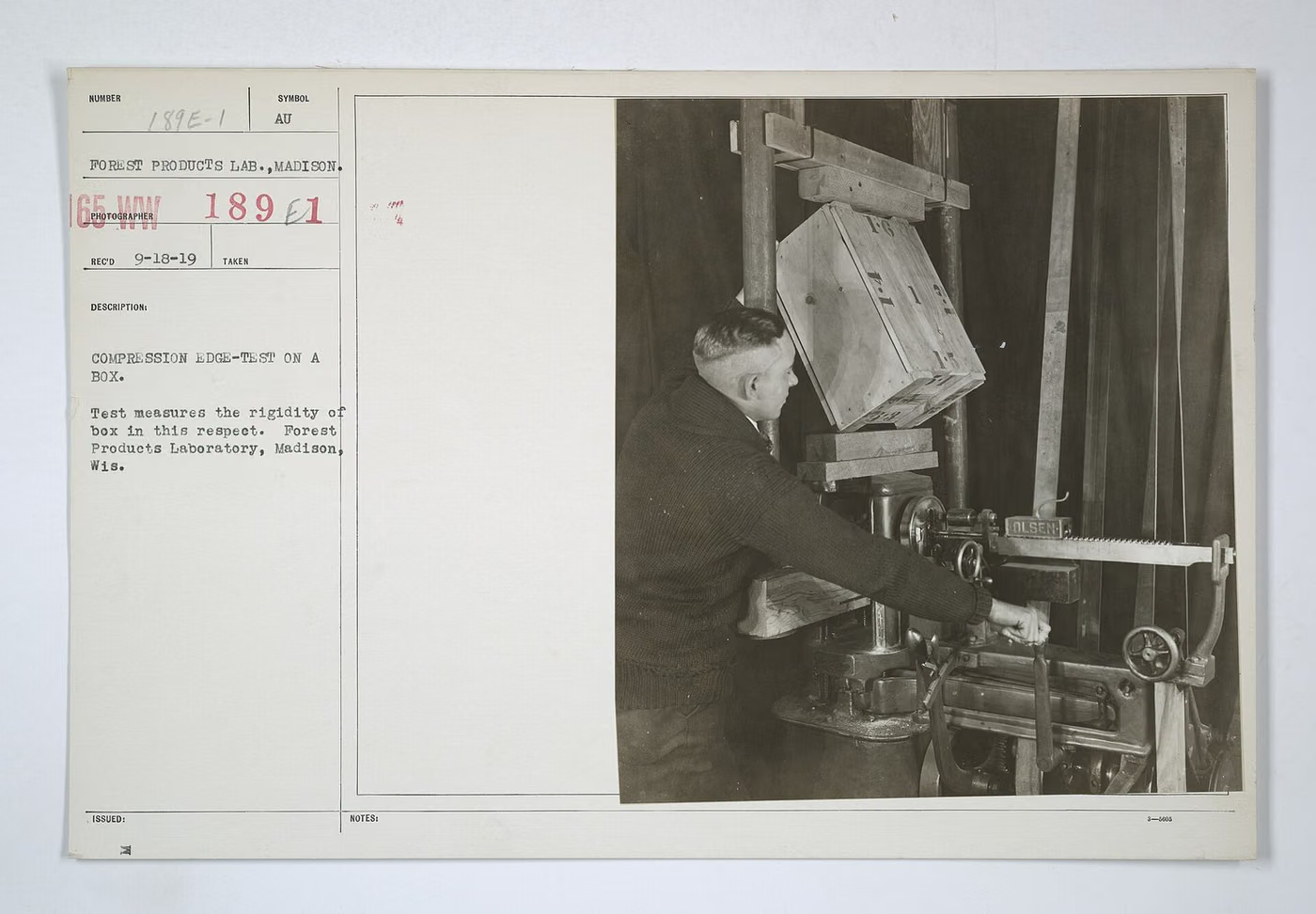
The compression strength test applies an increasing vertical force to a filled package between two plates and measures the collapse load and the deformation at collapse. It represents the load stacked packages impose on the one below in a warehouse or container.
Purpose of Compression
The purpose is to verify the package can be handled at its intended stack height without crushing the boxes below. Collapsed stacks in a warehouse are both a product-loss and a workplace-safety problem.
Which Products Is Compression Applied To?
- Corrugated cardboard boxes
- Filled shipping packages
- Carton boxes and trays
- Unit loads on a pallet
- Plastic crates
In Which Sectors Is Compression Used?
Standards Related to Compression
- TS EN ISO 12048 (packaging — complete, filled transport packages — compression and stacking tests)
- ASTM D642 (determining compressive resistance of shipping containers)
- TS EN ISO 2233 (conditioning atmosphere)
- ASTM D4169 (performance testing of shipping containers and systems)
- ISTApackaging transport performance test series test
Compression Conditions
- Conditioning
- Per ISO 2233; humidity directly affects strength in corrugated board
- Loading speed
- Constant speed defined in the standard
- Platen condition
- Fixed or articulated platen; the result differs between the two
Equipment for Compression
- Compression tester
- Load cell and deformation gauge
- Conditioning room
Sample Requirements for Compression
- A filled, closed package is required; an empty box does not represent real behaviour
- At least three specimens are recommended
- Specimens must be equilibrated in the conditioning room
- Corrugated board type and box code must be provided
Duration of Compression
The test itself is short. Duration is set by conditioning: the corrugated board must reach equilibrium in the standard atmosphere, and separate conditioning is done for high-humidity conditions.
Compression Procedure
- 1Specimens are conditioned in the standard atmosphere.
- 2The package is filled with its real contents or an equivalent filler and closed.
- 3It is placed between the machine's platens.
- 4Vertical force is applied at constant speed.
- 5Maximum force and the deformation at that point are recorded.
- 6The mode of collapse (side-wall buckling, corner crushing) is recorded.
Compression Acceptance Criteria
The acceptance criterion is that the calculated stacking load, together with a safety margin, stays below the measured collapse load. Stacking load is calculated from stack height, storage duration, humidity and transport conditions, and the safety factor is set accordingly.
Evaluation of Results
Maximum force alone is not sufficient: humidity markedly lowers the corrugated board's strength, and under sustained static load the box can collapse well below the value found in the short test. A safety margin is therefore essential in the stacking calculation.
Compression Report
- Package identification, box code and corrugated board type
- Contents and filled weight
- Conditioning conditions
- Maximum force, deformation and collapse mode
- Average and spread
Accreditation
EUROLAB holds internationally recognised accreditation obtained from accreditation bodies party to the IAF and ILAC multilateral recognition arrangements, under ISO/IEC 17025 for laboratory testing, ISO/IEC 17020 for inspection and surveillance, and ISO/IEC 17021-1 and ISO/IEC 17065 for system and product certification. This chain ensures the reports and certificates issued are accepted worldwide.
Whether this test can be offered within accredited scope depends on your product and the standard applied; since accreditation is method-based, the scope is confirmed in writing at the quotation stage.
Scope and authorisationsRelated Regulations
- EU 94/62/EC Packaging and Packaging Waste Directive
- Regulation on the Control of Packaging Waste
- EU 1935/2004 (materials in contact with food — where applicable)
Ambalaj Testleri — What Does This Testing Field Cover?
The section below describes the field that the Compression test belongs to; the conditions and acceptance criteria of this particular test are given in the sections above. The scope specific to your product is confirmed in writing at the quotation stage.
Packaging testing examines two different functions separately: does the packaging protect the product during transport, and does the packaging material transfer harmful substances into its contents? These two questions require different laboratory infrastructure and must not be confused.
On the protection side, distribution simulation is carried out: drop, vibration, compression, stacking and, where needed, low pressure tests are applied in sequences representing the real shipping chain. These tests are meaningful as a SEQUENCE rather than individually; in real life too, packaging is exposed to successive loads and each load builds on the damage left by the previous one. Specifications such as ISTA and ASTM D4169 define these sequences by shipment type.
The shipment type determines the sequence itself. The exposure of a palletised load differs from that of a parcel shipped individually: the latter sees far more handling, more drops and impacts in a wider variety of orientations. The growth of e-commerce has brought this second scenario to the fore and turned parcel shipping simulation into a specification group of its own.
On the food contact side, MIGRATION is what counts: the amount of substance passing from the packaging material into the food is compared against overall and specific migration limits. For plastic packaging the list of permitted substances and the limits are defined in separate legislation; the declaration of conformity (DoC) rests on this assessment and is a document that every link in the supply chain must carry.
In a migration test the choice of SIMULANT is critical. Because testing with real food is not practical, liquids representing food are used: different simulants for aqueous foods, for fatty foods and for acidic foods. Choosing the wrong simulant invalidates the result; the choice depends on which food type the packaging will contact and at what temperature.
Barrier properties are a third axis. Oxygen and water vapour permeability directly determine the shelf life of the product; in pharmaceutical and food packaging these values are a design input. Barrier performance is sensitive to temperature and relative humidity, so the measurement conditions are part of the report.
Sterile medical device packaging is the most tightly regulated sub-body of this family. Here the packaging is a barrier maintaining sterility; seal strength, leak testing, distribution simulation and shelf-life studies run together as a validation package.
The packaging legislation side is becoming rapidly more demanding. Recyclability, recovered content ratio, packaging reduction and reuse targets must now be measurable and declarable; this turns packaging design from a material selection exercise into a conformity exercise.
Method groups in this field
Distribution simulation
Drop, random and fixed frequency vibration, compression, stacking, low pressure; as ISTA and ASTM D4169 sequences.
Mechanical strength
Edge crush (ECT) in corrugated board, bursting strength, box compression strength, tape peel adhesion.
Barrier measurements
Oxygen transmission rate (OTR), water vapour transmission rate (WVTR), permeability in film and sheet materials.
Migration
Overall and specific migration tests; simulant and temperature conditions are chosen according to the use scenario.
Seal and integrity
Seal peel strength, leak detection by dye penetration, bubble test, headspace analysis.
Shelf life
Real-time and accelerated ageing; part of the validation package in sterile packaging.
Commonly confused in this field
- A single drop test is not a distribution simulation; the tests are applied as the sequence defined in the specification.
- A migration test carried out with the wrong simulant or the wrong contact temperature is invalid.
- Accelerated ageing does not replace real-time ageing; a shelf life claim is supported by real-time data.
- Barrier values are valid together with the measurement temperature and relative humidity; an OTR/WVTR value given without conditions cannot be compared.
- A packaging change (film supplier, seal parameter, box design) may require the validation to be repeated.
- A food contact declaration of conformity is not a test report; it is a document that rests on reports but summarises a broader assessment.
Which decisions these results support
- Reducing shipping damage and verifying the packaging design
- Declaration of conformity for food contact packaging
- Supporting the shelf-life claim
- Validation of sterile device packaging
- Recyclability and content declarations under packaging legislation
Related Tests

Frequently Asked Questions About Compression
Can the test be done with an empty box?
It can, but the result does not represent real performance. The contents can markedly increase strength by supporting the box walls, or reduce it by leaving voids. The test is done with the filled package as sold.
How much does humidity affect the result?
It is decisive for corrugated board; strength drops significantly at high relative humidity. For products going to a humid climate or a cold chain, the test must be repeated with a specimen conditioned to that condition.