
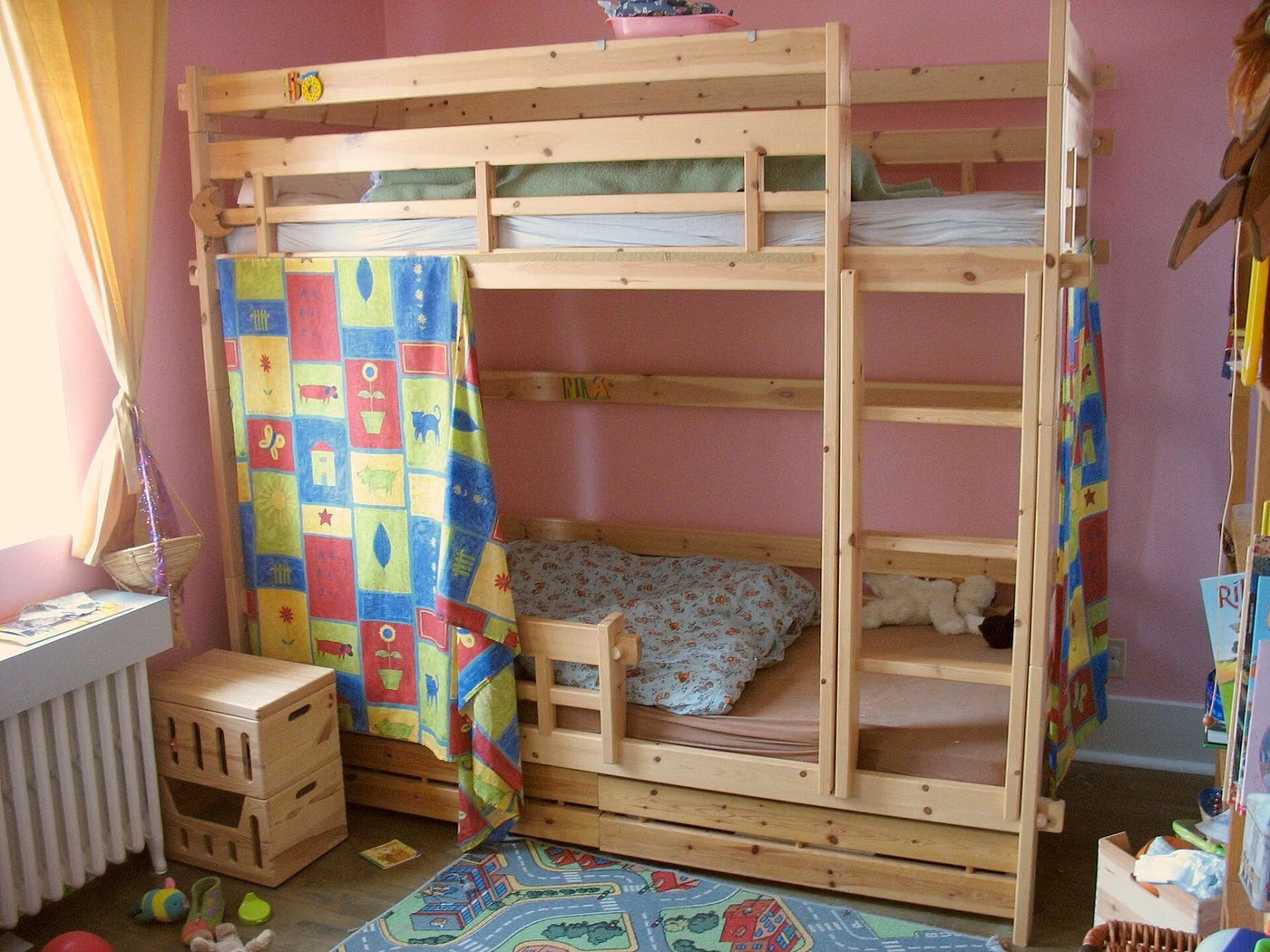
What Is Bunk Bed Safety?
The bunk bed safety test assesses two-tier and high beds against fall, entrapment and strangulation risks. Guard-rail height, gap dimensions, ladder design and structural strength are checked with the probes and templates defined in the standard.
Purpose of Bunk Bed Safety
The purpose is to verify the design requirements are met that prevent a child falling from the upper bed, becoming trapped in the gap between the guard-rail and the mattress, and head or neck entrapment. Bunk beds are the highest-risk product in children's furniture.
Which Products Is Bunk Bed Safety Applied To?
- Two-tier bunk beds
- High beds (loft beds)
- Children's bedroom bed systems
- Dormitory and barracks bunk beds
- Caravan and boat bunks
In Which Sectors Is Bunk Bed Safety Used?
Standards Related to Bunk Bed Safety
- TS EN 747-1 (bunk beds and high beds — safety, strength and durability requirements)
- TS EN 747-2 (test methods)
- TS EN 1725 (beds and mattresses — general requirements)
Bunk Bed Safety Conditions
- Gap checks
- With the probes and templates defined in the standard; head, neck, finger and body entrapment
- Guard-rail
- Height and position requirements defined in the standard
- Structural tests
- Static load, impact and cyclic loading
Equipment for Bunk Bed Safety
- Entrapment probe and template sets
- Loading and impact rigs
- Cyclic loading system
- Measuring instruments
Sample Requirements for Bunk Bed Safety
- Fully assembled bunk bed and all accessories supplied
- The declared mattress thickness must be provided — guard-rail height depends on it
- Assembly and instructions for use must be supplied with the specimen
- The tests are destructive
Duration of Bunk Bed Safety
Dimensional and entrapment checks are quick; structural and cyclic tests determine the duration and span several days.
Bunk Bed Safety Procedure
- 1The bunk bed is assembled per the instructions.
- 2Guard-rail height is measured together with the declared maximum mattress thickness.
- 3Gaps are checked with the probes and templates defined in the standard.
- 4The ladder and climbing elements are assessed.
- 5Static load, impact and cyclic loading tests are applied.
- 6The instructions for use and warning labels are examined against the requirements.
Bunk Bed Safety Acceptance Criteria
EN 747-1 defines requirements for guard-rail position, gap dimensions and structural strength; all must be met. The standard also requires the warnings and information to be supplied with the product — a missing warning is on its own a non-conformity.
Evaluation of Results
Dimensional requirements are assessed together with the declared maximum mattress thickness: a thicker mattress reduces the guard-rail's effective height and can render the product non-compliant. The declared thickness is therefore stated explicitly in the report.
Bunk Bed Safety Report
- Product identification and declared maximum mattress thickness
- Dimensional and entrapment check results
- Structural test results
- Instructions for use and warning assessment
- Photographs
Accreditation
EUROLAB holds internationally recognised accreditation obtained from accreditation bodies party to the IAF and ILAC multilateral recognition arrangements, under ISO/IEC 17025 for laboratory testing, ISO/IEC 17020 for inspection and surveillance, and ISO/IEC 17021-1 and ISO/IEC 17065 for system and product certification. This chain ensures the reports and certificates issued are accepted worldwide.
Whether this test can be offered within accredited scope depends on your product and the standard applied; since accreditation is method-based, the scope is confirmed in writing at the quotation stage.
Scope and authorisationsRelated Regulations
- (EU) 2023/988 General Product Safety Regulation
Mobilya Testleri — What Does This Testing Field Cover?
The section below describes the field that the Bunk Bed Safety test belongs to; the conditions and acceptance criteria of this particular test are given in the sections above. The scope specific to your product is confirmed in writing at the quotation stage.
Furniture testing shows that a product stays safe and functional throughout its expected service life. Tests are run with loading cycles representing real use: sitting, leaning back, opening and closing drawers, loading doors, loading shelves and tipping.
The logic of the field rests on the NUMBER OF CYCLES. Sitting on a chair once shows nothing; repeating it tens of thousands of times reveals structural weaknesses. Furniture tests therefore combine static loading with fatigue cycles and define different levels according to intensity of use: domestic use, commercial use and heavy commercial use mean different cycle counts for the same product.
TIP-OVER SAFETY carries particular weight in this family. Because storage furniture tipping onto a child has caused serious injuries and deaths, product standards define separate tests for it: loading with drawers open, hanging from a door and climbing scenarios are simulated. In the United States this subject has become a legislative heading of its own and has produced a mandatory specification.
The second axis is chemical and concerns indoor air quality. Formaldehyde release from wood-based panels and volatile organic compound emissions from coatings and textile components are measured. For formaldehyde, a restriction regulation applies on the EU side and CARB Phase 2 and TSCA Title VI limits in North America; these limits differ and export requires assessment against the destination market.
The third axis is flammability. In upholstered furniture the filling material and the upholstery fabric are assessed together; real ignition sources such as a cigarette and a match flame are simulated. The United Kingdom has historically applied the strictest national regime on this subject.
Surface durability is the fourth axis: abrasion, scratching, stain resistance, heat and moisture resistance, light fastness. These tests show how well the product will keep its appearance and shape commercial expectations particularly for kitchen and office furniture.
There is NO sector-specific CE regime for consumer furniture; safety is demonstrated under the general product safety framework using EN durability standards. For furniture permanently fixed into a structure, construction products legislation may come into play. This distinction matters in project work: a kitchen cabinet and a built-in system fabricated in place can fall under different regimes.
Method groups in this field
Seating
Seat and back loading cycles, arm strength, drop test, tipping resistance, leg and joint strength.
Tables and work surfaces
Static and cyclic loading, horizontal strength, tipping, surface durability.
Storage furniture
Shelf and door loading, drawer cycles, tip-over safety and climbing scenarios.
Beds and mattresses
Durability cycles, edge strength, loss of thickness after loading.
Emissions
Formaldehyde release (chamber, perforator and gas analysis methods), VOC emission test chamber measurements.
Surface and flammability
Abrasion, scratching, staining, heat and moisture resistance; ignitability in upholstered furniture.
Commonly confused in this field
- A result obtained for domestic use does not support a claim of commercial use; the cycle counts and levels are different.
- Tip-over safety is a separate test; passing the durability cycles does not demonstrate tip-over safety.
- Formaldehyde limits differ by market; EU compliance does not mean CARB/TSCA compliance.
- Flammability in upholstered furniture is valid for the COMBINATION of fabric and filling; a change of fabric requires reassessment.
- A result obtained on one model does not cover the whole range; differences in size, material and joints may require separate assessment.
Which decisions these results support
- Determining the durability class for commercial and domestic use
- Tip-over safety and child safety conformity
- Compliance with formaldehyde and VOC emission limits
- Meeting tender and project specification requirements
- Determining destination market requirements for export
Related Tests


Frequently Asked Questions About Bunk Bed Safety
Why does mattress thickness matter so much?
The guard-rail's protection is measured from the top surface of the mattress. If the user fits a thicker mattress than declared, the guard-rail becomes ineffective. The standard therefore requires the maximum thickness to be stated on the product and in the instructions.
Does a high bed count as a bunk bed?
EN 747 covers both two-tier bunk beds and single-tier high beds. If the bed surface is above a certain height, the same fall and entrapment requirements apply.