

What Is Battery Vibration — UN 38.3?
The UN 38.3 vibration test (T.3) is a shaker test representing the vibration lithium cells and batteries will be exposed to during transport. It is one of eight tests defined in section 38.3 of the UN Manual of Tests and Criteria, and is mandatory for transport approval.
Purpose of Battery Vibration — UN 38.3
The purpose is to show that the battery does not experience internal short circuit, leakage or degradation under transport vibration. The test is not applied on its own but as part of the T.1–T.8 series, and the order of the series is binding.
Which Products Is Battery Vibration — UN 38.3 Applied To?
- Lithium-ion cells and modules
- Portable device batteries
- Electric vehicle battery packs
- Energy storage systems
- Power banks and backup power units
In Which Sectors Is Battery Vibration — UN 38.3 Used?
Standards Related to Battery Vibration — UN 38.3
- UN 38.3Transport safety tests on lithium batteries test
Battery Vibration — UN 38.3 Conditions
- Vibration profile
- Sinusoidal sweep defined in UN 38.3 T.3
- Axis
- Separately in three orthogonal axes
- Specimen condition
- State of charge and cycling history are defined in UN 38.3
- Series
- T.1–T.5 are applied in sequence on the same specimens
Equipment for Battery Vibration — UN 38.3
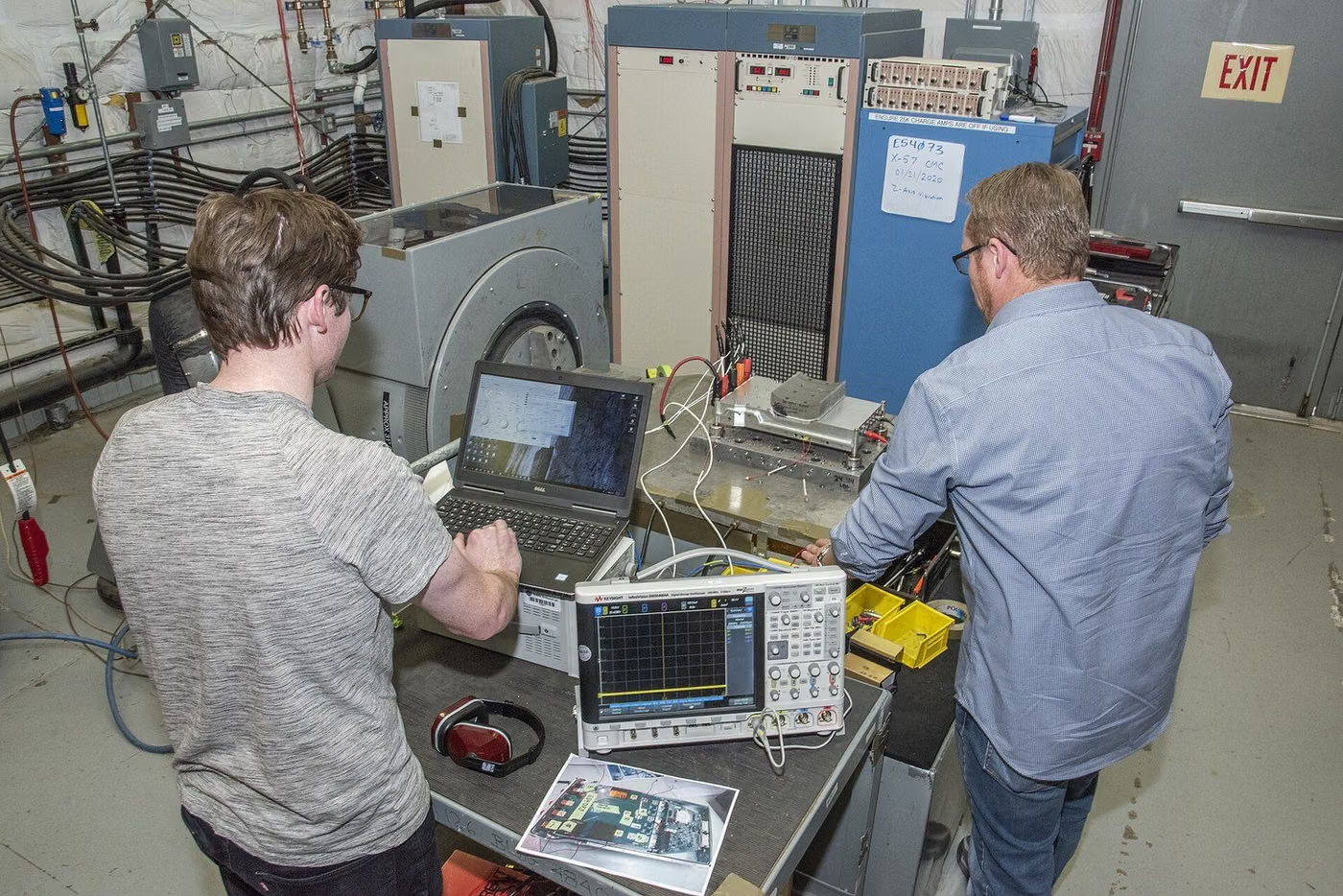
- Electrodynamic shaker system
- Vibration control unit
- Cell voltage and temperature monitoring system
- Safe test cell and ventilation
- Mass and voltage measurement equipment
Sample Requirements for Battery Vibration — UN 38.3
- The number of specimens and the state of charge are defined in UN 38.3; they cannot be chosen arbitrarily
- New and cycled specimens may be requested separately
- The test may be destructive; specimens are not returned
- The cell/battery's technical information and nominal values must be shared
- ADR/IATA rules must be followed for the safe transport of specimens
Duration of Battery Vibration — UN 38.3
The vibration test itself takes hours per axis. The full UN 38.3 series, together with all tests from T.1 to T.8, extends over weeks.
Battery Vibration — UN 38.3 Procedure
- 1Specimens are brought to the defined state of charge.
- 2Initial voltage, mass and visual condition are recorded.
- 3Specimens are mounted on the fixture.
- 4The sweep profile defined in T.3 is applied in the first axis.
- 5It is repeated in the other two axes.
- 6Voltage, mass loss and visual condition are assessed after the test.
- 7The test moves on to the next one in the series.
Battery Vibration — UN 38.3 Acceptance Criteria
UN 38.3 requires the absence of leakage, gas venting, disassembly, fire, and voltage drop above the defined limit. The criteria are defined in the standard's own text and cannot be changed by the laboratory.
Evaluation of Results
The result is evaluated over the whole series; passing a single test is not sufficient for transport approval. The test report is the basis for preparing the UN 38.3 test summary.
Battery Vibration — UN 38.3 Report
- Sample description, serial number and configuration
- Applied standard and year of printing
- Selected intensity level and basis for the level
- Experimental setup and measurement points
- Functional checks performed during the experiment
- Observations, measurement results and photographs
- A statement that the result applies only to the specimen submitted for testing
Accreditation
EUROLAB holds internationally recognised accreditation obtained from accreditation bodies party to the IAF and ILAC multilateral recognition arrangements, under ISO/IEC 17025 for laboratory testing, ISO/IEC 17020 for inspection and surveillance, and ISO/IEC 17021-1 and ISO/IEC 17065 for system and product certification. This chain ensures the reports and certificates issued are accepted worldwide.
Whether this test can be offered within accredited scope depends on your product and the standard applied; since accreditation is method-based, the scope is confirmed in writing at the quotation stage.
Scope and authorisationsRelated Regulations
- ADR / RID / IMDG / IATA dangerous-goods transport rules
- The obligation to issue a UN 38.3 test summary
- EU 2023/1542 Battery Regulation
Standard-Based Tests — What Does This Group of Pages Cover?
The section below describes the field that the Battery Vibration test belongs to; the conditions and acceptance criteria of this particular test are given in the sections above. The scope specific to your product is confirmed in writing at the quotation stage.
Standard-based tests are test pages whose address comes from a standard number. What the user is looking for is often not the name of the test but the code written in their specification: not "salt spray test" but "ASTM B117", not "drop test" but "IEC 60068-2-31", not "vibration" but "MIL-STD-810 Method 514".
This preference reflects the reality in the field. An engineer sees a code in the specification received from a customer and searches for that code; they do not need to know the name of the test. The code is the identity of the test and distinguishes the different adoptions of the same test by different bodies.
This group addresses the different adoptions of the SAME TEST separately. The same physical phenomenon may be published under different numbers by ISO, ASTM, EN, IEC, DIN and JIS. Even where the numbers are the same (as with ISO 6892-1 and EN ISO 6892-1), specimen preparation, conditions, calculation details and reporting may differ; adoptions may carry national annexes. The code written in the specification therefore governs, and "similar" is not accepted.
Searching at code level meets a different need from searching at scope level. A user searching for "corrosion testing" wants to learn about the field; a user searching for "ASTM B117" has a specification in hand and wants to know the feasibility, duration and price of that test. Two different intents require two different page structures.
The page for a code describes the scope of that code, the test field it belongs to, the product groups in which it is required and how it differs from neighbouring codes. Test conditions, durations and acceptance criteria are NOT CARRIED: these are defined in the copyrighted text of the standard and in the product specification. This boundary is a deliberate choice; a wrong duration or acceptance criterion means directly incorrect work.
Different parts of the same code and different adoptions of the same number are linked between pages. A user searching for IEC 60335 also sees 60335-2-40; a user searching for ISO 6892-1 also sees the EN ISO 6892-1 and DIN EN ISO 6892-1 adoptions. These links are derived from the number of the code rather than written by hand.
The edition year is NOT CARRIED in the library. It is held as "ASTM D638" rather than "ASTM D638-22", because the edition in force changes over time and the address of the page should not age with the edition. If a year is stated in your specification, that edition governs; if not, the most current edition is applied.
Method groups in this field
Searching by code
Direct search for the code written in the specification; it is found in the library with its code, scope title and issuing body.
Searching by scope title
A test whose code is not known is searched by its subject; a search for "salt spray" brings up the related codes.
Series and part relationships
The other parts of the same series are shown, derived from the number of the code.
Adoption relationships
Different bodies' adoptions of the same number are matched; the claim is kept limited to "the same number".
Superseded codes
Withdrawn codes are not held in the library but, when searched for, the user is directed to the counterpart in force.
Commonly confused in this field
- Different adoptions of the same number are not identical texts; they may carry national annexes.
- The code written in the specification governs; a technically similar code cannot be substituted.
- If an edition year is stated, that edition is applied; the most current edition is not automatically accepted.
- A code page carries no test conditions or acceptance criteria; these are in the copyrighted text of the standard and in the product specification.
- A part code (for example -2-40) may not be sufficient on its own; the general part of the series is applied as well.
Which decisions these results support
- Matching the code written in the specification to the correct laboratory scope
- Distinguishing between equivalent adoptions
- Clarifying the scope and edition at the quotation stage
- Finding the current counterpart of withdrawn codes
Related Tests




Frequently Asked Questions About Battery Vibration — UN 38.3
Is UN 38.3 mandatory?
Yes, for lithium cells and batteries to be transported. Transport rules require the UN 38.3 series to be completed and the test summary to be available.
Is the test repeated when the design changes?
Tests are renewed for changes that affect safety, such as cell chemistry, capacity, mechanical structure or protection circuit.