
About the Standard
Scope title: wireless local area network (WLAN) protocol
IEEE 802.11 is a standard published by Institute of Electrical and Electronics Engineers (IEEE). It publishes electrical, electronic and communication standards; the 802 series in wireless communication belongs to this organisation.
See the other 10 codes from IEEERF and Wireless Testing — What Does This Testing Field Cover?
The section below describes the field that code IEEE 802.11 belongs to; it is not the text of the standard or the regime itself. The scope title of the code is given above, and technical requirements are shared at the quotation stage.
RF and wireless testing shows that a device containing a radio uses the spectrum correctly and operates within the limits the relevant legislation allows. This family is a separate body of work from EMC: EMC addresses unwanted interference, whereas here INTENTIONAL emission is assessed.
Spectrum is a public and limited resource, and this determines the legal character of the field. A device spilling outside its permitted band or emitting excess power is not merely a technical defect but a violation that disrupts someone else's service. Radio conformity is therefore policed more strictly than other test fields and markets maintain their own national regimes.
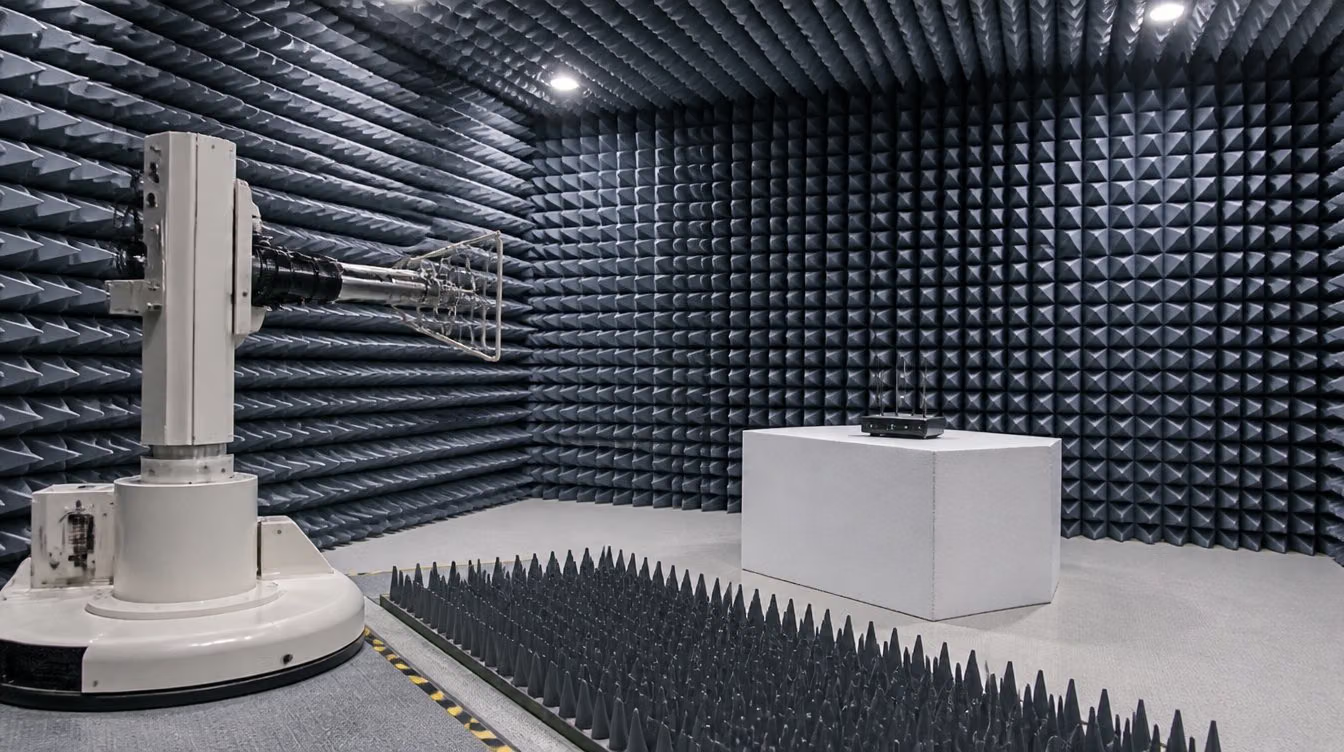
Measurements run separately on the transmitter and receiver sides. On the transmitter side, output power, occupied bandwidth, frequency error, unwanted emissions, adjacent channel power and the power envelope are measured. On the receiver side, sensitivity, selectivity, blocking and spurious response rejection are assessed. The receiver side is often neglected, but in some bands it is a regulatory requirement.
Access protocol specific behaviours are a third axis: listen before talk (LBT), duty cycle, dynamic frequency selection (DFS) and transmit power control (TPC). These mechanisms enable spectrum sharing and it must be shown that they work correctly.
HUMAN EXPOSURE is the fourth axis and one of the most commercially critical. For devices used close to the body, SAR (specific absorption rate) is measured; for devices used at a distance, a field strength assessment is made. Limits and measurement methods vary by market; the same device is assessed separately for Europe and the United States.
Market regimes are decisive in this family and do not substitute for one another: the Radio Equipment Directive and ETSI harmonised standards in Europe, FCC authorisation in the United States (through a TCB for intentional radiators), ISED in Canada, MIC in Japan, KC in South Korea and SRRC in China each carry their own set of requirements. The same device requires a separate file for each market, and some markets impose a local representative or local testing requirement.
Module integration is the subject that raises the most questions in the field. Using a certified radio module does not automatically make the device compliant. A module certificate is valid for a defined antenna, a defined supply and defined conditions of use; if the antenna changes, the layout changes or the module is operated at a different power level, reassessment is required.
The presence of several radios in the same device (Wi-Fi + Bluetooth + cellular + NFC) gives rise to a simultaneous transmission assessment: SAR and unwanted emission measurements are made for the worst case in which the radios operate together.
Method groups in this field
Transmitter measurements
Output power, occupied bandwidth, frequency error, unwanted emissions, adjacent channel power, power spectral density.
Receiver measurements
Sensitivity, selectivity, blocking, spurious response rejection.
Spectrum sharing mechanisms
Verification of listen before talk, duty cycle, dynamic frequency selection and transmit power control.
Human exposure
SAR measurement (handheld and body-worn devices), field strength assessment, multi-radio scenarios.
Protocol conformity
Cellular network conformity testing, Bluetooth and Wi-Fi certification testing, GNSS performance.
Antenna measurements
Gain, radiation pattern, efficiency and total radiated power (TRP) measurements.
Commonly confused in this field
- Using a certified module does not automatically make the device compliant; if the antenna, layout or power level changes, reassessment is required.
- An FCC file does not replace a CE file; each market operates its own regime.
- Receiver side measurements are a regulatory requirement in some bands; measuring only the transmitter produces an incomplete file.
- SAR limits and measurement methods differ by market; a result in one market does not carry over to another.
- For devices carrying several radios the simultaneous transmission scenario must be assessed; measuring them individually is not sufficient.
- Some markets impose local testing or a local representative requirement; technical conformity alone does not secure market access.
Which decisions these results support
- Market access under radio equipment legislation
- Verification of the antenna and RF front end design
- SAR and RF exposure conformity
- Verification of module integration and the scope of reassessment
- Determining the worst case in multi-radio scenarios
Structure of the Code
- Published by
- IEEE
- Serial number
- 802.11
- Part
- without partition
Codes in the library without release year is kept. The current version changes over time; If the year is specified in your specification, that version is taken as basis, if not specified, the most current version is applied.
Scope
Related Tests and Services
A separate test page based on this code has not yet been released. The code falls within the scope of the following test families.
Technical Requirements
Standard texts are copyright of the relevant organization; test condition, sample and acceptance criteria cannot be fitted here.
Technical requirements specific to your product, once we clarify the scope At offer stage shared in writing.
Related Standards
Frequently Asked Questions
Is this standard mandatory for my product?
Whether it is mandatory depends on the product group, the target market and the applicable legislation. Once you tell us your product and market, we clarify in writing whether this standard is required.
How long does the test process take?
Duration depends on the scope of the standard, the number of specimens and current capacity. The exact duration is shared, together with the specimen and scope details, at the quote stage.
Do you issue certification against this standard?
Which activity is carried out under which accreditation scope is separately confirmed at the application stage. Up-to-date scope information is published on our corporate page.
What happens if the standard I need is not here?
The library is based on a continuously growing inventory. If you cannot find the code you are looking for, you can send it through the quote form; we will assess the relevant scope and get back to you.